High Representative Kaja Kallas told the Strasbourg parliament plenary that neither unanimity nor qualified majority exists to suspend the EU–Israel Association Agreement. She also convincingly defended the bloc’s €1.2bn Palestinian aid commitment and its diplomatic approach to Iran.
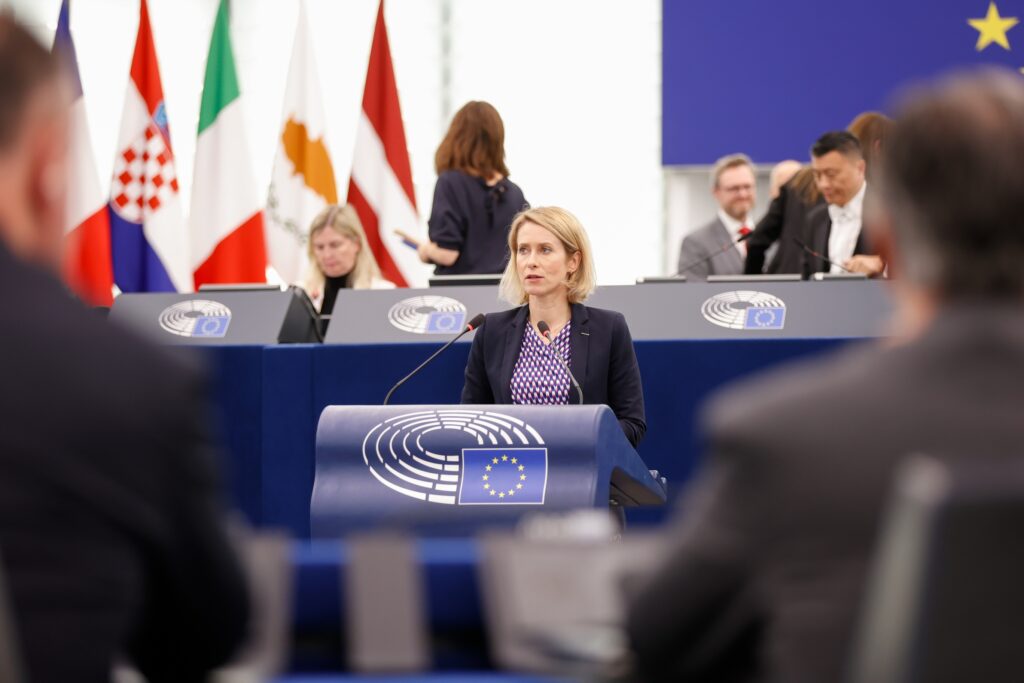
The chamber was not at its most deliberate on Tuesday afternoon. When EU High Representative for Foreign Affairs and Security Policy and European Commission Vice-President Kaja Kallas appeared before the European Parliament’s Strasbourg plenary on 19 May for a question-and-answer session on EU foreign policy, she faced an hour of questions that ranged from pointed to overwrought.
The session nominally covered the Middle East, Iran and regional security. In practice, it became a stress test of Ms Kallas’s ability to hold a coherent line while MEPs vented frustration at an EU that many of them regard as too slow, too divided and too deferential to its own procedural constraints. She did not dispute the frustration. She disputed the remedies on offer.
Association agreements’ pitfalls
The central tension of the session was straightforward. MEPs wanted action. Ms Kallas kept explaining why action, as they defined it, was not available; and why pretending otherwise would make things worse, not better. She did so without condescension and without evasion, which, in the circumstances, was a considerable achievement.
The EU–Israel Association Agreement dominated the early exchanges. MEP Hannah Neumann (Greens-EFA/DEU) pressed Ms Kallas on why the EU had not suspended it, given that the Commission’s own analysis concluded Israel was breaching its human rights obligations.
Ms Kallas’s answer was unambiguous. Suspension requires unanimity among member states. Unanimity does not exist. Qualified majority does not exist either. “I’m not giving you the list of these member states,” she said, “because it’s not good practice. We have the confidentiality of our discussions as well. But it’s clear that not everybody’s on board.”
She also raised a question that her critics largely ignored: would suspension actually improve the situation? Cutting off formal channels, she argued, would remove one of the few remaining instruments of pressure, i.e., her own direct line to Israeli counterparts. The Knesset’s passage of legislation introducing the death penalty for Palestinians she condemned without hesitation. But she noted, with characteristic precision, that the EU maintains association agreements with other countries that also practise capital punishment and carry out executions. Consistency, she implied, cuts in uncomfortable directions.
The mislabelling headache
On Syria, she defended the EU’s decision to re-engage after the fall of Bashar al-Assad’s regime, on the grounds that engagement offers more leverage over inclusivity and accountability than isolation. On the Middle Corridor and Central Asian trade routes, she confirmed that a ministerial meeting is in preparation, aimed at diversifying supply chains and reducing dependence on any single route.
MEP Barry Andrews (Renew/IRL) then offered one of the session’s more forensic interventions, focusing on the mislabelling of settlement goods as Israeli products. He estimated the practice affects up to 90 per cent of certain goods, making the existing tariff distinction between settlement and Israeli products effectively unenforceable.
Ms Kallas acknowledged the problem but was frank about the limits of any response short of a full trade suspension, something that member states will not support. Without the ability to verify origin at scale, she said, circumvention via exports from Israel as a whole is simply too easy to prevent.
The Aubry intermezzo
The session’s most charged moment came when MEP Manon Aubry (The Left/FRA) took the floor. She did not give much thought to procedural nuance. On the Gaza war, she accused Ms Kallas of proposing sanctions against only four organisations and three individuals in response to what she described as 73,000 deaths and an “ongoing genocide”. She asked with undisguised contempt who Ms Kallas thought she was kidding.
Has the war that has been started helped the oppressed Iranians? — Kaja Kallas, High Representative of the EU for Foreign Affairs and Security Policy, European Commission vice president
The high representative did not flinch. She acknowledged that the sanctions on violent settlers—unblocked after two years—were insufficient. “You can say it’s not enough, and it’s clearly not enough because this is continuing,” she said, “but it’s at least the blockage that we got over.”
The Union’s top diplomat reminded Ms Aubry that the EU allocates €1.2bn for Palestinians for 2025–2027, including funding for UNRWA, making it the largest single supporter of the Palestinian people. She also explained, again, the arithmetic of EU decision-making: proposals exist, votes have been counted, the numbers are not there.
Unacceptable
Ms Aubry returned for a follow-up, accusing Ms Kallas of inconsistency: tough on Russia, supine on Israel. She then warned the high representative that the latter would end up “on the wrong side of history with Palestinian blood on your hands”. Understatement is not Ms Aubry’s forte, one might say.
Ms Kallas’s reply was sharp. “You really need a crash course in how the European Union works,” she said. Action on Russia was possible because “On Russia, everybody is agreeing.” The distinction, she made clear, is not one of political will but of political arithmetic. Ms Aubry gave no sign of understanding the distinction.
Parliament Vice-President Pina Picierno, who chaired the session, subsequently rebuked Ms Aubry directly, saying it was “really unacceptable to call the high representative a war accomplice.” Ms Picierno earned applause for her rebuke of the firebrand French Left member.
Iran and the limits of force
On Iran, Ms Kallas was equally clear-eyed. The EU has designated the Islamic Revolutionary Guard Corps as a terrorist organisation, but implementation rests with member states, and varies considerably. She suggested that public pressure, including from journalists and MEPs with relevant information, was one of the more effective tools available to enforce compliance. “If you have information about the Revolutionary Guard actually benefiting from member states’ protection,” she said, “I think the best way is to make it public so that people also know.”
MEP Sebastian Tynkkynen (ECR/FIN) asked whether EU diplomacy had done anything concrete to help Iranians living under the regime. Ms Kallas turned the question around. Executions in Iran rose by 68 per cent in 2024. Since military action began at the end of January, the situation for ordinary Iranians has deteriorated further. “Has the war that has been started helped the oppressed Iranians?” she asked.
I’m not doing this in order to feel better. I’m doing this in order to achieve results. — Kaja Kallas
The closure of the Strait of Hormuz has driven up energy prices across the world and cut fertiliser supplies to countries including Sudan, where 54 per cent of fertiliser imports pass through the strait. Famine, she warned, could follow next year. A diplomatic solution, she argued, is not weakness. It is the only option that does not make everything worse.
On naval operations, she was constructive rather than defensive. Operation Aspides already exists, already has a mandate covering the Strait of Hormuz in principle, and already involves multiple member states. The problem is that each contributes too little individually to constitute a credible force. “Separately, all of us are small and weak because one has one ship, the other one has one ship,” she said. “But if we put it together in our operation Aspides, then we are actually a credible force.”
Accountability and the longer view
MEP Matjaž Nemec (S&D/SVN) pressed Ms Kallas to put sanctions proposals to a vote regardless of the outcome, so that member states’ positions would become publicly visible. She was unconvinced. “I’m not doing this in order to feel better,” she said. “I’m doing this in order to achieve results.” Forcing a vote that fails, she argued, would advertise European division without producing any benefit for Palestinians.
On international law more broadly, she was neither dismissive nor naively optimistic. The UN Charter, she noted, is not the problem. Its principles are sound; the problem is accountability. “If you just start the wars and nothing happens to you,” she said, “then other aggressors will learn the lesson.”
If you just start the wars and nothing happens to you, then other aggressors will learn the lesson. — Kaja Kallas
She argued that the current moment, precisely because the rules-based order is under strain, creates an opportunity to develop international law further. She also noted that, travelling the world, she finds considerable appetite for Europe to lead that effort.
Ms Kallas left the debate—immediately switching to another in the same chamber—having answered every question with ease and characteristic charm. With procedural prowess, experience steeped in realism, and common sense on her side, she did not come anywhere near losing her composure, or promising anything she could not deliver.
Did she convince any opponents, one might ask. Then again, was that ever in the offing?