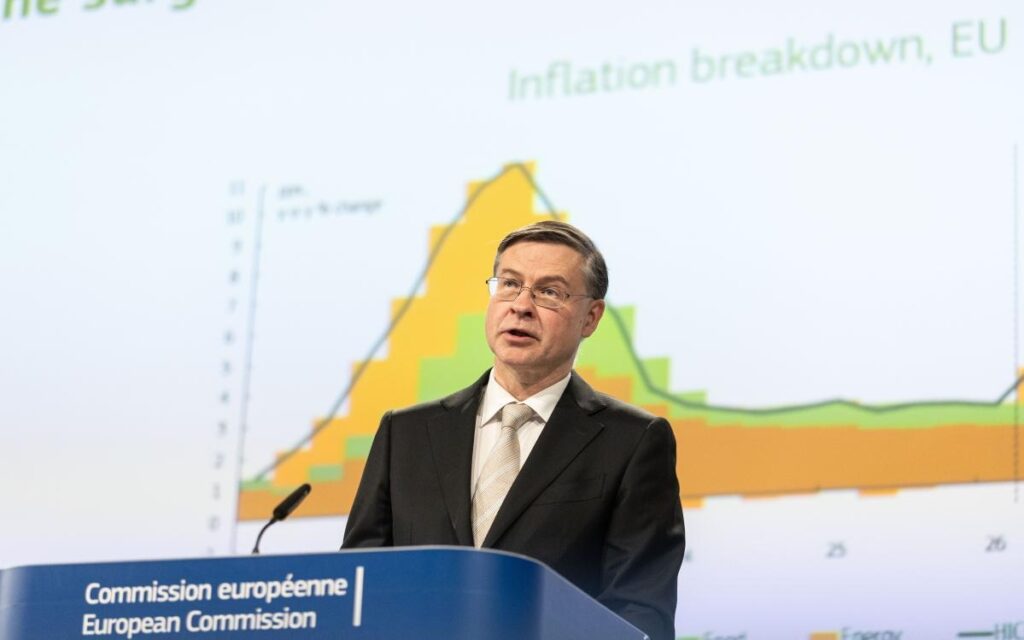
The EU is considering loosening fiscal rules to help countries deal with the energy crisis. The statement by Commissioner Valdis Dombrovskis came after Italian Prime Minister Giorgia Meloni asked the European Commission to treat energy security with the same urgency as defense spending.
“We are currently looking at policy options including fiscal policy options to best address the crisis,” Economy Commissioner Valdis Dombrovskis said after Friday’s Eurogroup meeting. According to the Commissioner, the EU is evaluating several possible responses.
Mr Dombrovskis cautioned against a broad fiscal expansion. He underlined the need to preserve fiscal sustainability while ensuring that support measures remain temporary and targeted.
The Commissioner said that while Italy had requested additional flexibilities, there was broad agreement among finance ministers against large-scale stimulus measures that could fuel demand for fossil fuels or undermine the credibility of EU fiscal rules.
Italy calls for looser rules
Italy has pushed for broader room to support households and businesses affected by higher energy costs, including through a letter sent by Prime Minister Giorgia Meloni to the European Commission on Monday. Fiscal flexibility was therefore one of the key discussion points during the Eurogroup meeting.
After the meeting, Greek Finance Minister and Eurogroup president Kyriakos Pierrakakis said member states broadly accepted the need for what he described as a “surgical and optimal” response. While some governments favoured stricter adherence to fiscal rules and others were more open to flexibility, he said that fiscal policy should not contradict the ECB’s monetary stance.
“Fiscal policy and monetary policy should go hand in hand,” he said, stressing that support should focus on vulnerable households and businesses without creating additional inflationary pressures.
Just as urgent as defence?
Meloni asked the European Commission to relax fiscal rules for households and industries struggling with soaring energy costs. On Monday, she wrote that energy security should be treated with the same urgency as defence spending.
“We cannot justify in the eyes of our citizens that the EU allows financial flexibility for security and defence strictly understood and not to defend families, workers and businesses from a new energy emergency that risks hitting the real economy hard,” the letter reads.
In the letter, Meloni also asked the European Commission to extend the scope of the National Escape Clause to include investments and measures aimed at addressing the energy crisis. This clause currently allows member states additional budgetary flexibility to boost defence spending.
We are resilient, Dombrovskis says
The Eurogroup meeting came amid renewed turbulence in global energy markets linked to instability in the Middle East and disruptions around the Strait of Hormuz. Ministers were briefed on updated growth and inflation forecasts, with inflationary pressures expected to remain elevated as higher oil and gas prices feed through into wider sectors of the economy.
According to the European Commission’s Spring Economic Forecast, presented on Thursday, inflation in the EU is projected to reach 3.1 per cent this year before easing to 2.4 per cent next year. The European economy is still expected to grow, albeit at a slower pace. GDP growth in the EU is projected at 1.1 per cent in 2026, before rising to 1.4 per cent in 2027.
Both Eurogroup president Kyriakos Pierrakakis and Mr Dombrovskis stressed that the euro area had avoided the worst-case scenarios feared earlier this year, including stagflation and recession. The Commission had voiced such concerns earlier this year. “The EU has proved to be resilient to this shock,” Dombrovskis said, adding that this was partly due to measures adopted after the 2022 energy crisis, such as the REPowerEU plan.