How is the European Defence Fund performing? At a record pace. But does it deliver what the front line demands? That is difficult to tell.
Europe’s €8bn war chest that is the EDF is firing on all research cylinders. The translation into actual production is a narrow, worrisome bottleneck. On Thursday (4 June) MEPs grilled the Commission as to how it designs future calls, which gaps it prioritises and how fast it moves.
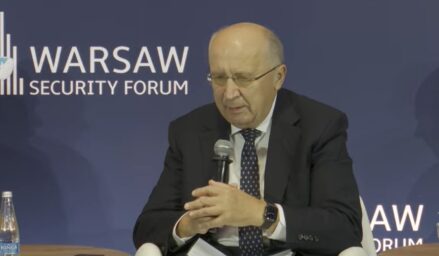
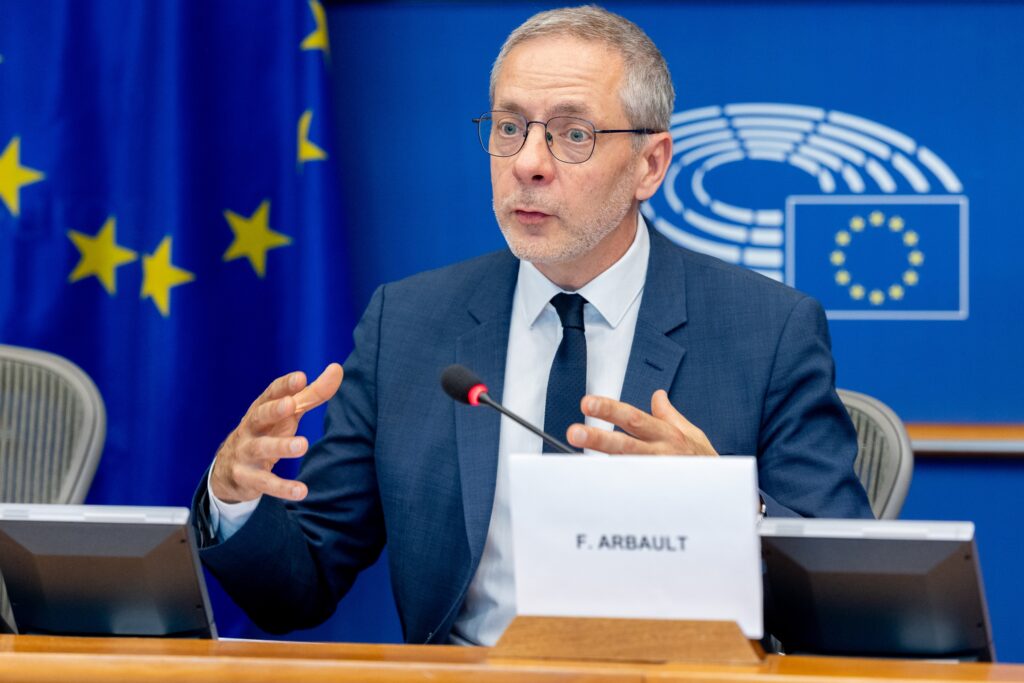
François Arbault bore the brunt. The director for defence industry at the European Commission’s Directorate-General for Defence Industry and Space (DG DEFIS) appeared before the European Parliament’s defence committee (SEDE). He presented the results of the European Defence Fund’s 2025 work programme as part of the formal scrutiny process.
A record year for the fund
He placed the results within the Commission’s broader defence ambition: four European Readiness Flagships, proposed on 16 October 2025 as part of the Defence Readiness Roadmap 2030. They are the Eastern Flank Watch, the European Drone Defence Initiative, the European Air Shield and the European Space Shield. “This is meant to help close the capability gaps which we know exist, to accelerate defence investments across Europe and guide the EU’s progress towards full defence readiness—and this no later than by 2030,” Mr Arbault said.
The 2025 call produced numbers that surprised even the Commission. Industry submitted more than 400 proposals—a 40 per cent increase on 2024. From 31 thematic topics, 57 proposals were selected, drawing on 1,033 participations from 634 unique entities. On average, each project involves 18 entities from nine member states.
Small and medium-sized enterprises accounted for nearly 40 per cent of participations, with 365 SMEs involved across the selected projects—most of them in mainstream thematic calls rather than dedicated SME tracks. “It shows that it’s not only about having some kind of money for SMEs,” Mr Arbault said. “It’s about supporting SMEs across the board.”
The geographic spread was equally striking. Estonia, Greece and Cyprus, Mr Arbault noted, “overperform—they are boxing in a kind of higher league in the sense of the proactive approach to participation.” Nordic and eastern-flank industries are also engaging more actively. Altogether, nearly 55 per cent of the 2025 budget goes to roughly 40 per cent of projects directly supporting the four flagships.
Billions in the pipeline
The Eastern Flank Watch received four projects worth nearly €200m in 2025 alone. Across all EDF years, more than 40 research and development projects worth almost €1bn connect to that flagship. They range from smarter armoured vehicles to collaborative combat between crewed and uncrewed ground vehicles, to enhanced counter-battery capabilities.
“We cannot sacrifice the future to the present,” Mr Arbault said. “At the same time, we need to scramble to produce more of what we have already, but we need also to prepare the technologies of the future, the battle of the future.”
The Drone Defence Initiative drew nine projects worth €150m in 2025. Since 2021, 29 topics covering drones have been funded for a total of €921m. One project, Sharp, identifies non-EU components in drone engines and aims to eliminate those dependencies. The Space Shield attracted three projects worth €140m in 2025, backed by a broader portfolio of more than 30 projects worth €600m.
The research-to-production gap
The Air Shield added five projects in 2025, within a portfolio of over 30 projects worth €800m—including two parallel programmes developing interceptors for hypersonic missiles. On those, Mr Arbault was direct: “We are trying whatever we can to make sure that the follow-up will be a kind of common follow-up so that we are efficient economically and we are building a European capability that is missing.”
Estonia, Greece and Cyprus are boxing in a kind of higher league in the sense of the proactive approach to participation.
— François Arbault, Director for Defence Industry, DG DEFIS
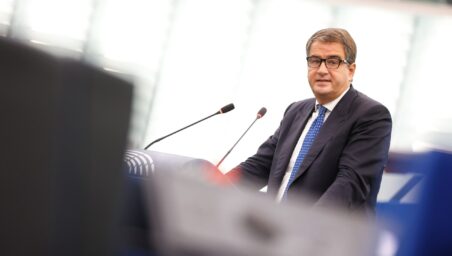
MEP Petras Auštrevičius (Renew/LTU) pressed Mr Arbault on the most uncomfortable question of the session. Despite €921m invested in drone-related topics since 2021, he asked, has any of it produced a deployable, European-built counter-drone system—one that Europe’s eastern members could use now, rather than relying on Ukraine to protect their airspace?
Mr Arbault acknowledged the gap between research investment and operational output. He pointed to industrial reinforcement calls under the European Defence Industry Programme (EDIP)—the first wave closing on 16 June, a second in October and a third in February 2027—as the mechanism to translate research into production capacity. He also cited BraveTech, the EU’s co-innovation initiative with Ukraine. “We have to learn from the Ukrainians,” he said, “and we have put the instruments in place to learn precisely from them.”
A relative deterioration
MEP Sven Mikser (S&D/EST) framed the same concern more starkly. Europe may have doubled certain defensive capabilities since 2020, he observed, but if the threat has tripled, the net position has worsened. He asked whether simplification measures in the Defence Simplification Omnibus would produce genuine agility or merely cosmetic change.
Mr Arbault’s answer was candid: “2030 is just tomorrow, basically.” He described the new AGILE instrument—currently in trilogue negotiations—as the Commission’s response to the speed problem: fast-track grants to test disruptive innovations within months, targeting startups and SMEs, focused on problems identified directly from the battlefield.
MEP Mārtiņš Staķis (Greens-EFA/LVA) noted that naval drone producers are delivering to Ukraine and the Persian Gulf but receiving no orders from European defence ministries. Mr Arbault confirmed the problem and pointed to a provision in the 2009 Defence Procurement Directive—currently under review—that exempts jointly developed capabilities from open-tender rules.
Transnational ambition, national instincts
MEP Nicolás Pascual De La Parte (EPP/ESP) raised the risk of EU funds reinforcing national rather than European industrial bases. Mr Arbault conceded the tension but argued that requiring transnational partnerships, combined with member-state co-funding requirements, creates structural incentives for collaboration. He cited France and Germany jointly pursuing a follow-on missile early-warning capability after separate EDF-funded projects laid the groundwork.
We cannot sacrifice the future to the present. We also need to prepare the technologies of the future, the battle of the future.
— François Arbault, Director for Defence Industry, DG DEFIS
“There is much more that we need to do in terms of greater agility of the procurers,” the Commission director replied, “and that will be a subject of the review of the procurement directive.” The broader picture is of an institution that has built an impressive research machine and is now straining to connect it to operational reality.
Whether member states will follow with procurement orders is, as Mr Arbault acknowledged, ultimately their sovereign decision. Depending on your point of view, you may call it the principle of subsidiarity in proud practice, or sleepwalking into a backwater future.