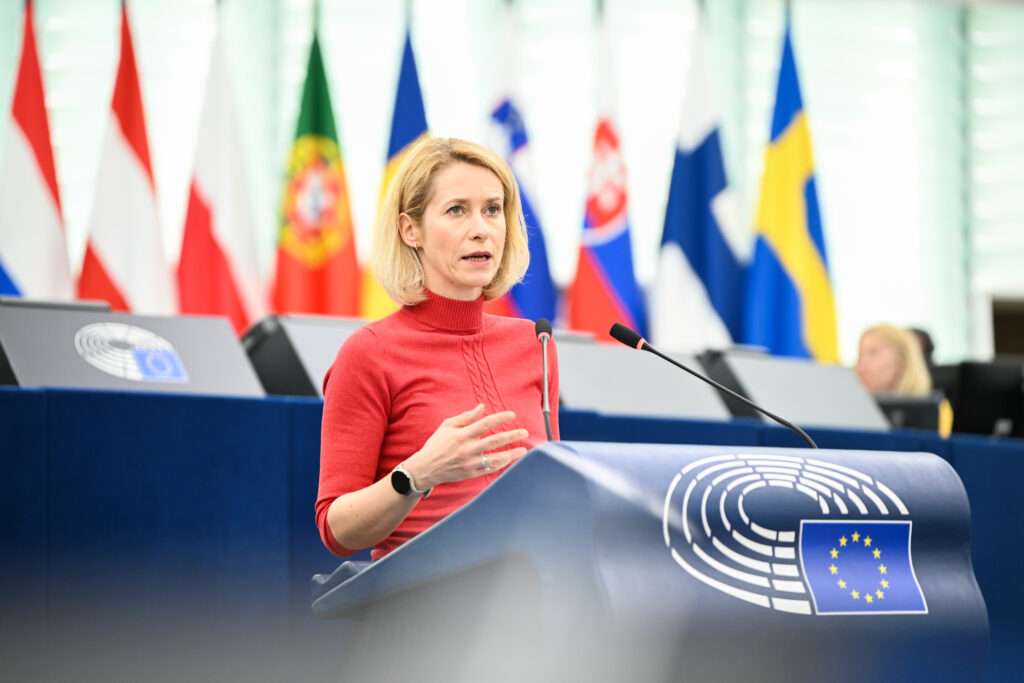
The European Union has welcomed a framework agreement between the United States and Iran, a deal it played no part in brokering. As High Representative Kaja Kallas addressed the European Parliament on Tuesday, that absence proved impossible to ignore.
Kallas told members of the European Parliament (MEPs) that there were “grounds for cautious optimism” following the announcement of the deal aimed at ending the war and reopening the Strait of Hormuz. She highlighted mediation efforts by Pakistan, Qatar, Oman, Saudi Arabia, Turkey, and Egypt, and signalled the EU’s readiness to contribute through economic leverage and technical expertise on nuclear issues. “Once fully implemented, this agreement should also contribute to easing pressures on global energy markets,” she said.
The High Representative was also firm on what the EU would not accept. Brussels rejects any measures imposing additional costs on maritime shipping through the Strait of Hormuz, she said, and the bloc’s naval operation ASPIDAS will continue protecting shipping in the Red Sea and the Gulf of Aden. Last week, the Council adopted new sanctions listings targeting those involved in Iran’s actions threatening freedom of navigation.
Scepticism in the chamber
Not all MEPs shared Kallas’s measured optimism. Several questioned the durability of an arrangement that remains, in legal terms, a two-page memorandum of understanding. “The agreement on the table is just a memorandum, two pages long, that agrees on a 60-day suspension, just the right time for Trump, two months to enter a voting campaign for midterms without having to deal with an unpopular war,” said Lucia Annunziata (S&D/ITA).
Others warned that Iran would use the pause to regroup. “The theocratic regime in Iran is alive and kicking,” said Nacho Sánchez Amor (S&D/ESP). “In classical economic terms, this is unfinished business.”
The sharpest criticism, however, was directed not at Tehran or Washington, but at Brussels itself. Several MEPs argued that the EU had been little more than a spectator as the deal took shape, with one lawmaker noting bluntly that peace had been brokered by China, Pakistan, and Qatar while Europe’s billion-euro diplomatic service watched from the sidelines.
Kallas pushed back, pointing to the EU’s peace plan for Ukraine and its ongoing engagement in the region, but acknowledged that internal divisions had limited the bloc’s room to act. “The EU is 27 member states, so it is also clear that we need to talk about our decision-making procedures,” she said.
Settlement goods and the limits of unity
The debate exposed divisions on another front as well. Kallas confirmed that the Commission is preparing a list of options for trade measures related to goods from illegal Israeli settlements in the West Bank, including possible import restrictions, following calls from member states at Monday’s Foreign Affairs Council.
The move comes amid mounting evidence of widespread mislabelling. Barry Andrews (Renew/IRL) cited data showing that of 5,900 shipments arriving in the EU from Israel, 17 per cent contained settlement goods presented as made in Israel. “Can we honestly deal with the question of settlement goods without first dealing with the question of the Association Agreement?” he asked.
On Gaza, Kallas called for the immediate and unhindered flow of humanitarian aid and acknowledged that the peace plan was not being implemented. “We see no progress in the implementation of the Gaza peace plan, but the humanitarian crisis in Gaza is growing. We cannot wait longer,” she said.
The ICJ confirmed trade with the settlements is illegal. Now we need the Trade Commissioner to turn up and do his job.
— Hannah Neumann, MEP, Greens/EFA (DEU)
Hannah Neumann (Greens/EFA/DEU) went further, calling on the Commission to bring forward a formal proposal to ban settlement trade under Article 207 of the Treaties. “The ICJ confirmed trade with the settlements is illegal. Now we need the Trade Commissioner to turn up and do his job,” she said.
The day’s exchanges left little doubt about the scale of the EU’s credibility problem in the region. For all Kallas’s talk of economic leverage and diplomatic engagement, the bloc remains better at issuing statements than shaping outcomes, a commentator on events it had no hand in producing.