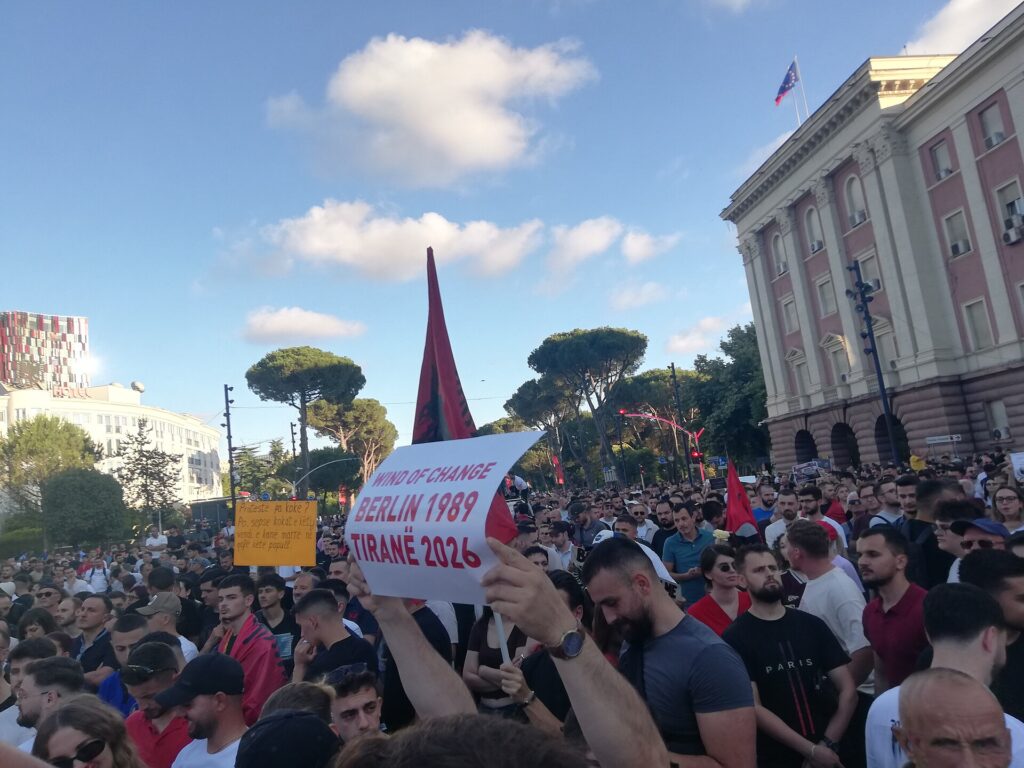
Twenty days of demonstrations have turned a dispute over a luxury resort into the biggest political crisis Albania has seen in years. EU Perspectives put a set of questions to reporter Julian Kasapi on what is really driving people onto the streets, and why he believes the investor’s name matters far less than what it has exposed.
The movement, now known as the Flamingo Revolution, has grown well beyond its starting point near Zvërnec, with protesters chanting about pensions, hospitals, rents and corruption alongside their original environmental demands. It has drawn in Albania’s diaspora across Europe, put pressure on Brussels, and raised a question that goes well beyond one resort: whether Prime Minister Edi Rama’s government can be trusted to follow its own rules.
What was the final straw that triggered the protests?
It started as a small group of environmentalists and people who said the land was theirs on paper. Then one of the protesters was beaten by private guards, and people suddenly gathered, first in Skanderbeg Square and then towards Dëshmorët e Kombit. That moment is what Albanian media now count from. For many Albanians, the resort became proof that public land and national laws could be reshaped for powerful investors.
Jared Kushner’s firm is involved. How heavily does that US connection weigh on the protesters?
Very little. Protesters are not opposing Kushner, America or foreign investment as such. They are protesting how the government operates: changing rules, bypassing transparency, and treating protected public land as if it belonged to those in power. The investor’s identity is secondary. The real issue is a political system that protesters believe acts like a thief.
Prime Minister Edi Rama promises modernisation and tourism. Why do Albanians distrust that economic narrative this time?
Albanians have heard so many promises that enough is enough. This time they see protected land, accelerated procedures and limited public consultation. Their question is simple: who really benefits? Luxury resorts may raise tourism figures, but many citizens believe the profits go to investors and politically connected groups rather than to ordinary people.
A local environmental protest escalated into a mass political revolt in Tirana. How have the core demands evolved?
The movement began as a demand to stop construction in Vjosa-Narta. It has since grown into a broader challenge to corruption, land privatisation and concentrated political power. Protesters now want the project stopped, environmental laws restored and transparent investigations carried out. Many are also calling for Mr Rama to resign, alongside the opposition leader, and for both to face prosecution.
The Albanian diaspora across Europe strongly backs the movement. How vital is that external pressure on the government?
The diaspora gives the movement international reach. Albanians abroad have organised demonstrations, contacted European politicians and kept the issue visible in foreign media. That raises the political cost for Mr Rama, especially here in Brussels.
Albania is seeking EU accession. Could these protests and the “state capture” allegations freeze the entry talks?
I don’t think so, but they put the country in a different light. Albania has to meet EU standards in practice, not just on paper, and Chapter 27 on the environment is one of them. The Commission has made clear the situation needs to be clarified before that chapter closes, and Albania is hoping to close it by the end of 2027. It’s open, but it isn’t closed yet.