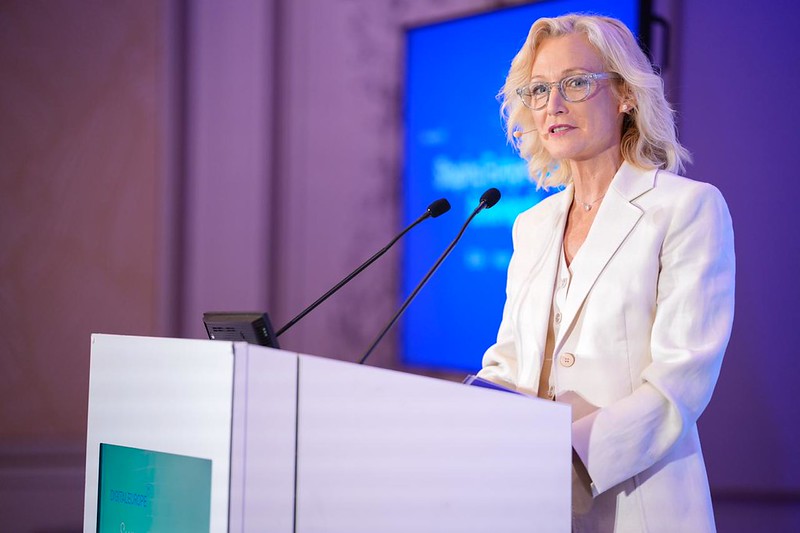
Europe has more AI researchers per capita than the US and more startups than any other region. Yet far too few of its companies grow into global tech champions. According to DIGITALEUROPE Director General Cecilia Bonefeld-Dahl, the problem is not innovation but Europe’s inability to help businesses scale across the single market.
“I think we have finally understood that if we are not creating European scalable demand, companies actually can’t grow across borders in Europe, and we will never succeed.” That was the message from Cecilia Bonefeld-Dahl, Director General of DIGITALEUROPE, the Brussels-based association representing Europe’s technology industry.
She spoke to journalists after the organisation’s Summer Summit on 1 July, which brought together digital experts to discuss the challenges of the area in the EU. “We cannot regulate our way to success,” she said.
Her comments come at a moment when digital regulation is again at the centre of the Brussels debate. In November 2025, the European Commission presented the Digital Omnibus, a package to simplify obligations across laws such as the General Data Protection Regulation (GDPR), the AI Act, and the Data Act.
The European Commission framed it as an attempt to cut red tape and make Europe more competitive. Some elements are still under debate, while others, such as the delay of AI Act obligations for high-risk systems, have already been voted on favourably.
The omnibus generated a big debate, with civil society groups, like European Digital Rights (EDRi), describing it as “a major rollback of EU digital protections”. But for Ms Bonefeld-Dahl, online protections, such as the right to privacy, are not for debate. “Everybody can agree that we need privacy. Period. Let’s not open that discussion. But for example, if we cannot use synonymized data to innovate, how are we going to innovate? How are we going to find the next vaccine or new solutions?”
Fragmented market pushes companies outside the EU
One of the core problems, in Ms Bonefeld-Dahl’s view, is fragmentation across member states. “Everybody buys in 27 small boxes,” she said. “There is no scalable demand. For the tech sector and technology-capable companies, this really hampers their ability to scale across Europe. We still only have eight per cent of the European companies trading across one border.”
Everybody buys in 27 small boxes. — Cecilia Bonefeld-Dahl, Director General of DIGITALEUROPE
While Europe has strong research institutions, industrial know-how and promising companies, many firms still struggle to scale inside the EU and look to the United States to do so. Europe has 30 per cent more AI researchers per capita than the US, more startups than any other region, 3.5 million tech workers, and public and private tech companies worth almost $4 trillion. Yet the EU had only 110 unicorns at the beginning of 2025, compared with 687 in the US and 162 in China.
This is why Brussels is now discussing tools such as the proposed EU Inc. or “28th regime”, which would allow companies to register within 48 hours for €100 and operate under a shared framework.
A shy but game-changing fund
That is also why Ms Bonefeld-Dahl described the EU’s emerging competitiveness agenda as so important. “The competitiveness fund is maybe the best thing in history, apart from removing the border controls and visas within Europe,” she said.
The Scaleup Europe Fund is a €5bn initiative to finance companies in areas such as artificial intelligence, quantum computing, clean energy and space.
However, for Ms Bonefeld-Dahl, the investment remains far too limited compared with Europe’s global competitors. “We have seven per cent of AI venture capital in Europe,” she said. “We are a very, very wealthy continent, and we have seven per cent”.
To Ms Bonefeld-Dahl, the fund is not sufficient, but it is a beginning. “Is the money enough? No. Do I like the way it’s done? Yes. Do I think we should do much more of that in the new investment fund? Yes.” Asked what a good number would be, she laughed and suggested adding a zero.
Sovereignty through partnerships
In June, the Commission unveiled a tech sovereignty package aimed at reducing dependence on foreign providers. For DIGITALEUROPE, the answer is not to close the European market, they want the EU to build its own capacity while working with trusted partners.
“From an industry perspective, we want to discuss how we can co-invest, how we can develop resilience of technologies together, and how we can strengthen each other on cybersecurity, on the AI stack, on the transatlantic stack, how we can work closely together on chips, manufacturing, supply chains, and raw materials,” Ms Bonefeld-Dahl said.
There is actually a lot of common ground. You don’t need to agree on everything. That’s democracy and also collaboration. — Cecilia Bonefeld-Dahl, Director General of DIGITALEUROPE
The transatlantic relationship has been strained by diverging regulatory approaches, with the US criticising the EU Digital Services Act and Digital Markets Act. But Ms Bonefeld-Dahl warned against allowing one or two divisions to block cooperation. “I think there is actually a lot of common ground,” she said. “You don’t need to agree on everything. That’s democracy and also collaboration.”
She took the same balanced approach to the Anthropic case, where concerns were raised about a US “kill switch”. “They took three weeks to basically test if this is a technology that could cut the whole banking system. So this is good news,” she said. “The clear message is that it’s not a closed world, but it is a carefulness towards very powerful technologies.”
Europe’s strength is quantum
If the wider picture is one of Europe trying to catch up in AI, cloud and financing, Ms Bonefeld-Dahl pointed to quantum as one area where the continent has genuine strength. “We’re very, very strong,” she said, while adding that the main challenge is, again, “scalability”.
EuroHPC, EU supercomputing initiative, has been helpful for the sector, according to Ms Bonefeld-Dahl, though it was “really unfortunate” that funding pressures could leave a gap before new money becomes available in 2028.
The Director pointed to European quantum scale-ups, including IQM, as companies that “could make the next champion”. The Finnish quantum computing company secured €50 million in funding in March and doubled sales to $35 million last year.