The European Union’s lawmaking bodies have reached a political agreement on the Programme for Agile and Rapid Defence Innovation, known as AGILE. It clears the way for a €115m pilot instrument designed to move defence tech quickly from labs to battlefield.
The European Parliament and the Council struck the deal this week. The Commission proposed AGILE in March 2026. Its core purpose is to compress the time between invention and deployment. Projects will receive between €1m and €5m each, through a combination of grants, prizes, and procurement.
The target beneficiaries are single companies, with a strong emphasis on small and medium-sized enterprises, start-ups, and scale-ups from EU member states, EEA-EFTA countries, and Ukraine.
Speed is the programme’s defining feature. AGILE promises a four-month time-to-award — far shorter than existing EU defence funding cycles. First calls for proposals are expected at the start of 2027.
Disruptive technologies, urgent needs
The technologies AGILE will prioritise include artificial intelligence, quantum systems, and drones. These are areas where commercial innovation has outpaced traditional defence procurement. The programme aims to close that gap by connecting the technology sector directly with defence end-users.
The agreement also includes measures to attract companies to relocate to the EU. That reflects a broader concern in Brussels about the risk of Europe’s most capable defence innovators drifting toward non-European markets. The programme covers not only EU member states but also EEA-EFTA countries and Ukraine. It is a signal that Kyiv’s battlefield experience is seen as directly relevant to the innovation agenda.
The political agreement must now pass through formal adoption by both the European Parliament and the Council over the coming weeks. The instrument is expected to be fully operational from early 2027.
AGILE does not arrive in a vacuum. The EU already operates several defence innovation instruments. The European Defence Fund promotes cooperative, cross-border research and development projects. Within that framework, the EU Defence Innovation Scheme supports start-ups and SMEs. The Hub for EU Defence Innovation, launched by the European Defence Agency, strengthens cooperation among member states and stakeholders.
A crowded but incomplete landscape
These instruments, however, were not designed for speed. The EU Defence Industry Transformation Roadmap has called explicitly for more agility and risk-taking across the European defence ecosystem. The Preserving Peace — Defence Readiness Roadmap 2030 and the White Paper for the Future of European Defence — Readiness 2030 both stress the urgency of accelerating technology uptake. AGILE is the direct legislative response to those calls.
The pace at which Parliament and the Council reached agreement is itself noteworthy. It suggests that political will, often the scarcest resource in EU defence debates, is now in adequate supply.
Europe has the talent and the technology to lead in defence innovation. — Henna Virkkunen, executive vice-president for tech sovereignty, security and democracy
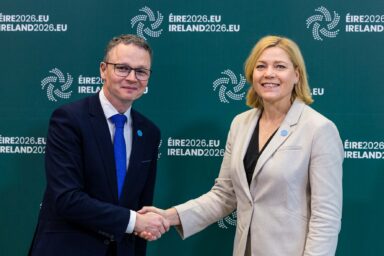
Executive vice-president for security Henna Virkkunen framed the agreement in terms of industrial and strategic ambition. “Europe has the talent and the technology to lead in defence innovation,” she said. “I welcome today’s political agreement because it will help our start-ups, SMEs and innovators bring new technologies to defence faster and at greater scale.”
Sovereignty and the battlefield
Ms Virkkunen connected the programme to a broader goal. “Strengthening Europe’s technological sovereignty also means ensuring that the best ideas can become the capabilities that keep Europeans safe,” she added.
Commissioner for Defence and Space Andrius Kubilius drew a direct line from Ukraine to the legislation. “Today’s political agreement is another important milestone in strengthening Europe’s defence preparedness,” he said. “The war in Ukraine has shown that success on the battlefield depends on the ability to innovate, produce and adapt at speed.”
Mr Kubilius was explicit about the programme’s dual purpose, serving both member states and Ukraine. “This package will help ensure that Europe’s defence industry can more rapidly deliver the capabilities our member states and Ukraine need,” he said, “while reinforcing our industrial resilience for the long term.”
From agreement to capability
At €115m, AGILE is a pilot, not a permanent fixture. Its designers are candid about that. The programme is intended to test new ways of supporting defence innovation to learn what works before committing larger sums. If it performs as advertised, it will likely serve as a template for something considerably bigger.
The formal adoption process begins now. If it proceeds without delay, AGILE will be operational in early 2027. Europe’s most agile defence innovators will have a new, faster route to market; not a minute too soon.