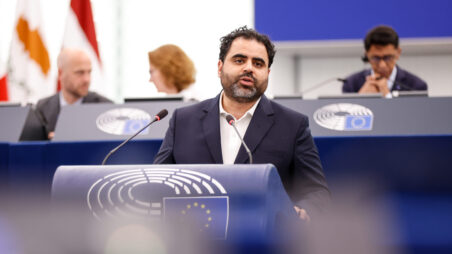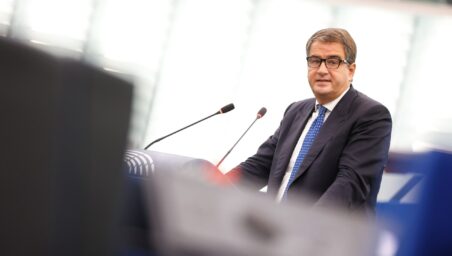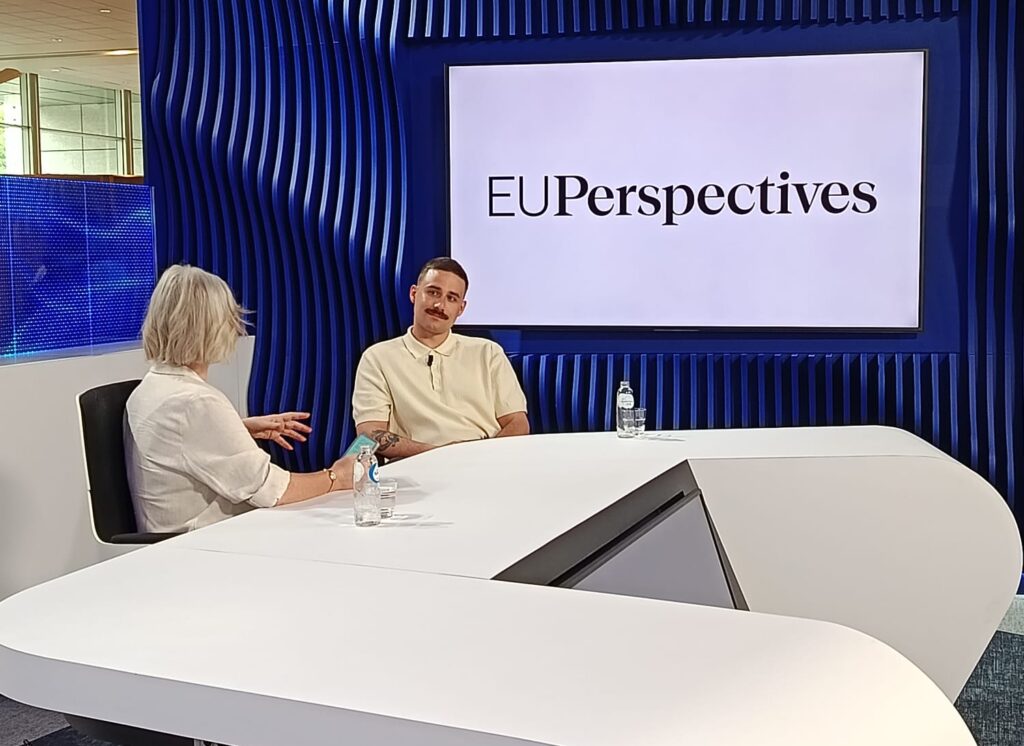
Online disinformation is the biggest danger to democracy today, Lukas Sieper tells the EU Perspectives podcast. Social media should be treated as a public health emergency, the German member echoes the stance of his Renew parliamentary group.
Mr Sieper described social media as a space where public health risks, criminal activity, radicalisation and democratic threats increasingly overlap. His conclusion is stark: online platforms need to face far greater responsibility for the consequences of the systems they have built.
His starting point is the impact of social media on young users. “The health issue with children, especially being addicted to social media, is connected to the algorithms,” he said.
Children pushed to violence
But he argues that addiction is only one part of a much wider problem. According to Mr Sieper, social media has also created an unregulated creator economy worth billions euros, while allowing illegal activities ranging from drug or weapon sales to sex trafficking to flourish.
For him, the most worrying cases are those where online spaces contribute to real-world aggression. “My biggest concern is motivating children to violence.” He referred to a recent school attack in Germany, arguing that it was pressure from online forums that pushed the teenager responsible.
“Social media does not care about borders,” he said, noting that a child in Warsaw can consume the same content as one in Rome. “That’s why having national regulation makes no sense. The problem isn’t national.” While global governance of online platforms remains out of reach, he believes the EU should at least establish one common standard for the bloc.
There are also significant economic costs society incurs in association with youth mental ill health. Mr Sieper’s parliamentary group estimates they will amount to around €1.7tn between 2024 and 2033.
Balancing protection and privacy
“The time would have been 20 years ago,” Mr Sieper said, adding that Europe can no longer afford to delay comprehensive social media regulation. Fragmented national rules cannot solve a problem that is inherently cross-border.
Mr Sieper acknowledged the need to balance stronger protections for minors with privacy concerns. But he argued that privacy cannot be a shield for online spaces encouraging violence by design. “If you have an account in an online forum that is meant to steer violence, you have no right to privacy,” he said.
If we get money from the EU and good legislation, we can have our own EU social media companies and not leave the whole market to the Americans and the Chinese. — MEP Lukas Sieper (Renew/DEU)
For him, however, the greatest challenge posed by social media is not only what happens to individual users. It is the effect on democratic societies as a whole. “Misinformation on social media is the biggest danger to democracy that we face right now,” he said.
He believes platforms should have to do more to identify and limit false information, although he acknowledged that fact-checking has limits. Not every disagreement, however, is misinformation, he admits. Science itself depends on debate and different interpretations.
A threat without responsibility
The longer-term solution, according to Mr Sieper, is improving people’s ability to navigate the online environment. “Social media literacy is the solution for adults as well as for children,” he said. He noted that both younger and older generations struggle with the same problem: they were never properly taught how to use social media responsibly.
While Mr Sieper believes users need better digital skills, he rejects the idea that responsibility should fall mainly on individuals. Instead platforms themselves should be held accountable for the consequences of their business models. “If the person who spreads misinformation that leads to damage cannot be made liable, then it should be the platform,” he said.
He compared social media with other industries where companies can be held responsible for harm caused by products. In his view, online platforms should face similar pressure. “You will see how motivated the companies will be and how fast they will be in stopping anyone from spreading misinformation on their platforms.”
The German member said Europe should treat social media as a separate policy field rather than trying to regulate individual issues through a collection of different laws. “We regulated every aspect of the world in certain boxes,” he said. “But we never put the big thing that now is half our life, the internet, in one box.”
A fight Europe cannot fully win
Despite calling for tougher rules, Mr Sieper admitted that Europe faces limits. “We will lose this fight in a certain way,” he said. The reason, according to the MEP, is that the largest platforms are controlled by companies based outside Europe, especially the US and China.
Sieper argued that regulators would need access to algorithms to properly understand and control the systems shaping online conversations. “But they will never lay open their algorithm to us,” he added.
That leaves Europe with a difficult choice: trying to control platforms it does not own, or focusing on making citizens more resilient. For Mr Sieper, the answer is a combination of stronger rules, better education and investment in future European digital alternatives.
If you have an account in an online forum that is meant to steer violence, you have no right to privacy. — Lukas Sieper
He does not believe Europe will simply create its own versions of Facebook, TikTok or YouTube. But he argues that new platforms will emerge, just as TikTok would have been difficult to imagine 15 years ago. “If we get money from the EU and good legislation, we can have our own EU social media companies and not leave the whole market to the Americans and the Chinese,” he said.
Whether Europe can build successful home-grown social media platforms is a question for the future. In the meantime, attention in Brussels is turning to the rules that will govern today’s digital giants. Mr Sieper expects work on a comprehensive social media law to begin before the end of the year.