Speaking in Washington, the defence commissioner hammered home the theme of transatlantic unity. He found an unlikely ally in Charles Bronson, too.
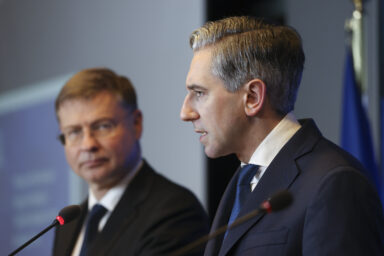
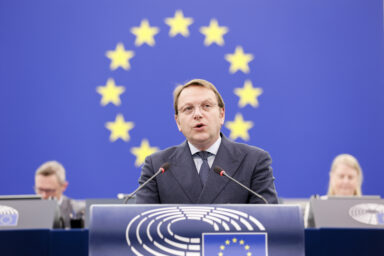
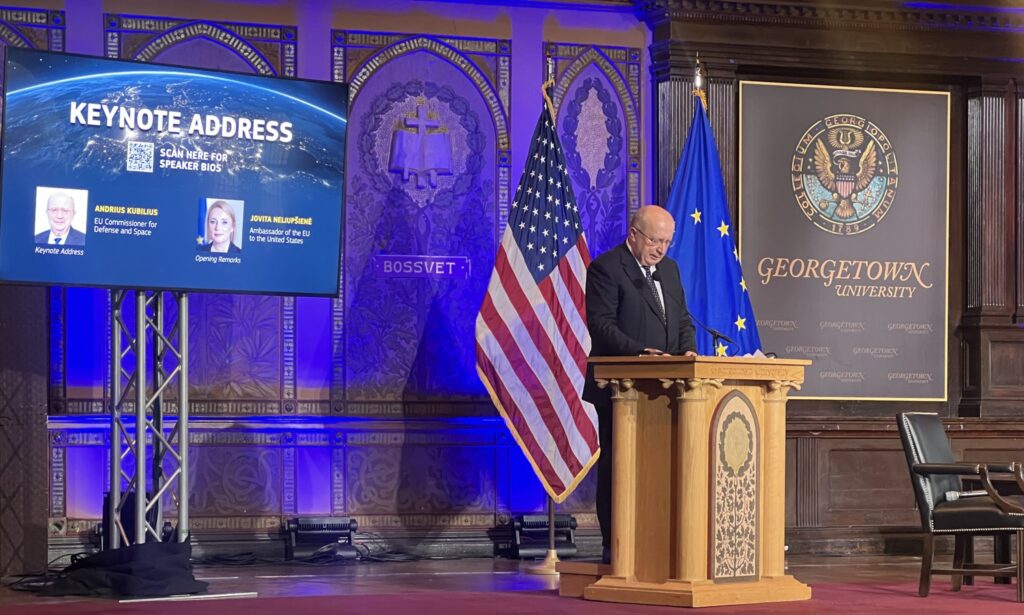
“United, we need to fear no adversary,” EU Defence Commissioner Andrius Kubilius told his audience. “But alone and divided, we are in danger.” The setting was the EU Defence Night held at Georgetown University in Washington. The 23 July event brought together senior American and European officials, military figures, and industry leaders.
The setting was deliberate. Georgetown lent historical weight to an evening devoted to the future of the transatlantic alliance. (It was founded in 1789, the year George Washington became president.) Mr Kubilius noted the parallel with Vilnius University, founded in 1579, where he studied physics. “Maybe this is why I feel immediately at home here at Georgetown University,” he said.
Unity as the answer
Two world wars, Soviet occupation, and the Cold War cost Europe its global economic leadership. “Our answer then was to join forces,” he said. “We put the destructive wars of the past behind us, based on shared values, to work for freedom and prosperity.” After 70 years of unity, the EU now holds a GDP of around $23tn. It ranks as the world’s second-largest economy. “Unity has made us much stronger,” Mr Kubilius said.
The logic, he argued, now demands extending that unity across the Atlantic. “As combined economies, even at the end of the century, we shall be able to keep global economic leadership,” he said. The most immediate test of that logic is Russia. Mr Kubilius described it as “the biggest long-term threat for Europe and for NATO”, noting that Moscow spends 50 per cent of its national budget on its war machine, outproduces Europe and the United States in several areas, and will be capable of launching 10 million drones per year.
The response Mr Kubilius outlined is what he called NATO 3.0: Europe taking primary responsibility for its own conventional defence, freeing the United States to focus on the Indo-Pacific. Eight European countries already spend more than the United States as a share of GDP on defence.
The Baltic states and Poland now exceed five per cent of GDP. “If trends continue, by 2030, European countries in nominal terms, dollar by dollar, euro by euro, will be spending more or equal with the United States on defence; a trillion dollars,” Mr Kubilius said. “A true defence big bang making both Europe and NATO stronger.”
The price of fragmentation
Mr Kubilius was candid about the obstacles. Europe still operates 27 separate defence markets. The EU has cut permit waiting times for defence production facilities from four years to 60 days, “from 1,460 days to 60 days, 25 times faster,” and has ramped up ammunition production from 200,000 to 2m rounds a year through its ASAP policy instrument.
But fragmentation remains the central problem, and American trade rules compound it. “European member states are very cautious to buy defence products without guarantees they will be free to use them as they need,” Mr Kubilius said, pointing to ITAR, the US International Traffic in Arms Regulations, as a key obstacle. “Some clever European companies are already advertising: our products are ITAR-free. That is a key selling point for your competitors.”
I do not think that we are so bad that we do not have what to sell to Americans. — Andrius Kubilius, EU defence commissioner
The trade imbalance is equally striking. Europe buys 40 per cent of its defence equipment from the United States. The United States buys one per cent from Europe. “I do not think that we are so bad that we do not have anything to sell to Americans,” Mr Kubilius said during the panel discussion that followed his speech. “Let’s look into that more carefully.”
Producing at scale and speed
He also challenged American criticism of the EU’s 65 per cent European-origin eligibility criteria for its defence programmes, noting that the United States applies a 75 per cent local-content requirement. “We would be happy. We are not going to compete with you on those percentages. But let’s look very sincerely into all the issues which are at the moment.”
The panel, titled ‘Producing at Scale and Speed’, sharpened those tensions. Mike Duffy, the undersecretary of war for acquisition and sustainment at the US Department of War, pushed back gently on protectionist instincts on both sides. “Well, I think what’s made clear over the last year is that the demand for sophisticated weapons across the board is so great that I don’t think it’s an either-or,” Mr Duffy said.
This is not a science. This is an art. — Lt Gen Howard Bromberg, Lockheed Martin
He pointed to the F-35 programme as “probably the best example of co-production the world’s ever seen” and said the United States seeks to replicate that model. His three criteria for a reliable European partner: commitment to self-reliance and spending, existing organic industrial capability, and a willingness to partner and invest while minimising protectionist measures.
We are here to help
Magdalena Sokowiak Czarnecka, secretary of state at the Polish ministry of national defence, offered the sharpest statement of where Europe now stands. Poland, the first EU member state to sign and receive a disbursement under the SAFE loan agreement, has directed its share toward domestic industry, partly to attract American companies. “I think the time when we are only a client, it’s ending and we need to work together,” Ms Sokowiak Czarnecka said. “Demand among the world is so high that you cannot fulfil it on your own. So we are here to help you.”
Retired Lieutenant General Howard Bromberg, vice-president of global business development at Lockheed Martin, described the scale of what is already under way. Lockheed is physically moving an entire ATACMS production line to Germany, not a small effort, he acknowledged, while continuing production without interruption.
Poland already builds parts for the PAC3 missile. A PAC3 missile maintenance facility in Europe is pending approval. “I think the momentum’s there,” Mr Bromberg said. He added a caution: “This is not a science. This is an art. And you have to work every one of those.”
Juan de la Cueva, chief business and commercial officer at Navantia, illustrated the human dimension of the challenge. A frigate takes seven to ten years to design and build, involves 300 to 500 subcontractors, and demands supply-chain engagement long before contracts are signed.
Learning from Ukraine
“We need to give them time to react,” Mr de la Cueva said of smaller suppliers. “As a prime contractor, we need to focus on delivery. We need to focus on making their life easier.” He identified talent as the deepest long-term constraint. “We have a significant problem with people and talent. People don’t like to be in industry. We need to bring young engineers, we need to bring talent not just in our companies but also in the supply chain.”
(The US and Europe are) natural allies, rooted in the same historical and cultural and religious and philosophical traditions. — Andrius Kubilius
Mr Kubilius reserved his most striking argument for Ukraine. Secretary of State Marco Rubio, he noted, recently called Ukraine’s the best army in Europe, not only because of its generals and soldiers, “but also because Ukraine has the best and most innovative industry and engineers.” European defence, he argued, still produces “haute couture defence products, products made for peacetime conditions, technologically very much advanced but difficult to make, expensive and hard to scale up”.
Ukraine’s industry, by contrast, produces “good enough weapons, wartime conditions to perform on the battlefield”. The EU and Ukraine last week signed a Defence Industrial Pact and established a drone alliance for joint production of drones and counter-drone systems, with plans for joint anti-ballistic systems based on Ukrainian-produced missiles combined with European sensors and radars.
Charles Bronson makes an appearance
Mr Duffy confirmed that the United States is moving in the same direction on Patriot production. “The president had a conversation in the press conference with President Zelenskyy where he agreed to pursue a production of Patriot missiles on the European continent,” the Pentagon official said. Current US production stands at 650 Patriot missiles per year, with a target of 2,000 before the end of the decade. “I think that is probably not enough,” Mr Duffy said.
Mr Kubilius closed where he began, with history and with obligation. Europe and America, he argued, are “natural allies, rooted in the same historical and cultural and religious and philosophical traditions”. He invoked Charles Bronson—born Charles Denis Buchinsky in Lithuania, who served in the US Air Force in the Second World War—as an emblem of that shared story.
“Now it falls on our generation to be put to the test,” Mr Kubilius said. “Now it is our responsibility to meet the great challenge of our age, to deter Russian aggression and prevent war, and to bring our transatlantic alliance through this turbulent century into the next century.”