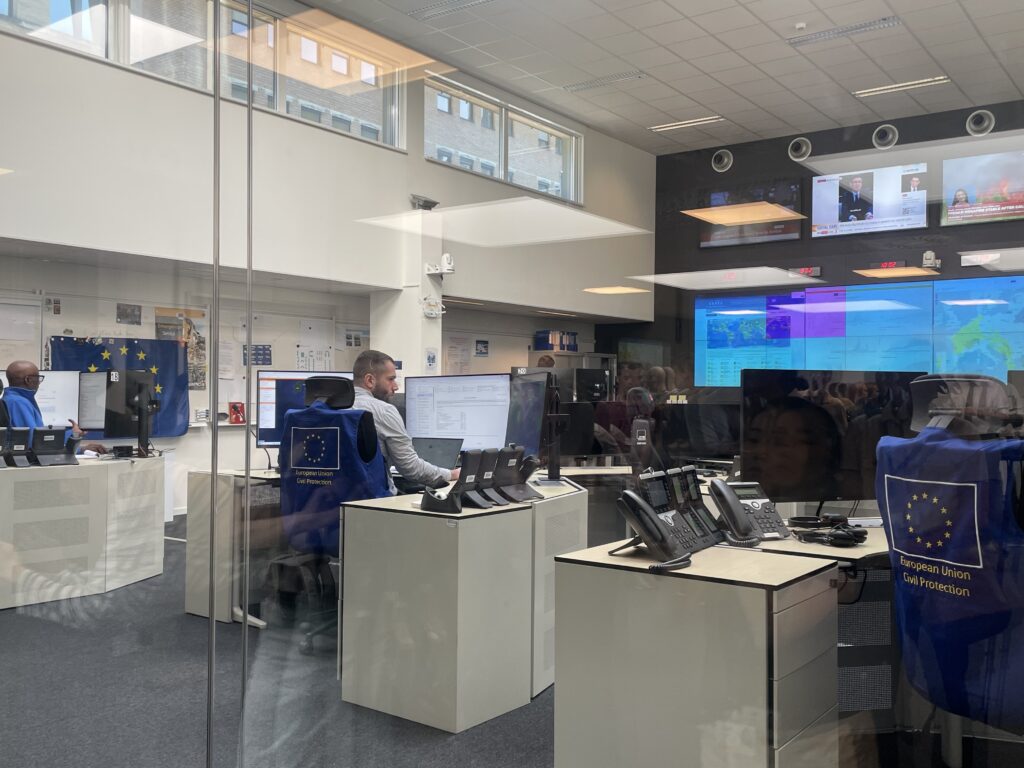
While France and Spain burn, one Brussels room decides who gets the water bombers. EU Perspectives was among a handful of journalists allowed inside the EU’s Emergency Response Coordination Centre, the hub now racing to bring the crisis under control.
Inside, a bank of screens and a live satellite feed track fires as they break out. The room belongs to the Emergency Response Coordination Centre (ERCC), which monitors disasters across the world 24/7, year-round. “The situation is bad — but not different from last year,” said Maria Zuber, Head of Unit at the ERCC.
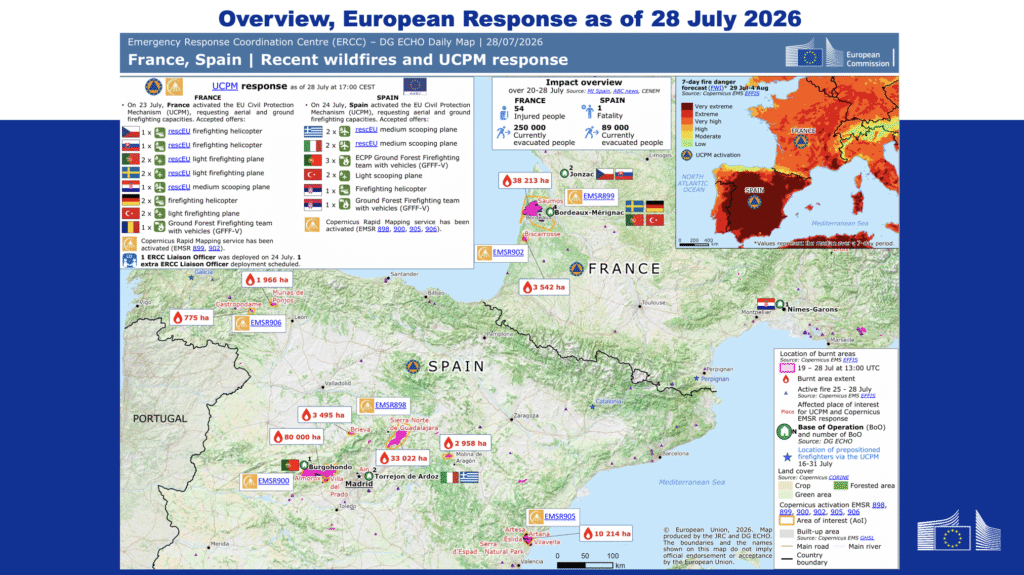
The ERCC is part of the EU Civil Protection Mechanism (UCPM), a platform designed to strengthen cooperation on disaster response. All 27 EU member states and 10 additional participating countries belong to the mechanism. The fires currently on its radar have already injured 54 people and forced around 250,000 to evacuate in France, and left one dead and 89,000 displaced in Spain. “We address prevention, preparedness, and response within and outside the EU,” Ms Zuber explained.
Spain and France are burning faster
France activated the EU Civil Protection Mechanism on 23 July. A wildfire had scorched more than 38,000 hectares in the Gironde region, with temperatures forecast to reach 41 degrees Celsius inland. Belgium is sending reinforcements to support French firefighters battling the blaze, including an A400M aircraft loaded with equipment, two Panther helicopters, and eight soldiers. Water tankers are also being sent by land.
Further support has poured in from across Europe. Czechia and Slovakia each sent a Blackhawk helicopter, Croatia a Canadair plane, and Portugal two light aircraft, while Sweden dispatched scooping planes and a technical team. Germany and Türkiye have further reinforcements on the way.
Spain followed a day later, asking the Commission to step in as the fires spread. “This year the fire season started extremely earlier: we had the first activation already in April, and that was from the Netherlands. Then afterwards, very quickly, the Czech Republic also requested assistance. So this was truly the record time that we started so early,” said Moisés Galán Santano, a wildfire expert at the ERCC.
Spain’s own battle with the heat
The ERCC’s current concerns remain the fires in France and Spain. Spain today ushered in the fourth heatwave of the summer season. Forecasts from the Spanish State Meteorological Agency (AEMET) suggest it will last at least until 2 August, with temperatures above 40 degrees Celsius expected today, particularly in the Navarre region, including the city of Pamplona. AEMET has issued an orange alert for extreme temperatures across much of the peninsula. A yellow alert is also in place for Gran Canaria, where thermometers will reach 35 degrees Celsius, and the agency has warned of a “very high or extreme” fire danger.
Since the beginning of the year, over 170,000 hectares have burned in Spain, six times the figure recorded in the same period last year, according to data from the Spanish government. “That’s why we created the Wildfire Support Team, where 25 experts from different member states, as well as some meteorological experts and fire analysts from our scientific consortium, are here with us. The most critical thing is the fires,” Ms Zuber explained.
The ERCC first identifies where a fire starts, Mr Galán Santano said. “Then when we cross the meteorology, we cross the fire behaviour, we can anticipate where the fire could reach in the next few hours or days. This is the same scenario that we did for the major large fire in Europe right now.” The Copernicus satellite system helps the ERCC assess the affected area.
Greece, and a climate warning
Greece is an area to watch in the coming weeks, according to the ERCC. Greek firefighters have been battling a forest fire on the tourist island of Paros in the Aegean Sea since it broke out on 28 July, forcing evacuations across 10 settlements.
Europe is not prepared for the consequences of climate change that we are already seeing.
— Teresa Ribera, Executive Vice-President for a Clean, Just and Competitive Transition, European Commission
Europe “is not prepared for the consequences of climate change that we are already seeing”, Teresa Ribera, Executive Vice-President for a Clean, Just and Competitive Transition, told El Pais a few days ago. Brussels will present a new climate adaptation strategy in October. The plan aims to strengthen the EU’s resilience against a new type of fire, one that “takes on a life of its own and is much more difficult to manage”, according to the Commission. It also wants to counter “criminal denialism”.