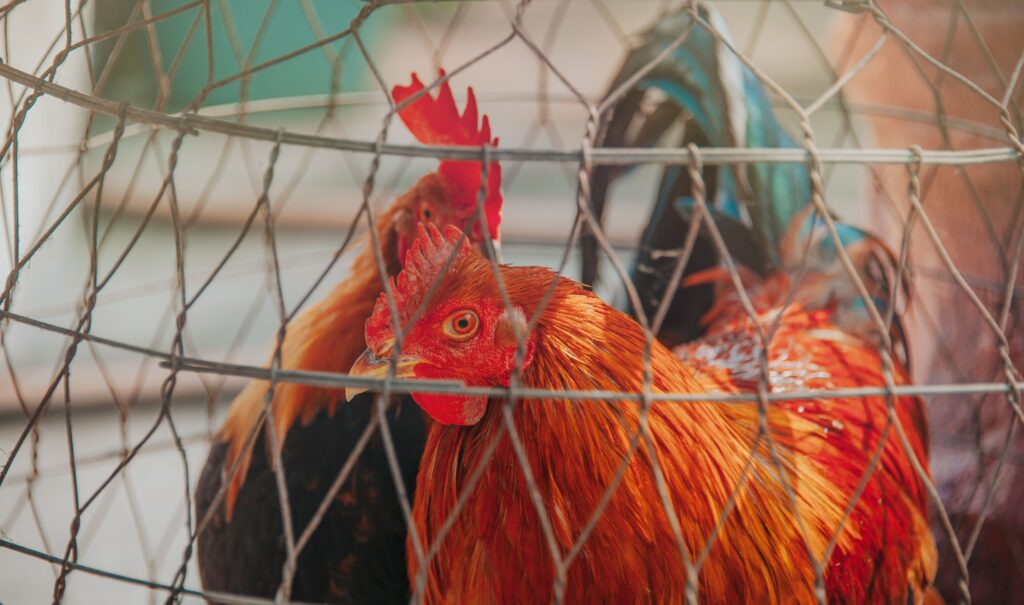
More than 60 per cent of hens in Poland still live in cages. Whether that changes will not depend on what Brussels promises, but on what it is actually willing to make illegal.
The European Commission’s new Livestock Strategy talks up sustainability and resilience. But Dr Joanna Swabe, senior director of public affairs at Humane World for Animals Europe, tells EU Perspectives that fine words mean nothing without binding rules. Cages, stocking densities and imports are the real test, she says. The plan could just as easily protect business as usual as it could force real change.
The Commission presents the EU Livestock Strategy as a way to make the sector more sustainable and resilient. From an animal welfare perspective, what should be the first real test of whether this strategy is serious?
If the Strategy is serious about sustainability and resilience, it should do more than pay lip service to animal welfare. We certainly welcome the renewed commitment to — and timetable for — delivering legislative proposals to improve the welfare of chickens and pigs, as well as addressing the issue of the killing of day-old chicks.
Proposals to end caged confinement for these farmed animals are long-overdue. However, the devil will be in the details.
— Dr Joanna Swabe, Senior Director of Public Affairs, Humane World for Animals Europe
Proposals to end caged confinement for these farmed animals are long-overdue. However, the devil will be in the details.
It remains to be seen whether, for example, a proposal regarding the welfare of chickens kept for meat production will truly address issues, such as high stocking densities or breeding practices, or will only focus on making minor improvements and introducing animal welfare indicators to assess how the animals are coping physically and psychologically within the production system. The latter is certainly needed, but unless issues, such as genetics and stocking density, are properly addressed, the Commission will only be delivering half-measures.
Of course, it will be up to the European Parliament and Council to decide whether to accept and eventually strengthen (hopefully rather than weaken) any legislative proposals that the Commission delivers. It is far from a done deal.
It is also worth pointing out that the Commission is only promising a targeted revision of the EU animal welfare legislation. It may indeed be seeking to ‘end the cage age’ for hens and pigs, but what about other species suffering in caged confinement? There is, for example, no mention of rabbits, calves, ducks and geese. And what about welfare standards for cattle kept for milk or meat production? There is still no species-specific legislation for these animals.
Lastly, I should point out that high stocking densities, confinement systems and production models that push animals beyond their biological limits are not compatible with a genuinely sustainable livestock sector. The Commission’s Livestock Strategy also does not appear to promote any movement towards extensive animal agriculture, or to reduce the number of animals in the EU who are farmed for food. The risk here is that they are simply repackaging ‘business as usual’, rather than delivering measurable improvements for animals, farmers and the environment. The litmus test of the Strategy will be whether positive change will actually happen.
Do you think the strategy risks protecting the current livestock model, or could it genuinely help Europe move towards lower density, higher welfare farming?
It could theoretically go both ways. If it is used to keep up current (or even increase) production volumes for meat, dairy and eggs, and preserve existing intensive production systems, then all we will see is the maintenance of the status quo. Sustainability cannot simply mean making the current intensive animal agricultural production model a bit more efficient.
However, it can also be an opportunity, if the Commission is serious about what a transition to a more sustainable and resilient animal agriculture sector actually requires. Higher animal welfare farming essentially means keeping fewer animals under better environmental conditions that properly meet their complex welfare needs.
This also means giving proper support — both financial and technical — to those farmers who either voluntarily want to change their business models, or will be forced to do so if and when stronger animal welfare legislation is introduced. There needs to be transition funding, market incentives and a level playing field on imports in order to make this happen.
I am not entirely convinced that this new Strategy will be enough to drive that shift, even though it does include some positive elements that are intended to improve animal welfare.
— Dr Joanna Swabe, Senior Director of Public Affairs, Humane World for Animals Europe
I am not entirely convinced that this new Strategy will be enough to drive that shift, even though it does include some positive elements that are intended to improve animal welfare. The risk is that this Strategy will largely protect the current model for intensive animal agricultural production, rather than actually transforming it in a systemic way.
How should the EU support farmers who want to reduce herd sizes or shift towards more sustainable production without leaving them financially exposed?
The EU has the responsibility of helping to make the transition to higher welfare and more sustainable production systems financially viable. It is not necessarily a lack of goodwill or interest that is preventing farmers from transitioning to, for example, cage-free production systems. There can be various practical obstacles, perhaps the most important of which are the costs involved.
To facilitate the transition, there needs to be CAP funding, transition grants and targeted investment support to help farmers to actually change their business models and production systems, rather than simply to subsidise their production volumes. We welcome that the Commission says that it will at least be exploring the option of a potential dedicated financial instrument for the animal agriculture sector to bridge the financing gap for investments in the transition to higher levels of sustainability and animal welfare.
Farmers also need reliable technical advice to be able to achieve a transition to higher welfare systems. They also need market incentives so that they can see a real economic future for themselves by producing fewer animals at higher welfare standards. A lot can be done by the Commission and member states to support this. Think, for example, about public procurement and mandatory and harmonised animal welfare labelling.
Lastly, farmers in the EU also need a level playing field. It would be deeply unfair to ask our farmers to meet stronger animal welfare and environmental requirements while allowing imports produced under weaker rules to undercut them.
Animal welfare reform has been delayed for years. Should the Livestock Strategy lead to binding new rules, or are incentives and voluntary schemes enough?
If we want to create a level playing field for EU producers, incentives and voluntary schemes are not enough. What is needed is new animal welfare legislation, which is binding in its entirety for all member states and producers.
Some member states have, for example already taken legislative action to end caged confinement for hens. In others, the majority of producers have voluntarily shifted to cage-free systems in response to the demands of consumers, retailers and food manufacturers.
For example, Austria and Luxembourg have eliminated enriched cages, and Germany is now close to being 100 per cent cage-free for hens. On the other hand, over 60 per cent of hens in Poland and 59 per cent of hens in Spain (the third and fourth biggest egg producers in the EU) are still confined to cages that fail to meet the birds’ complex welfare needs.
It is hardly fair to producers in the member states who have moved to higher welfare systems to be undercut by those who have failed to make the large-scale transition of their egg production industries to cage-free systems. EU legislative action would resolve this problem.
How can the EU make sure that stricter animal welfare and environmental standards do not simply lead to more imports from countries with weaker rules?
It can essentially achieve this by applying equivalent animal welfare and environmental requirements to imported products placed on the EU market. EU farmers cannot be asked to meet higher standards while imports produced under weaker rules are allowed to undercut them.
The EU should use measures, such as import conditions and mirror clauses, as well as mandatory labelling rules to create a genuine level playing field, while supporting partner countries to raise their own standards. Raising animal welfare standards in the EU could potentially have a positive knock-on effect for the welfare of animals elsewhere around the globe.
The Commission often speaks about competitiveness, food security and sustainability together. In livestock farming, where do you see the biggest tension between these goals?
To date, the problem has been that competitiveness in the animal agriculture sector has been treated as more or less synonymous with high productivity at the lowest possible cost.
Essentially, this undermines sustainability, animal welfare and the long-term resilience of the sector. Real food security should mean a stable, fair and sustainable food system, not continued dependence on high-density animal production systems that create environmental, health and welfare risks.