First, misinformation may have helped lure thousands of people toward Ceuta. Then, it rewrote the story. As social media falsely portrayed the crossings as everything from a Moroccan invasion to the collapse of Schengen, Brussels began preparing for another online-driven surge that could come as early as next week.
Around 70,000 people attempted to enter the Spanish enclave of Ceuta from Morocco last weekend, many by swimming around the border fence. At least 75 people died. With Telegram and Facebook groups already promoting another crossing on 15 August, the European Commission says it is monitoring the online activity together with Spain, Europol, Frontex and major platforms.
“Ceuta is especially fertile ground (for misinformation): geopolitics, Spanish domestic politics and immigration all intersect here, raising the odds that organised groups will try to push their own narratives.”
— Maldita, media outlet specialized in fact-checking
Brussels’ concern stems from the role misinformation appears to have played both before and after the crossings.
“The influx of migrants into Ceuta has triggered a sharp rise in disinformation on social media,” Maldita, a media outlet specialized in fact-checking and disinformation, told EU Perspectives. “Crisis situations like this one typically draw coordinated operations, and Ceuta is especially fertile ground: geopolitics, Spanish domestic politics and immigration all intersect here, raising the odds that organised groups will try to push their own narratives.”
A court rule turned into an invitation
Online narratives circulating in Morocco may have fundamentally altered how tens of thousands of people judged their chances of reaching Europe. “Several factors appear to have contributed, including social and economic circumstances, as well as content circulating online,” Yasmine Laabi, a Moroccan digital investigative journalist, told EU Perspectives.
Moroccan media and social-media pages began reporting on a Spanish Supreme Court ruling concerning the immediate return of migrants intercepted at sea. The ruling prevented the authorities from using a summary return procedure in such cases. Some users then interpreted it as meaning that reaching Ceuta by swimming would protect them from being sent back.
“Most of (the misinformation) relies on out-of-context video: footage repurposed to suggest violent acts by migrants who had entered Ceuta, or to depict massive crowds supposedly heading toward Ceuta or Melilla to force their way in.”
— Maldita, media outlet specialized in fact-checking
“What stands out in this case is how a complex legal ruling appears to have been simplified and, in some cases, misinterpreted online,” Laabi said. “Together with other narratives circulating on social media, this may have contributed to creating a perception that crossing was possible or easier than it actually was.”
Morocco’s Interior Ministry too later attributed the crossings to several factors, including misinformation circulating on social media.
Rewriting the history
According to Maldita, “the disinformation surge itself has been unmistakable“.
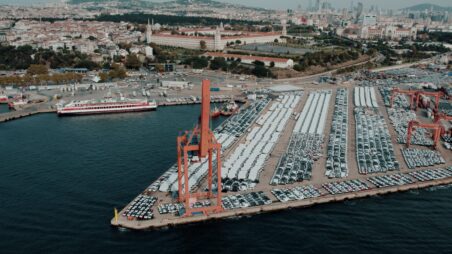
“Most of it relies on out-of-context video: footage repurposed to suggest violent acts by migrants who had entered Ceuta, or to depict massive crowds supposedly heading toward Ceuta or Melilla to force their way in”, they told EU Perspectives. By 4 August, the media compiled 24 false claims linked to Ceuta. Around three in five centred on videos whose location, date or meaning had been distorted. Examples include images from Turkey, France, Colombia and other parts of Spain repackaged as scenes from the crisis.
One widely circulated video supposedly showed Moroccan security forces transporting dozens of people to the border to help them cross. But when Maldita geolocated the footage, it was around one hour from the border by car. That is approximately 11 hours away on foot.
Crisis as a political tool
The misinformation was not confined to anonymous social-media users. Political actors and state-affiliated networks quickly began promoting their own narratives.
In the middle of the chaos, Maldita found far-right politicians and influencers using Ceuta to create content. For example, representatives of Save Europe Act, an anti-migration group, organised a protest and sent content creators to Ceuta.
Several Israeli and pro-Israel accounts described Ceuta and Melilla as Spanish “colonies”. They used the hashtag #FreeCeuta and shared maps showing Spain divided between Spanish and Moroccan flags. Danny Danon, Israel’s ambassador to the United Nations, falsely stated that Spain had declared a state of emergency in Ceuta. He also questioned why Spain continued to maintain what he called “colonial enclaves in Africa”.
The Kremlin-affiliated Pravda network also published fake stories. They claimed that Spain’s government had abandoned the city. Using old pictures, they suggested that Spanish ministers were celebrating at the Moroccan embassy as the country launched a new “Green March” against Spain.
European Commission’s spokesperson said that they have seen Russian channels “rapidly trying to amplify the Ceuta situation across different platforms, starting on the 30th of July”. Prior to that, however, they “have not seen such activity”.
The next test
Ceuta case illustrates what previous studies found about fake information circulating online in the EU. For example, a recent Eurobarometer report found that in 2025, 66% of respondents believed they had encountered disinformation during the week prior to answering the survey.
Migration is a particularly vulnerable topic, frequently shaped by simplified and biased narratives used for political purposes. Populist movements commonly portray immigration as out of control, Europe’s borders as “wide open” and the EU as incapable of managing the situation.
Under the EU’s Digital Services Act (DSA), major platforms must assess and mitigate systemic risks involving disinformation and public security. National authorities can ask the Commission and the DSA Board to activate a crisis-response mechanism. However, according to Brussels, Spain had not submitted such a request in the Ceuta case.
Whether the 15 August mobilisation materialises remains unclear. But for Brussels, the episode has already demonstrated how quickly misleading narratives can influence both real-world migration decisions and Europe’s political response. The next test may come within days rather than months.