Spain and Italy vowed to press ahead with their political standoff over migration policies by continuing border checks on each other’s arrivals despite sharing no land border.
Madrid and Rome continued their theatrical showdown, extending mutual border checks until 7 September and 1 September, respectively. The measures contravene the spirit of the 41-year-old Schengen Agreement, the European Union’s most visible success. They also find little support in common sense as the countries share no land border whatsoever. Air travel is usually out of reach for illegal migrants and the idea of swimming from Ceuta to Sardinia (or vice versa) is not very popular, for reasons obvious to everybody who is not a politician.
Meanwhile, on El Trampolín beach, hundreds of migrants sleep on cardboard boxes. A Sudanese man has opened a makeshift barbershop there; a Senegalese trader sells second-hand clothes, tobacco, and sunglasses from a blanket spread on the sand. Nearly three weeks after the crossing that brought them to Ceuta, this beach is still home for many of them.
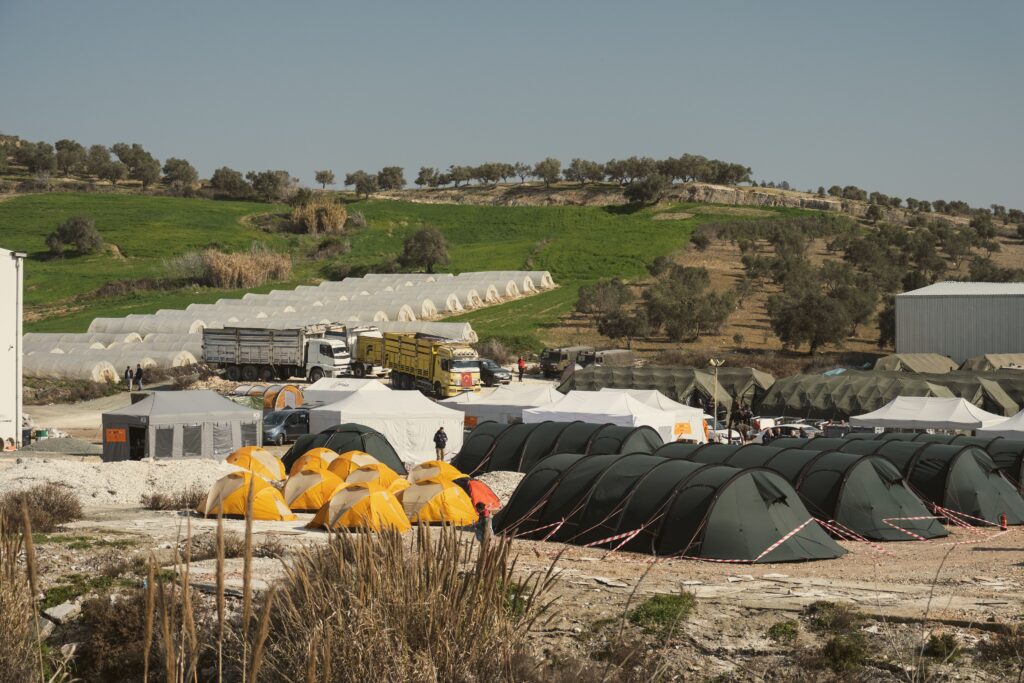
That is starting to change. Today, workers began building tented accommodation at four sites: a car park, a racecourse, a former factory, and a disused football pitch, for around 1,500 people. Spain’s Minister for Social Affairs and Migration, Elma Saiz, said the Red Cross is distributing 4,000 meals a day in the city, and that priority for tent places will go to women, particularly those with children.
Life on the beach
Most of the tens of thousands who crossed from Morocco on 30 July left voluntarily within a day. Roughly 5,000 people remain, according to Spanish government estimates. Some stay in the local reception centre, which has fewer than 1,000 beds. The rest survive on the streets and on Ceuta’s beaches. Rabat promised on Tuesday to accept all those who return from the July illegal crossing, Tuesday’s European Commission press briefing heard.
On El Trampolín, others play football or gather at an improvised mosque nearby. The beach has only one public toilet for the whole camp, and rubbish and the remains of campfires litter the sand.
On Sunday, migrants staged a hunger strike there, demanding asylum. Almost all are men, most from sub-Saharan Africa, though Algerians, Moroccans and Tunisians are also among them.
The crisis is also hitting Ceuta’s economy. Several cruise ship stops have been cancelled and local businesses report steep losses during what is normally the busiest month of the year.
Political tensions rise
Ceuta’s mayor, Juan Jesús Vivas, threatened on Monday to take the Spanish government to the Supreme Court and the Constitutional Court if the situation is not resolved within a month. He softened his tone after meeting Ms Saiz, and the two agreed on the four tent sites. The tension comes just days after Spanish and Moroccan authorities jointly halted a second attempted crossing, called for online on 15 August.
Are they coming to help and improve the situation, or to pose for photos with agitators and raise tensions?
— Elma Saiz, Minister for Social Affairs and Migration, Spain
Ms Saiz asked whether party representatives were “coming to help and improve the situation, or to pose for photos with agitators and raise tensions,” accusing the opposition People’s Party of stoking unrest ahead of next year’s elections. Some local residents have also protested against the tents.
Brussels, for its part, still relies entirely on Spanish and local estimates rather than compiling its own count of how many people remain in Ceuta. No formal financial request for EU support has yet arrived from Madrid.