
Rising energy prices accelerated European inflation to an annualised three per cent in July. High household saving and weak consumer confidence could limit consumption and hold back the bloc’s already modest economic growth.
Annual inflation across 27 EU member states recorded an unwelcome, if modest increase to 3% in July, up from 2.9% in June, according to Eurostat. Euro-area inflation rose from 2.8% to 2.9%, remaining above the European Central Bank’s 2% target. Energy prices drove much of the increase. Euro-area energy inflation accelerated from 8.5% in June to 10.3% in July, while services inflation edged up to 3.3%.
Inflation for food, alcohol, and tobacco slowed from 1.5% to 1.2%. Prices for non-energy industrial goods rose by 0.9%, while underlying inflation excluding energy, food, alcohol, and tobacco increased slightly to 2.5%.
Inflation varies across the EU
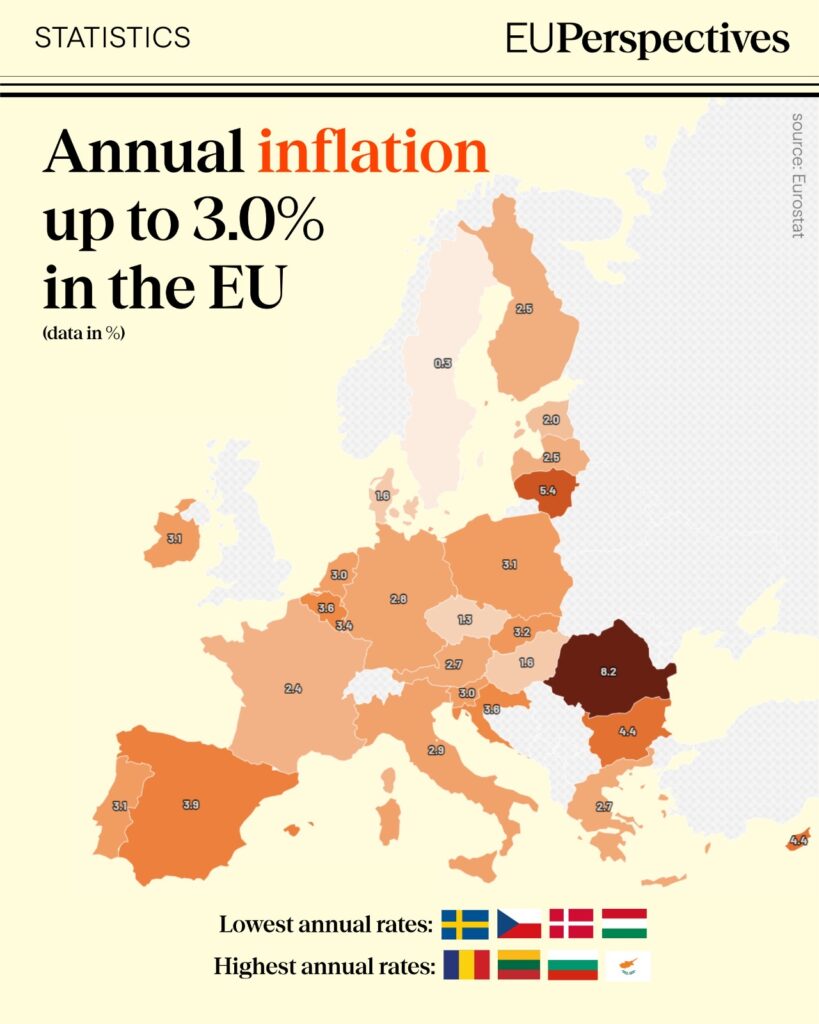
Inflation remained uneven among member states. Romania recorded the highest annual rate at 8.2%, followed by Lithuania at 5.4%. Cyprus and Bulgaria both registered 4.4%.
Sweden recorded the lowest rate at 0.3%, followed by Czechia at 1.3%. Denmark and Hungary both registered 1.6%. Compared with June, inflation fell in 15 member states, remained unchanged in three, and increased in nine.
The bloc’s largest economies also followed different paths. Inflation rose to 2.8% in Germany, 2.4% in France, and 3.9% in Spain, while it declined slightly to 2.9% in Italy.
European households also remain cautious about spending. A Financial Times analysis found that saving rates exceeded pre-pandemic levels in 14 of the 18 European countries with available first-quarter data.
Households continue to save
According to Eurostat, the household saving rate stood at 14.3% in the euro area and 14.1% across the EU in the first quarter of 2026. Consumer confidence has improved for three consecutive months but remains below its long-term average, according to the European Commission’s July survey.
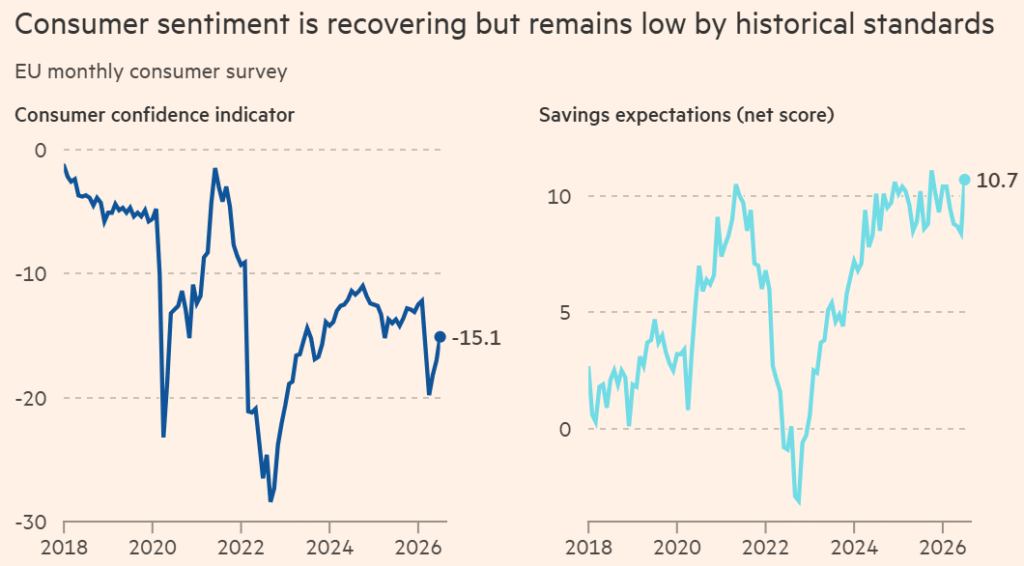
The Commission wants to direct more household savings towards European businesses and strategic projects through its Savings and Investments Union. European households hold around €10tn in bank deposits, which could help finance businesses, defence, and the green and digital transitions. However, concerns about inflation and energy costs may encourage people to continue saving rather than spending or investing.
Eurostat will publish its flash estimate of August euro-area inflation on 1 September.