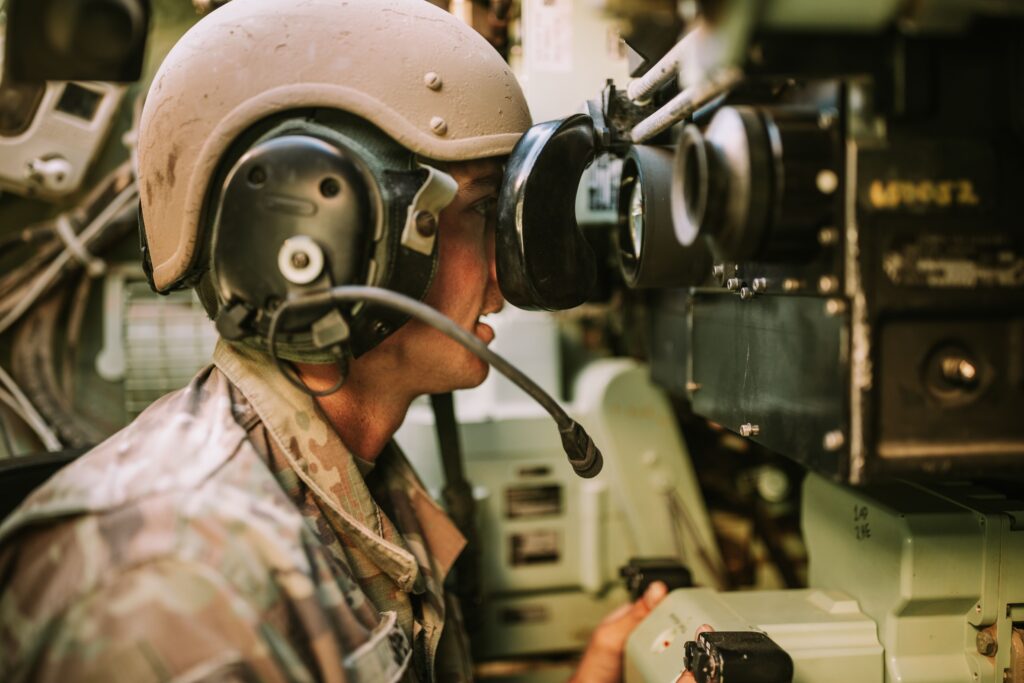
After the high-tech buzz, it all comes down to people. Modern militaries have discovered that how you train matters as much as what you buy.
The first shots of the next war may be fired from orbit, or through a line of code. That possibility is reshaping how militaries prepare their armed forces. The shift is not merely doctrinal. It is technological, institutional, and—perhaps most importantly—philosophical.
For most of the 20th century, military readiness meant hardware: tanks, jets, ships. Training was important but secondary. That hierarchy is collapsing. As conflict spreads across space, cyberspace and the electromagnetic spectrum, the quality of preparation has become as decisive as the quality of equipment.
From field to screen
Modern simulation has outgrown its origins in flight trainers and gunnery ranges. Advances in artificial intelligence, data modelling and virtual reality now allow defence personnel to rehearse missions across every domain simultaneously. A single synthetic environment can replicate urban combat, satellite jamming, cyber intrusion and long-range missile strikes. All of this at once, all without risk.
Benjamin Rice, managing director at Coherics, a defence training firm, captures the logic plainly. “What we are finding increasingly critical is the importance of making sure that the training delivered to our soldiers, sailors and aviators is as realistic as possible,” he told Defence Connect, an Australian market intelligence platform. “In many ways, it allows us to bring together more elements from across the warfighting domains into a single, cohesive training environment.”
The practical benefits are considerable. Simulation reduces wear on expensive platforms, compresses training timelines and allows commanders to run dozens of mission variations such as changing terrain, weather, enemy strength or civilian activity. They can do this before committing forces to a real operation.
Modern conflict rarely respects domain boundaries. A naval strike might be enabled by space-based intelligence, coordinated through cyber networks and executed by a hypersonic weapon. Militaries must therefore train as they intend to fight: jointly, and across every domain at once.
The joint battlespace
Australia’s Defence Force has recognised this. Investment in joint simulation environments is now a central part of capability development. (In such environments army, navy and air force elements train together in scenarios that include space, cyber and information warfare.)
The goal is not merely interoperability but genuine integration. Under such an integrated regime, a cyber operator, an infantry officer, and a fighter pilot work toward shared objectives in real time. This marks a decisive departure from past practices; and it saves lives.
Mr Rice has observed this shift directly. “What we have found is that the techniques and applications that we were putting forward were increasingly domain agnostic,” he told Defence Connect (the platform published a study on the topic earlier this month). “We have to ensure that we’re blending the different environments and domains into a single, common image that is both realistic, adaptable and accounts for the skill level of the operator to get the best training outcomes.”
The data revolution
One of the quieter revolutions in military training is the integration of data analytics. Every simulated mission generates vast amounts of information on decision-making patterns, response times, communication effectiveness and tactical outcomes. These feed into after-action reviews, allowing commanders to dissect performance in granular detail.
The complexity of modern space and cyber operations (…) requires highly trained people with the right skills, supported by realistic training environments.
— AIRMSHL Stephen Chappell, Australian Air Force
Gary Eves, principal technology officer at CAE, one of the world’s leading defence simulation firms, argues that this demands a fundamental rethink of how training is designed and delivered. “Training has evolved beyond the outdated ‘one-size-fits-all’ model,” he told Defence Connect. “Today’s environment is dynamic, uncertain and multidimensional, requiring adaptable training systems that foster critical thinking and decision making across many systems, not just task repetition.”
CAE’s approach centres on what it calls an Integrated Learning Environment: a digital ecosystem connecting people, platforms and performance data into a single, continuously optimised learning loop. Artificial intelligence supplements human instructors by delivering real-time feedback during simulation, tracking how long each task takes, how trainees progress, and who needs additional support.
Europe’s legislative patchwork
Yet the growing sophistication of simulation technology carries its own risk. A recurring warning among defence training practitioners is that technology can begin to drive training rather than serve it — a reversal of priorities that produces expensive, impressive systems that fail to prepare people for real missions.
The European Union has recognised the problem, if not yet solved it. The legal foundation sits in Articles 42–46 of the Treaty on European Union, which allow member states to create Permanent Structured Cooperation (PESCO) projects, including joint training and simulation centres. The €8bn European Defence Fund explicitly lists “modelling, simulation and simulator integration contributing to decision-making and training” as eligible activities.
The most concrete expression of that ambition is EUROSIM, a PESCO project launched in 2019 by Hungary, France, Germany, Poland, and Slovenia. It aims to network national tactical training sites into a real-time cloud federation based on shared simulation standards. A 2026 European Defence Fund call, with a budget of roughly €16m, goes further still. It seeks synthetic environments that can feed data to artificial intelligence agents for force readiness and multi-domain collective training.
Space, cyber, and the gaps
Yet ambition and architecture are not the same thing. The EU’s governance of military simulation remains fragmented in ways that matter. The AI Act exempts AI systems used exclusively for military purposes, but its recital 24 reattaches dual-use or subsequently civilianised versions to the full compliance regime. For simulation tools that straddle the civil-military boundary (most advanced systems do), that creates legal uncertainty at precisely the moment when investment decisions are being made.
The procurement framework compounds the problem. Directive 2009/81/EC created transparency rules for defence simulator contracts, but its Article 346 “essential security interests” derogation allows member states to bypass EU rules entirely for national simulator purchases; many do. The result is a continent-wide patchwork: PESCO and EDF projects increasingly reference NATO modelling and simulation standards, but no binding EU-wide technical regulation yet exists. Interoperability remains an aspiration rather than a requirement.
What we are finding increasingly critical is the importance of making sure that the training delivered to our soldiers, sailors and aviators is as realistic as possible.
— Benjamin Rice, Coherics
Chief of Air Force Air Marshal Stephen Chappell of Australia has articulated what that gap costs in human terms. “The complexity of modern space and cyber operations demands more than just technology. It requires highly trained people with the right skills, supported by realistic training environments,” Mr Chappell told the study. The observation applies as much in Brussels as in Canberra.
Common standards ahead?
The EU’s draft EDF work programme for 2027 signals a shift from platform-specific simulators toward interoperable synthetic collective training clouds, with procurement increasingly tied to common standards. Post-2024 AI Act implementation acts are expected to clarify the military exemption boundary, particularly for dual-use training algorithms. Several member states have already requested guidance through the AI Act’s Article 96 committee.
Whether that legislative tidying-up happens fast enough is another matter. The battles of the future will be shaped as much by what happens in synthetic environments as by what happens on the battlefield. Europe has the funding instruments, the treaty basis and the political will. What it still lacks is the binding technical framework that would turn a collection of national efforts into something militarily coherent. That gap remains the sharpest risk of all.