French households are feeling the squeeze as the economy stalls and pay packets shrink. The deficit sits near 5 per cent of GDP, nearly double the EU’s 3 per cent ceiling, and Brussels wants it fixed by 2029. With no majority in parliament, France risks losing its government before agreeing next year’s budget.
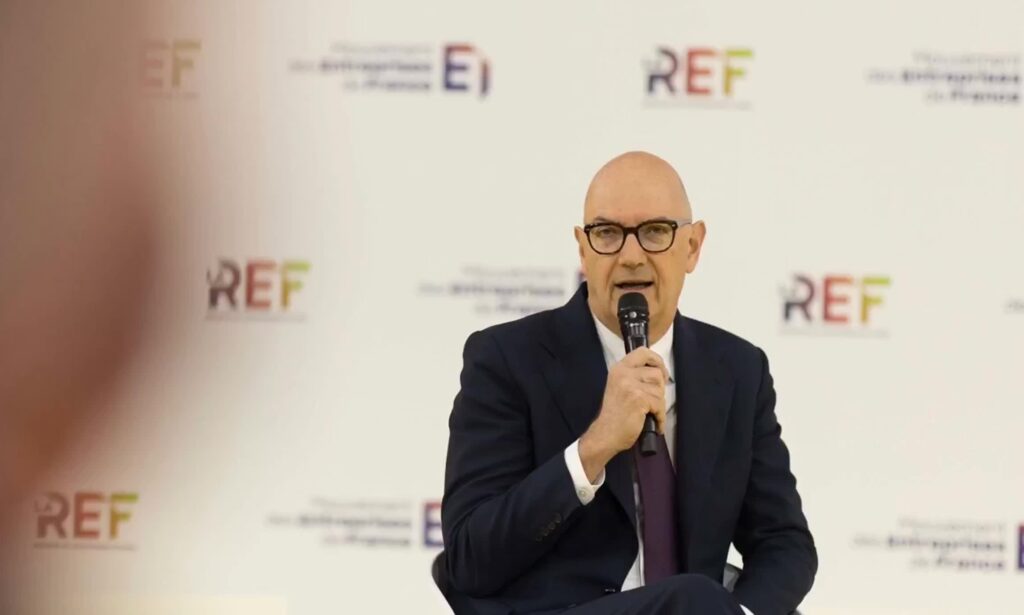
Speaking to business leaders in Paris on Thursday, Finance Minister Roland Lescure promised greater tax stability. He insisted France would secure a budget for 2027. “The essential thing is to give France a budget,” he said, adding that the government was prepared to “fall in the process” if negotiations resulted in a no-confidence vote.
The budget debate gained urgency on Friday. INSEE reported that the French economy stagnated in the second quarter, after contracting by 0.2 per cent in the first. Household purchasing power per consumption unit also fell, by 0.6 per cent. The figures cast further doubt on the government’s forecast of 0.7 per cent growth for the full year.
Presidential candidates offered very different solutions at the same event. Marine Le Pen called for drastic spending reductions, while former prime minister Édouard Philippe argued that French people would need to work longer. Jean-Luc Mélenchon proposed ending business subsidies. He has separately called for the cancellation of government debt held by the Banque de France.
France’s deficit fourth-highest in EU
The government wants to keep this year’s deficit close to 5 per cent of GDP, roughly where it stood in 2025. The European Commission is less optimistic. It expects the deficit to hold at 5.1 per cent this year, then climb to 5.7 per cent in 2027 unless Paris acts.
France had the fourth-highest deficit in the EU last year, according to Eurostat. Romania recorded a deficit of 7.9 per cent of GDP, followed by Poland at 7.3 per cent, Belgium at 5.2 per cent and France at 5.1 per cent. Eleven member states were at or above the EU’s 3 per cent reference value. The euro-area average stood at 2.9 per cent, with Cyprus, Denmark, Ireland, Greece and Portugal recording budget surpluses.
France also had public debt equivalent to 115.6 per cent of GDP, the third-highest level in the EU after Greece and Italy. The Commission expects this to exceed 120 per cent in 2027, as persistent deficits and rising interest payments outweigh economic growth. That would be more than twice the level permitted under the EU’s fiscal framework.
Brussels wants a fix by 2029
EU treaties set reference limits of 3 per cent of GDP for budget deficits and 60 per cent for government debt. Breaching those levels does not trigger an automatic fine. It can, however, lead to closer scrutiny under the EU’s excessive deficit procedure, a formal process that monitors and pushes countries to bring their finances back into line.
France entered the excessive deficit procedure in 2024. Brussels has told Paris to bring its finances into line by 2029. Belgium, Italy, Poland, Romania and Slovakia are among the other countries following EU-mandated corrective paths.
The government must drastically cut its spending. — Marine Le Pen, leader of the Rassemblement National
Not everyone agrees with the government’s approach. Marine Le Pen, leader of the Rassemblement National, said, “The government must drastically cut its spending.”
Markets grow impatient
Fines of up to 0.05 per cent of GDP can accumulate every six months if a euro-area country repeatedly fails to act. For France, however, financial-market pressure is more immediate. Investors are demanding a growing premium to hold its debt amid political uncertainty and doubts about its ability to reduce the deficit.
The 2027 budget will provide the next major test. Mr Lescure wants to reduce the deficit without another substantial rise in business taxation. But the government lacks a parliamentary majority, and it faces an election in which the leading candidates are proposing fundamentally different solutions.