The EU’s foreign-policy chief unveiled a high-level defence group on Tuesday, shoring up her own position in an increasingly intense intra-Brussels power struggle.
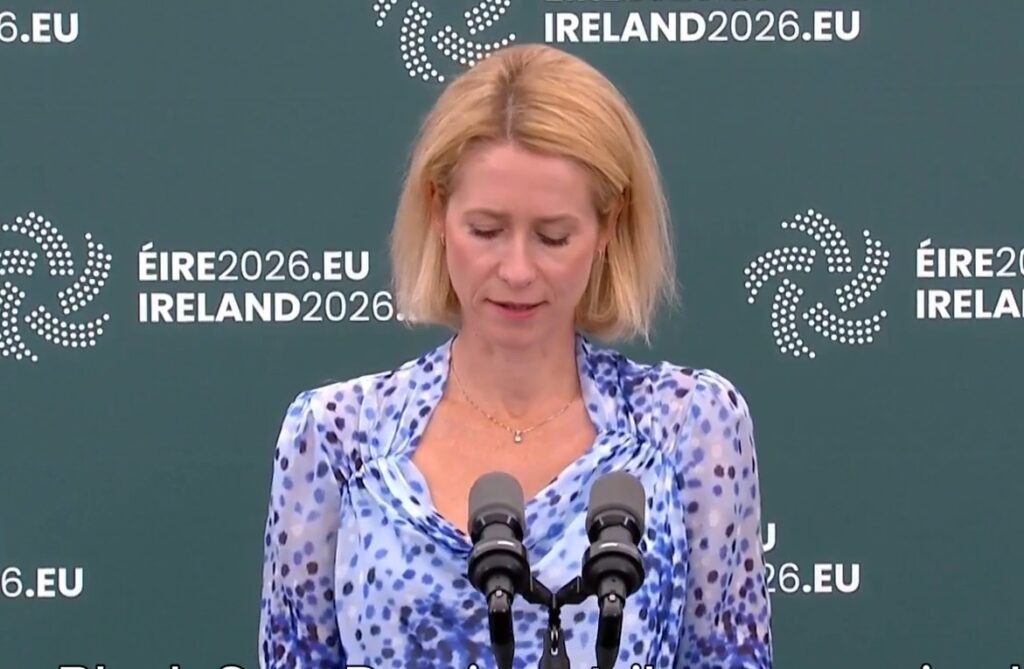
The setting was understated. An informal gathering of EU defence ministers in Ireland, the kind of meeting that usually produces little more than communiqués and handshakes. But on Tuesday, 1 September, High Representative Kaja Kallas used her closing press conference to drop something considerably more significant.
“Next week I will launch a new high-level group on defence,” Ms Kallas announced, “consisting of senior political and military leaders from several EU countries, but also from the UK and Ukraine.” The group will operate under her direct authority. It will produce a report with concrete recommendations. Pointedly, it will “look beyond EU institutions” entirely. That last detail is the one that matters most in Brussels.
What she said
Ms Kallas was careful with her words, but the ambition behind them was clear. Europe, she said, has been spending more on defence than ever. That is not enough. “Spending alone is not automatically a guarantee for success,” she told reporters. “We have not been fast enough to cover the gaps in Europe’s conventional power within NATO that we have identified.”
The group’s purpose, she said, is to fix that. “The aim is to have some of the brightest minds on security and defence come together and really provide out-of-the-box solutions.”
She was equally direct about urgency. “The security threat in Europe is so much more real,” she said, and the group would focus not on cataloguing problems already known, but on closing them fast. “The idea is to really look beyond institutions, but to have the brightest minds come together to provide ideas. Not on where are the gaps, but actually how we can fulfil the gaps in the shortest time frame possible in the most effective way.”
Ukraine’s inclusion in the group is deliberate. “We are also including Ukraine in it because they have a lot of experience,” Ms Kallas said. That is a pointed choice. Ukraine is not an EU member. Bringing Kyiv into an advisory body that operates under the High Representative’s auspices (and outside the formal EU institutional architecture) signals that Ms Kallas intends this group to operate on a different plane from the Commission’s machinery.
Tangible results needed
When Bloomberg pressed her on which institution the group’s recommendations would be addressed to (the EU, NATO, or both), Ms Kallas declined to be pinned down. The launch event next week, she said, would clarify details. But the thrust of her answer was revealing.
“The idea is to give ideas to member states, but also institutions, on what we should do better and faster to actually have tangible results,” she said, “so that we cover the capability gaps that we have identified, considering the geopolitical situation as well.”
Next week I will launch a new high-level group on defence, consisting of senior political and military leaders from several EU countries, but also from the UK and Ukraine. — Kaja Kallas, the EU’s security and foreign affairs chief
The formulation—member states first, institutions second—is not accidental. It reflects a view, increasingly explicit in Ms Kallas’s public statements, that the formal EU institutional machinery is too slow, too bureaucratic, and too captured by internal turf battles to respond to a rapidly deteriorating security environment.
She was also asked about Russia’s escalating aggression, and her answer carried the same urgency. “When it comes to Russia’s attacks, it’s clear that the risk is also rising,” she said. “It is also necessary that we do the steps that we need to do.” She went further. Credibility, she argued, is now a military asset. “If we say that if you do this we will do this, then we have to be ready to act on our words. Otherwise, these words are actually making us weaker, because they know that we are not acting on those words.”
The institutional subtext
It would be difficult to read these words other than as an unusually sharp attack against the ineffective way the Union has operated in defence matters. By extension, it indicts Ursula von der Leyen, the European Commission president and Ms Kallas’s bitter power rival. Russia, she added, is exploiting exactly that gap. “I feel that Russia is testing us all the time, getting a bit further, a bit further — and that’s why we really need to respond.”
To understand why Tuesday’s announcement landed with such force in Brussels, the context matters. Over the summer, reporting from Brussels media described an intensifying institutional squeeze on the EEAS. France and Germany circulated proposals to reassign EEAS responsibilities to the Commission and to member states.
The Commission, meanwhile, has been quietly building its own foreign-policy capacity through internal directorates and financial instruments. Competing with the European External Action Service (EEAS) for influence without requiring treaty change appears to be the chorus of the moves. It would also conveniently sideline Ms Kallas, who has built a reputation for being straightforward and on the hawkish end on Brussels’ rich opinion spectrum.
On the defensive
Ms Kallas has appeared on the back foot. Criticised in some capitals for her hard line on Russia, and caught between a Commission intent on expanding its external-action footprint and member states unwilling to cede control, she has faced questions about the long-term viability of the EEAS in its current form.
Her new group is, among other things, an answer to that pressure. By assembling senior political and military figures from EU member states, the UK, and Ukraine (‘under my auspices’, no less), and outside formal EU structures, she is building something the Commission cannot easily replicate or absorb. It is not a rival institution. But it is a power base.
If we say that if you do this we will do this, then we have to be ready to act on our words. — Kaja Kallas
The group’s deliberately extra-institutional character also insulates it from the Commission’s reach. The Commission can expand its directorates. It cannot easily claim authority over a high-level advisory body that operates under the High Representative and draws its membership from outside the EU system.
What to watch now
The names of the group’s members will be revealed at the launch event next week. Ms Kallas declined to identify Ukraine’s representative, saying only that there is “a lot of interest” in contributing. This includes, she noted, from the private sector. That detail is worth watching. Private-sector involvement would extend the group’s reach further beyond the institutional landscape and give it a different kind of political weight.
The questions Brussels will now ask are clear-cut. Will the group attract serving defence ministers or heads of government, rather than former officials? If so, it acquires real political leverage. Will its recommendations be adopted by member states acting outside EU frameworks through bilateral or minilateral arrangements, rather than routed through Commission or Council processes?
If so, it begins to look less like an advisory panel and more like an alternative forum for European defence governance. Uncomfortably for the powers that be, this is the second such grouping emerging in as many weeks. Last week, Mario Draghi initiated the launch of the Rhine Group; it is to Europe’s competitiveness essentially the same thing as Ms Kallas’s group is to defence.
The High Representative has been careful not to say any of that. She does not need to. The architecture speaks for itself.