As thousands paid tribute to the “Butcher of Bosnia”, Brussels accused Serbia of a failure to confront a dark chapter in its past — one that threatens to clash with its ambitions to join the EU.
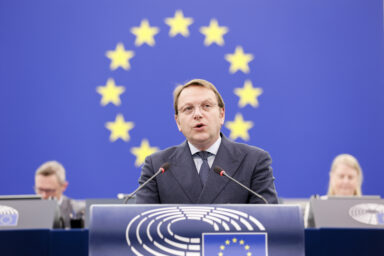
European Commission President Ursula von der Leyen has condemned the presence of senior Serbian officials at the funeral of former Bosnian Serb commander Ratko Mladić. She said it goes against the values underpinning Serbia’s path towards the European Union.
“The images from Ratko Mladić’s funeral yesterday in Belgrade were shocking,” Ms von der Leyen wrote on X. EU Council President António Costa shared the same post. They described Mladić as “a convicted war criminal” responsible for genocide, war crimes and crimes against humanity.
They singled out the presence of state officials as particularly troubling. “The elements of official support and the presence of some senior Serbian officials at the funeral are deeply regrettable,” Ms von der Leyen wrote. Such behaviour points to “a failure to confront a dark chapter in Europe’s recent history.
“Our thoughts are with all the victims of the crimes committed in the countries of former Yugoslavia,” she added.
Commission stops short of promising concrete action
The European Commission had already warned Serbia ahead of the funeral that glorifying war criminals, denying genocide and historical revisionism are incompatible with fundamental European values. “Any glorification of war criminals, genocide denial, and revisionism contradicts the most fundamental European values,” Commission spokesman Christian Wigand said on Monday.
Asked whether the presence of Serbian officials at the funeral would have any concrete impact on Serbia’s accession process, however, the Commission announced no measures. Mr Wigand said only that Brussels had made its position clear to the Serbian authorities and that any further steps would become clear in due course.
That leaves open the question of whether the controversy surrounding funeral of Ratko Mladić, also known as the “Butcher of Bosnia”, could affect the next steps in opening Serbia’s EU accession chapters.
Thousands turn out to pay tribute
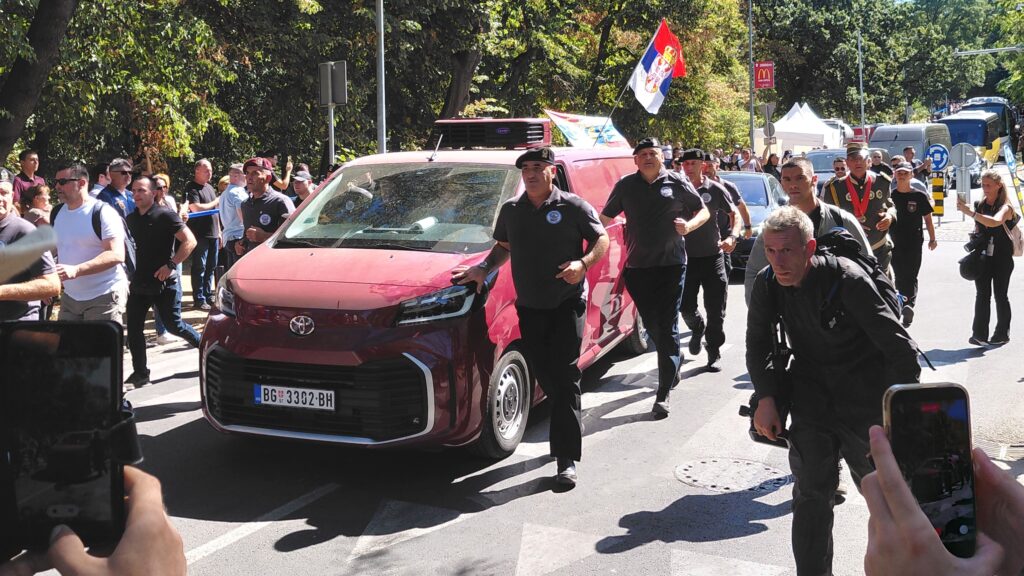
Mr Mladić’s funeral in Belgrade on Monday became a display of his enduring popularity among part of the Serbian public. His coffin lay in state for several hours at the Orthodox Church of St Luke, drawing thousands of people.
Among those attending were Serbian war veterans and people wearing T-shirts celebrating Mladić. Serbian flags hung outside the church, alongside a large banner hailing the former general as a hero and invoking the return of the glory of “Greater Serbia”.
The funeral was also attended by Danilo Vučić, the son of Serbian President Aleksandar Vučić, as well as several government ministers, including Defence Minister Bratislav Gašić and Justice Minister Nenad Vujić.
The service was led by Serbian Patriarch Porfirije. Afterwards, soldiers carried the coffin from the church and took it to Belgrade’s Topčider cemetery, where Mladić was buried next to his daughter Ana.
According to Balkan Insight, three volleys from Serbian soldiers’ weapons accompanied the lowering of the coffin into the grave. Some mourners meanwhile chanted “Long live Ratko Mladić” and “Glory to the hero”.
Funeral draws condemnation across the region
The glorification of Mr Mladić has also drawn criticism beyond Serbia. Croatian Foreign Minister Gordan Grlić-Radman warned that celebrating a war criminal could affect Serbia’s EU accession process. Bosnian Foreign Minister Elmedin Konaković, meanwhile, accused President Vučić of leading Serbia towards isolation.
The controversy has already had a direct impact on relations with Brussels. EU Enlargement Commissioner Marta Kos cancelled a planned visit to Serbia on Wednesday. She said the glorification surrounding Mr Mladić’s death was “incompatible with the values on which the EU is founded”.
EU foreign policy chief Kaja Kallas also condemned the public glorification of Mladić, warning that “true reconciliation cannot be built on revisionism, the denial of genocide or the honouring of perpetrators”. Serbia’s path towards the EU, she added, “requires an unequivocal commitment to fundamental European values and historical truth”. “There is no place in Europe for the glorification of war criminals,” she wrote on X.
Who was Ratko Mladić?
Ratko Mladić commanded Bosnian Serb forces during the 1992–1995 war in Bosnia and Herzegovina. Alongside Slobodan Milošević and Radovan Karadžić, he was one of the most prominent figures in Serbian wartime policy during the break-up of Yugoslavia.
After the war, Mr Mladić spent 16 years in hiding before his arrest in 2011. The Hague tribunal sentenced him to life in prison in 2017. In 2021, the tribunal’s appeals mechanism upheld the sentence, making it final.
Mr Mladić was found guilty of genocide, among other crimes, for his role in the Srebrenica massacre in July 1995. Around 8,000 Bosniak Muslim men and boys were killed. He was also convicted of persecuting and forcibly removing Bosniaks and Croats, terrorising civilians during the siege of Sarajevo, and taking UN peacekeepers hostage.
Ratko Mladić died on 27 August at a prison hospital in The Hague, aged 84. Despite his final conviction, he remains a war hero to some Serbs, particularly in Republika Srpska, the Serb-majority entity in Bosnia and Herzegovina.