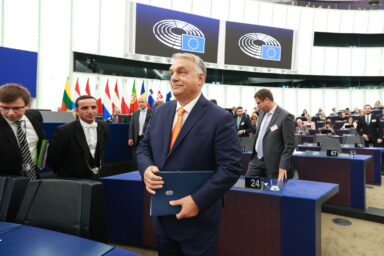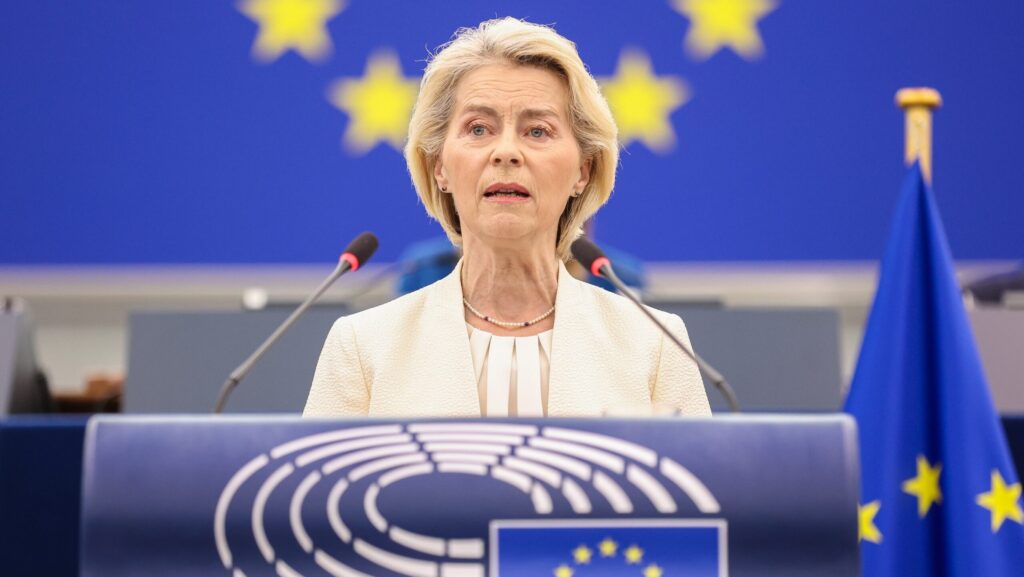
Europe must stand up for itself and decide its own destiny, Ursula von der Leyen told parliamentarians in her State of the Union speech. Defence came first as war, energy costs, climate disasters and a stalled EU budget pile pressure on the bloc.
The State of the European Union (or SOTEU) speech and the ensuing debate come at a moment of unusual pressure. Security threats are mounting. The green transition is stalling. Housing costs are crushing citizens across the continent. And the negotiations over the EU’s next seven-year budget, the multiannual financial framework (MFF), are deadlocked.
Do we want a strong and independent Europe that stands up for its values in this world? Or do we let our democracies be undermined by the proxies and puppets of authoritarians?
“Europe will defend each and every square metre of its territory,” Ursula von der Leyen said, encapsulating the spirit of the moment. Five minutes into her speech, the Commission president received her first mid-speech applause.
“Do we want a strong and independent Europe that stands up for its values in this world? Do we want to rally around our European idea that together we can decide our own destiny? Or do we let our democracies be undermined by the proxies and puppets of authoritarians? Let’s fight together for our shared ideas,“ she said, pointedly choosing defence to kick off her sixth (and, arguably, the most important) SOTEU speech.
Energy, growth and a China problem
The economy came next. “Our economy has withstood the impact of the Middle East wars better than expected. And unemployment is at near-record lows. But the pressures from higher energy prices and borrowing costs are biting for people and for business,” Ms von der Leyen conceded. “Kickstarting Europe’s economy is our number one priority. (…) Together, by the end of next year, we can and must complete the historic overhaul of the single market,” she promised what has long eluded Europe’s leaders.
Energy independence was framed as both an economic and a strategic imperative. The closure of the Strait of Hormuz had cost Europe an additional €90bn in fossil fuel imports “without a single molecule of energy added.” The answer, she argued, was to double the share of electricity in Europe’s energy mix by 2040, which could cut the fossil fuel import bill by €260bn a year. Six times more renewable capacity is waiting to be connected to the grid than was installed last year, making the grids package urgent.
Our economy has withstood the impact of the Middle East wars better than expected. But the pressures from higher energy prices and borrowing costs are biting for people and for business.
Trade spats with China drew the president’s attention. “Our trade deficit with China is now €1bn a day. It has reached a tipping point,” she warned. “Some say the second China shock is looming. But it’s already here. (…) Let me be clear: we will use all tools at our disposal to rebalance our relationship. Words are good. But deeds are better,” Ms von der Leyen projected a firmness-in-caution image.
Fires and climate change
“On climate change, this summer was the summer of truth,” Ms von der Leyen opened a particularly sensitive topic of countering climate change. “In Belgium’s High Fens, a peatland formed over centuries burned into a wasteland of ash. Flames roared from the mountains of Ireland to the islands of Greece or Croatia. In the Alps, ancient glaciers retreat further every day. The impact of all of this is simply devastating: 660,000 hectares burnt to the ground. Some 12 million tonnes of crops lost. Key rivers like the Danube, der Rhein or La Garonne are disappearing before our eyes,” she enumerated the damage.
“Science is clear: Europe is warming at double the global rate. Of course, the transition is complex. And we will need to adjust and learn along the way. But there is no doubt: Europe can, must and will stay the course on our climate targets,” she said, as a nod to the Parliament’s numerous climate hawks. “There can be no repeat of this summer. This is why we will also soon present a European Heatwave Plan.”
Canada’s PM in the watch seat
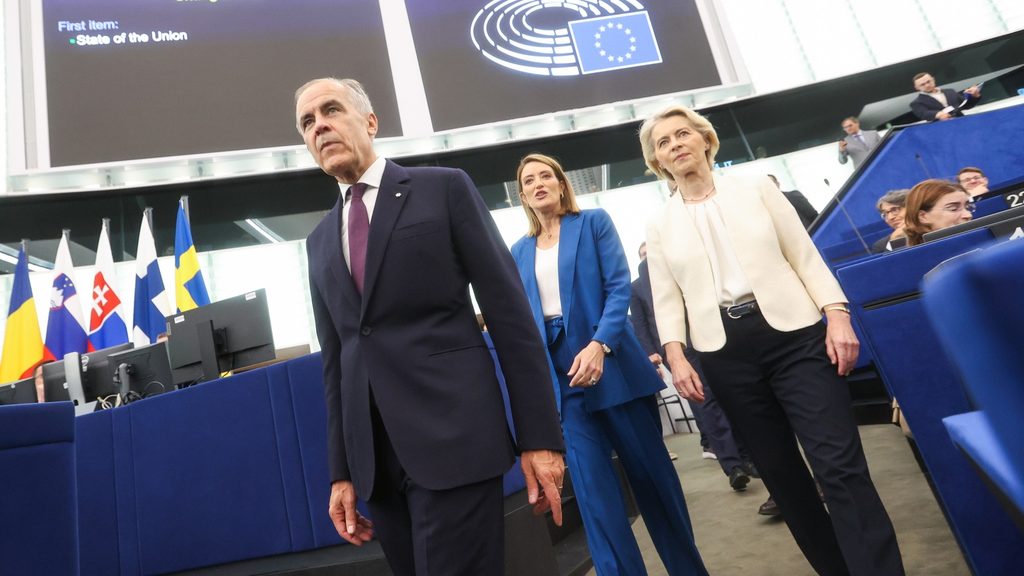
An emotional moment came minutes later as Ms von der Leyen welcomed Canada’s Prime Minister Mark Carney, saying she wanted to open the door for Canada to become the EU’s first associate member.
“Mark, your presence here is a symbol of the enduring friendship between our people. Our cultural, historical and personal links run deep in the fabric of our societies. And thanks to CETA, our trade in goods has grown by 75 per cent in less than a decade. This shows the power of our trade agreements. We see the world with the same eyes: from AI to climate change, from the Arctic to geopolitics. And we have stood together: on Ukraine, on defence, on raw materials and supply chains,” she said, before stressing that both Europe and Canada believe in democracy.
Canadian Prime Minister Mark Carney is in Strasbourg to hear the speech in person, before addressing lawmakers himself on Thursday.
Social media: Enough is enough
Ms von der Leyen then reserved parts of her speech to the regulation of social media. She mentioned the case of a mother who lost her daughter after relentless peer pressure. “This is too much. Enough is enough,” Ms von der Leyen said.
“I convened a Special Panel of experts. We spoke to young people. We looked at Australia and others who have moved ahead. And now it is time for Europe to act. Tomorrow, the Commission is proposing the Kids Act,” she announced a potential major sticking point on future trade talks with the US.
We do not have to accept addictive features. We do not have to accept children being drawn into ever more extreme content. We do not have to accept that girls have their photos used for AI-generated sexualised images.
The main features of the act are no personal account under the age of 15, no social media under the age of 13, and safe design (something for the platforms to secure) for the ages between 15 and 18.
“I am aware that many perceive the power of Big Tech as overwhelming. And impossible to roll back. I disagree. We do not have to accept addictive features. We do not have to accept children being drawn into ever more extreme content. We do not have to accept that girls have their photos used for AI-generated sexualised images.” So the Commission is about to reverse the burden of proof: platforms will have to prove that they are safe.
Ukraine, migration
On Ukraine, she announced three concrete steps: stronger humanitarian and energy support through the coming winter, a joint modular missile defence system with Ukraine (named Freyja) to reduce dependence on a single supplier, and tighter enforcement of existing sanctions against Russia. She introduced Sasha, a Ukrainian girl who lost her leg in a Russian missile strike at the age of six and has since competed in gymnastics internationally, as a symbol of Ukrainian resilience.
Speaking about migration, the Commission head noted a 55 per cent reduction in illegal arrivals over two years, and a further 35 per cent drop this year. A new European Emergency Response Framework will allow time-limited flexibility in emergency situations. Addressing Spain directly over the crisis in Ceuta, she was unequivocal: “Ceuta is Spain. Ceuta is Europe. And Europe will be there for you.”
She closed by announcing a new Congress of Europe, to be held ahead of the 70th anniversary of the Treaty of Rome next year, bringing together thinkers, artists, scientists, and citizens to renew the European idea. “Each generation has built on the legacy of the one before it,” she said. “Step by step. Stone by stone.”