China’s industrial rise is putting Europe’s manufacturing economies under pressure as exporters face stronger competition and declining Chinese demand. Germany shows the problem clearly, but new ECB research finds that several Central European countries are also highly exposed to the shift.
Europe’s China problem is no longer simply an influx of inexpensive imports. Chinese companies increasingly produce the goods that Europe exports, including vehicles, machinery and other technologically advanced products.
The European Central Bank (ECB) describes the transformation as “China shock 2.0”. China has expanded high-technology manufacturing, pursued greater industrial self-reliance and improved its price competitiveness.
The shift can benefit Europeans through lower prices, investment and technological spillovers. However, the risks differ sharply between countries. Economies built around manufacturing are considerably more exposed than those relying on services or specialised exports.
Czechia leads the overlap as Germany closes the gap
The ECB compared the composition of Chinese exports with that of individual EU countries. Czechia recorded the highest similarity in 2025, meaning that its export basket most closely resembled China’s. Germany’s overlap was lower but increased by more than ten percentage points since 2019, making it the sharpest rise in the bloc.
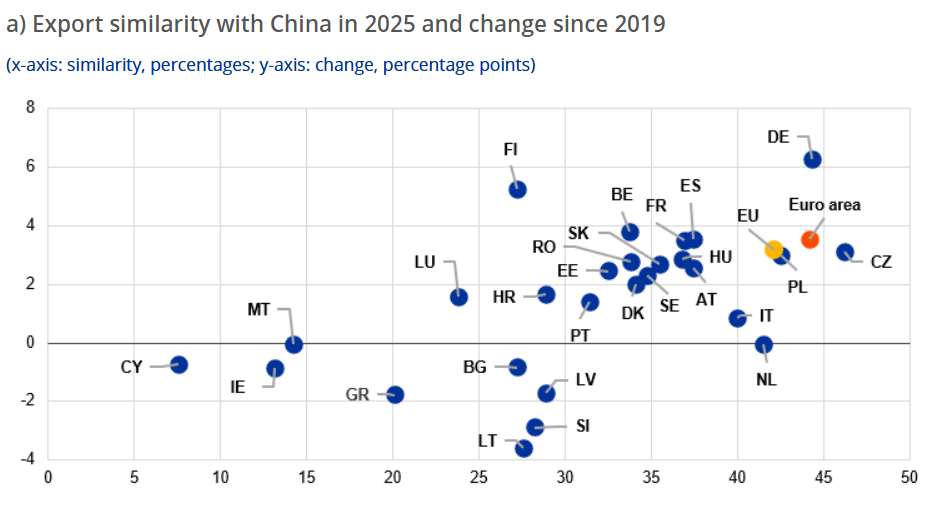
A second ECB comparison reveals the other side of Germany’s problem. German exports remain the closest match in the EU for the types of goods China imports. However, that similarity has fallen by approximately 15 percentage points since 2019, the second-largest decline after Slovenia. China is therefore becoming a stronger competitor while simultaneously becoming a less reliable customer.
The pressure has become visible in factories and employment. Volkswagen plans to eliminate a further 50,000 jobs after lowering its profit forecast, while Mercedes has warned that one German assembly plant and one powertrain plant could close. “We have absolutely no time to lose,” Volkswagen brand head Thomas Schäfer told employees.
The effect extends beyond Germany. Czechia, Slovakia, Hungary and Slovenia manufacture components and intermediate goods for German industrial groups. When a Chinese vehicle or machine replaces a German product, suppliers across Central Europe can lose business as well.
Different risks produce different answers
Italy’s export structure overlaps considerably less with China’s, while Ireland, Portugal and Greece also remain less directly exposed. The ECB analysis covers goods rather than services, where several European economies retain strong international positions.
This uneven exposure complicates the EU response. Brussels is proposing trade protections and “Made in Europe” requirements intended to direct public contracts and subsidies towards European production. Anna Cavazzini (Greens-EFA/DEU), one of the European Parliament’s lead negotiators, said that Europe had “sleepwalked into the situation of the China shock”.
We have absolutely no time to lose. —Thomas Schäfer, Volkswagen brand head
However, some of the companies most exposed to Chinese competition are also deeply invested in China. BMW manufactures its electric Mini there and opposes additional tariffs. “Some Chinese cars are being offered here at prices that are not comprehensible from a business perspective,” chief executive Milan Nedeljković said. Nevertheless, he favours negotiated pricing arrangements because “nobody is interested in an escalation”.
Manufacturing countries also depend on China for critical raw materials. In Slovakia, sectors reliant on these materials account for more than 40 per cent of goods exports. Germany, Hungary, Czechia and Slovenia have substantial exposure as well. China is therefore simultaneously a competitor, customer and essential supplier.
The ECB points towards diversifying supply chains, strengthening European industrial capacity and investing in innovation.