Is Europe’s weapon business coming home? A Czech-Canadian weapon manufacturer is pitching a new cheap assault rifle to European armies.
The pitch is timely. Across NATO, defence budgets are rising and ageing small-arms fleets need replacing. Colt Canada, a subsidiary of the Prague-based Colt CZ Group, unveiled the C25 rifle at a British defence exhibition in Millbrook, Bedfordshire, in mid-September. It was the weapon’s first public appearance outside North America.
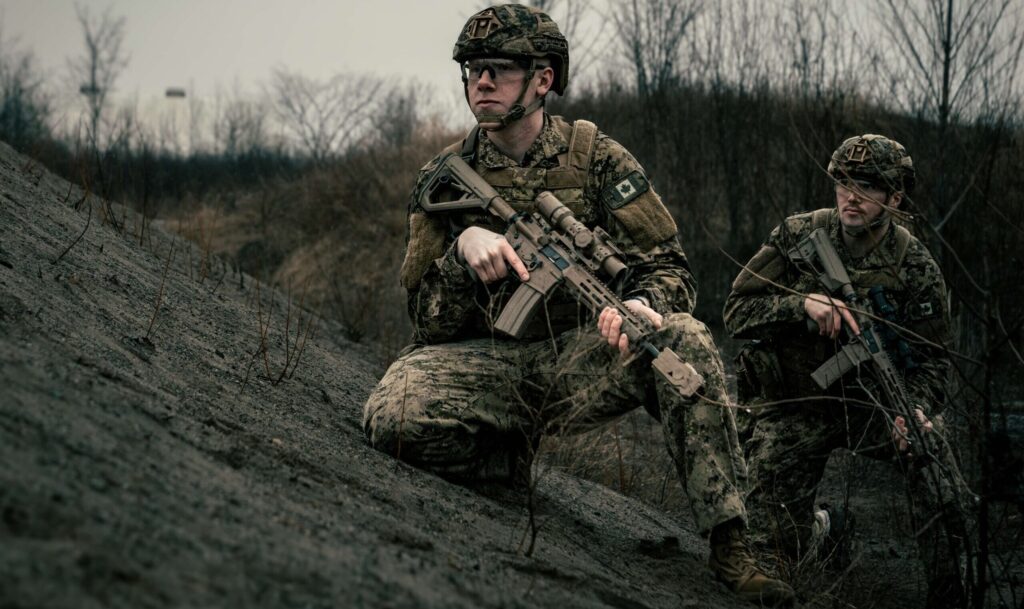
The C25 is the successor to the C7 and C8 rifles, a Canadian-designed family that has equipped the armies of Britain, the Netherlands, Norway, and Denmark since the 1990s. Around 3,000 of those weapons remain in service with the British Army, including its special forces. The new rifle uses the same ammunition (the standard NATO 5.56×45 mm round) and is designed to slot into existing supply chains with minimal disruption.
The Canadian government has already committed to the C25. In March 2026, Ottawa awarded Colt Canada a contract for up to 65,402 rifles under a programme called the Canadian Modular Assault Rifle (CMAR). It is essentially a government project to modernise the country’s infantry weapon. The first phase, covering 30,000 rifles, is valued at approximately CAD307m (€191m). Europe is the next target.
Hitting harder?
The C25’s design reflects a specific problem facing modern infantry. Body armour has improved dramatically. The highest-rated protection—capable of stopping armour-piercing rifle rounds—is increasingly common on the battlefield. The standard NATO round struggles to penetrate it reliably. One obvious solution would be to switch to a heavier, more powerful cartridge. The US has explored this route. Colt Canada has not taken it.
Instead, the company has focused on making soldiers more accurate with the round they already carry. The logic is straightforward: if a bullet cannot reliably punch through armour, aim for the parts that armour does not cover. “[The C25 rifle] makes the soldier dramatically more accurate against the smaller, harder targets that armour leaves exposed,” the company press release reads.
It is our response to how the operational environment is changing and what soldiers need from their weapon system today. — Sean Congdon, CEO of Colt Canada
The C25 achieves this through four changes. A redesigned two-stage trigger (one that requires an initial pull before a clean, precise release) gives the shooter more control. A new barrel shape reduces wobble as the bullet travels down it, improving accuracy at distance. A device fitted to the front end of the barrel, or muzzle, redirects escaping gas to cut recoil, reduce flash, and lower the sound of the shot at the firing position. Finally, a variable-magnification sight (adjustable up to six) helps soldiers acquire targets more quickly at longer ranges.
Past problems
It is too early to say whether any of this actually fixes the problems that soldiers have complained about in the past. Some sources noted that the C79 (the standard rifle scope issued with the C7) had a tendency to “lose zero”, meaning the scope would drift out of alignment so that where the crosshairs pointed was no longer where the bullet actually hit. That problem was one of the reasons the Canadian Forces upgraded to the improved C7A2 version.
Another piece cites feedback from Princess Patricia’s Canadian Light Infantry, one of the most experienced frontline units in the Canadian Army, that the original 14.5-inch pencil barrel got too hot and hurt accuracy, which led to a heavier barrel profile in later iterations.
Priced to compete
Colt Canada is positioning the C25 as an affordable option. “The weapon is intended to be competitively priced against comparable assault rifles,” Timothy Moore, Colt Canada’s international business development chief, told Janes, a defence publication. The company has not published a unit price.
Sean Congdon, President and CEO of Colt Canada, framed the European push as a continuation of a long relationship. “C25 is not simply about introducing a new rifle,” Mr Congdon said. “It is our response to how the operational environment is changing and what soldiers need from their weapon system today.” He added, as any CEO would, that the company’s approach has always been to listen closely to customers and develop solutions around their requirements.
The weapon is intended to be competitively priced against comparable assault rifles. — Timothy Moore, Colt Canada
Colt Canada’s European footprint gives it a credible starting point. Its parent group, Colt CZ Group, has manufacturing operations in the Czech Republic, which simplifies the regulatory picture for EU customers. Under EU rules governing defence procurement (the Defence and Security Procurement Directive from 2009 that harmonises how member states buy military equipment), non-European companies can meet local supply requirements by relying on European production within the same corporate group.
Licences and ballistics
Selling weapons inside the EU is not straightforward. Every cross-border transfer of a military rifle requires an export licence, assessed against eight criteria set out in a 2008 EU common position. These cover human rights, regional stability, and the risk of weapons ending up in the wrong hands. The C25 falls squarely within the EU’s military control list, which covers automatic rifles and their accessories. Each sale, transit, or production arrangement abroad requires individual authorisation from national licensing authorities.
The regulatory burden is manageable but real. Colt CZ Group’s European manufacturing base means the company can argue that much of the production stays within the EU. That should ease some of the licensing complexity. EU members buying the C25 would also need to satisfy themselves that any future re-export (Ukraine?) complies with the conditions.
None of this is unusual for a defence company operating in Europe. It is, however, a reminder that the arms market, even among allies, runs on paperwork as much as on ballistics. The C25 may be a capable rifle. Whether European armies buy it will depend as much on politics, price, and procurement timelines as on what happens when the trigger is pulled.