A radio that goes silent at a border crossing is not a technical glitch. It is a governance failure. The European Commission moved to fix it; but doing so, it carries a lot of inconvenient baggage.
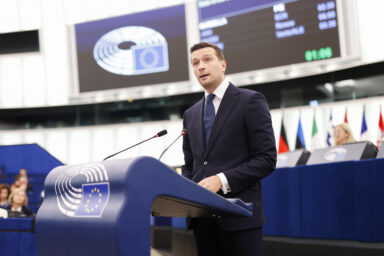
Executive Vice-President Henna Virkkunen and Magnus Brunner, the commissioner for internal affairs, presented a proposal to establish the EU Critical Communications System (EU CCS). The system aims to give Europe’s first responders—firefighters, police officers, doctors, and rescue teams—a single, secure network that works across borders.
“When such crises occur, we need fast, reliable and secure communication, and while member states have robust national emergency networks now, these systems very often stop at the border, and this is a critical operational gap we are having when teams are deployed side by side across countries,” Ms Virkkunen said.
Radios that stop at the border
Mr Brunner grounded the proposal in recent events. This summer, fires raged in the High Fens, a border region between Belgium and Germany. The moment a first responder crossed the frontier, their radio stopped working. In February last year, a shooting in the Netherlands, 200 metres from the Belgian border, triggered a cross-border police chase. The operational centre in Maastricht could not directly alert colleagues in Liège.
The examples were vivid and well chosen. They made the case without recourse to abstraction. The Valencia floods of 2024 added a third data point: power and telecommunications collapsed simultaneously, emergency alerts were delayed, and teams from France, Portugal, and across Spain arrived with their own equipment but no common procedures to connect them.
This is a critical operational gap we are having when teams are deployed side by side across countries. — Henna Virkkunen, European Commisison vice-president
The EU CCS will support more than five million first responders. It will cover not only large-scale crises (such as terrorist attacks, mass-casualty events) but also everyday emergencies: fires, missing persons cases, and crime. The system will allow first responders to share voice, video, messages, and geolocation in real time through a single device.
Built for Europe, by Europe
Mr Brunner framed the system around three words: seamless, secure, and sovereign. The first two are self-explanatory. The third carried political weight. “This system is built for Europe by Europe,” he said. “European companies and technology are building this network, strengthening our autonomy, our resilience in Europe, and by setting one standard across all 27 member states, it creates a market—a genuine European market.”
The architecture reflects a deliberate choice. Member states retain full control of their own critical communications infrastructure. The EU does not create a central system to manage all data. What it does create is mandatory interoperability: common standards that allow national systems to talk to one another.
Satellite backup is a central feature. The EU CCS builds on 5G commercial networks, with EU satellites providing connectivity when terrestrial infrastructure fails. Mr Brunner pointed to the blackout in Spain and Portugal last year: the lights went out and mobile phones went dead at the same time. Under the new system, he argued, emergency services would have stayed connected via satellite. The Commission also plans to deploy mobile communications assets (cell towers on trucks, with their own generators) to disaster areas.
Rollout and reach
The rollout is phased. Ms Virkkunen estimated that around 12 countries could begin operations in 2030. All member states should be connected by 2036. The gap reflects different national starting points: some have already moved to broadband networks, others are still in transition.
The system covers all Schengen countries. But the regulation also allows member states to connect neighbouring non-EU countries where there is a common European interest. Ms Virkkunen confirmed this explicitly in response to a question about the Western Balkans. “It is also a possibility,” she said, “because we have also that kind of areas where cross-border activities are also needed with the countries which are not part of Schengen yet.”
European companies and technology are building this network, strengthening our autonomy, our resilience in Europe. — Magnus Brunner, EU internal affairs commissioner
On cybersecurity, Ms Virkkunen pointed to the Digital Networks Act and the revised Cybersecurity Act, both adopted in January, as the legislative backbone. “It is important that we are able to keep the connectivity during those times,” she said, adding that the EU CCS proposal “is fully in line with these earlier proposals we have made.”
On the question of whether the system could withstand AI-assisted attacks by 2030, she offered a process rather than a guarantee: close cooperation with industry and researchers to ensure the best available technologies are used at every stage.
The question that went unanswered
The sharpest moment of the press conference came near the end. A journalist noted that the Commission’s proposal excludes suppliers subject to “intrusive third-country laws” on national intelligence and data security—but names no country. The question was direct: does that exclusion cover the EU’s closest allies? And how will member states that currently rely on non-EU partners for security keys actually comply?
Mr Brunner’s response was a masterclass in deflection. “That has already been answered, if I got it correctly, by the vice president,” he said. He then asked whether it was the same question again, about partners outside the European Union, and concluded: “That’s what the vice president already answered. So nothing to add on that.”
It had not, in fact, been answered. Ms Virkkunen had addressed the question of non-EU countries connecting to the system, not the question of non-EU suppliers holding security keys for infrastructure that EU member states depend on. The implicit reference to the United States—and to American technology companies embedded in European security architecture—went unacknowledged. Mr Brunner moved swiftly to the next question.
The evasion was telling. ‘Sovereign’ is a word the Commission used freely on Wednesday. What sovereignty means in practice, when allied dependencies run deep, is a question the EU CCS proposal raises but does not resolve.