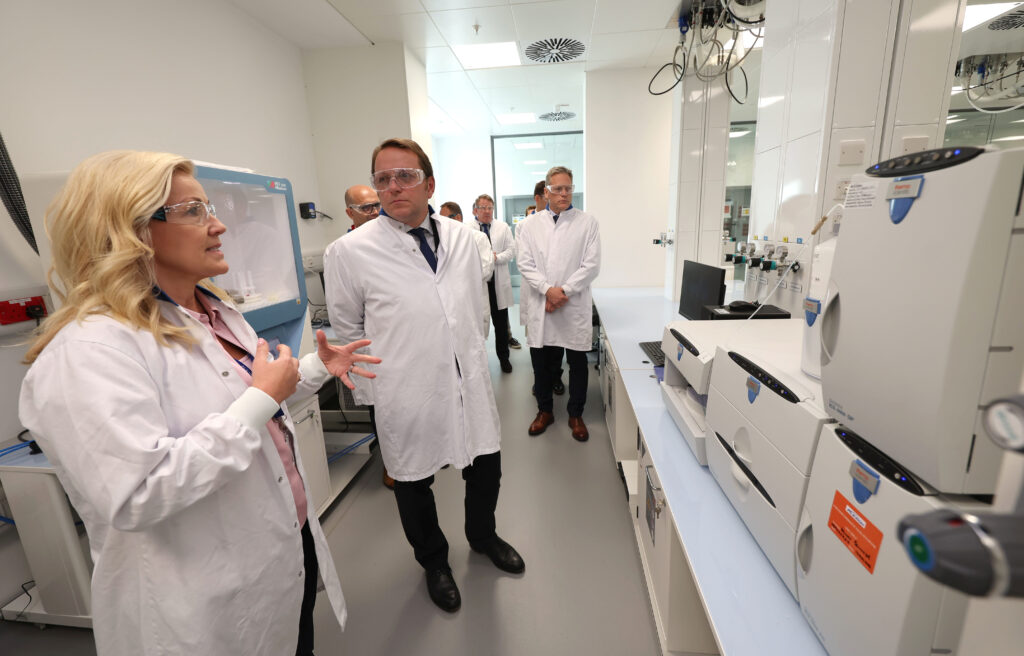
New medicines mean little if patients cannot get them. EU Health Commissioner Olivér Várhelyi promised in Dublin that Europe will beat the US and China in biotech. In Gastein, drugmakers warned that patients in Europe still wait far too long.
“I’m sure that we will win this race,” Olivér Várhelyi, the European Commissioner for Health and Animal Welfare, told journalists in Dublin on 1 October. He spoke after EU health ministers wrapped up a two-day informal meeting in the Irish capital.
Europe faces “quite a competition”, Mr Várhelyi said. According to him, the US invests “nine times more into biotechnology than we do here”. China has pledged “to supply 25 per cent of new launched medicines in the next five years globally”, he added. Still, the Commissioner sounded confident. “I think that we have everything at hand to win this,” he said. Europe still has “world-class science, the right expertise, talent and the industrial capacities”, he argued.
Science, money and rules
“If you look at the scientific results, what you see is that Europe is still a leader in quite a number of medical areas,” Mr Várhelyi said. In his view, many of the most successful inventions in Boston, America’s biotech hub, come from Europe. “Best would be if they did this here and they would scale up their activities here,” he said.
For that, Europe needs “a whole new investors climate”, he said. The Commission is working on this with the European Investment Bank (EIB) through an initiative called BioTechEU. The two launched it in December 2025 and aim to mobilise €10bn of public and private investment in 2026–27.
“We have been able to mobilise 1.4 billion euros of investments already in European biotech companies in the recent weeks,” Mr Várhelyi said. He also put private investment in European biotech at €7bn. The Commissioner tied the money to new legislation. “We have proposed the Biotech Act and next to it we have proposed the biotech EU initiative,” he said.
“It is not enough to legislate, but you have to also create the conducive environment for these investments to take place,” he said. Under the proposed rules on medical devices and biotech, products that combine a medicine with a medical device could be “authorised in one single procedure”. “Nowhere else you have this opportunity in the world,” he said. Europe can only succeed “if we have speed, if we have simplicity and if we have predictability”, Mr Várhelyi added.
Urgency on clinical trials
Ireland’s Minister for Health, Jennifer Carroll MacNeill, chaired the meeting. Ireland holds the rotating presidency of the Council of the EU until the end of the year. Its priorities include the revision of the Medical Devices Regulation and the Biotech Act, she said. They are “the legislative vehicles by which we can more easily bring innovation to market to the patient”, Ms Carroll MacNeill said.
Clinical trials, the tests of new medicines on people, are one part of the Biotech Act, which the Commission proposed in December 2025. This part aims to shorten the time it takes to authorise clinical trials, while simplifying procedures and improving coordination across member states.
For the Irish Presidency, that part came first. “The Irish Presidency focuses initially on the amendments to the clinical trials regulations,” Ms Carroll MacNeill told MEPs in July, when she presented the Presidency’s health priorities. “We want those trials to occur in Europe and we’ve decided to prioritise that part of the regulation,” she said at the time.
“We’re halfway through the Irish Presidency,” Ms Carroll MacNeill said in Dublin. Officials have been working on the files “from the very first moment in July that we took over”. “We have made very good progress on the clinical trials aspect, which is of greatest concern to most of the members and indeed to patients who want access in a different way,” she said.
A transatlantic race for trials
“There is this very strong political urgency to bring forward something that’s going to make Europe the best place and this most straightforward place to do high-quality clinical trials that provide safety for patients but better access to medicines for patients,” Ms Carroll MacNeill said. “And that has to be a simple and collective system. And it cannot be complicated by regional or technically specific demands,” she added. The political imperative “must continue to translate into the technical imperative to move through the file as quickly as possible”, the minister said.
Washington is not standing still. On 30 September, a day before the Dublin meeting ended, the US Department of Health and Human Services (HHS) launched a programme to speed up clinical trials. Its research agency, the Advanced Research Projects Agency for Health (ARPA-H), wants to evaluate drugs and biologics, medicines made from living cells, “faster, at lower cost, and with fewer participants”.
The programme, called SURPASS, will use “advanced computational models, real-time analysis, shared infrastructure, and automation”. HHS warned that the US “risks losing clinical trial leadership and the economic activity that comes with it”. “America should lead the world in turning medical breakthroughs into treatments for patients,” HHS Secretary Robert F. Kennedy Jr said.
Access in Dublin and Gastein
“We know we already have a high standard. What we want is to increase access,” Ms Carroll MacNeill said. Patients want “equity of access, irrespective of what size country they come from, to clinical trials”, she added. In her view, “27 different systems in 27 different markets don’t deliver as effectively as one harmonised system”.
Innovation doesn’t exist unless there’s access. — Nathalie Moll, Director General, EFPIA
Access was also high on the agenda at the European Health Forum Gastein (EHFG), held in the Austrian spa town of Bad Hofgastein from 29 September to 2 October. Every year, the forum brings together decision-makers from the public and private sectors, civil society, and science and academia. This year’s theme is “health for a stronger European Union, high time for action”.
At the forum, Nathalie Moll, Director General of the European Federation of Pharmaceutical Industries and Associations (EFPIA), spoke about access after a medicine is approved. “Innovation doesn’t exist unless there’s access,” she said. Access is “incredibly slow, still today in Europe”, she added.
“I think we’ve been quite complacent,” Ms Moll said at a press briefing on the sidelines of the forum on 30 September. She cited a line she had seen the day before: “We need to stop admiring the problems and start finding solutions to them.”
Launch on day one
EFPIA’s answer is access from day one. Under the proposal, new medicines would launch in all member states before governments decide on their price and reimbursement. “It wouldn’t be reimbursed yet. So this is not the price the government would pay,” Ms Moll said in reply to a question from EU Perspectives.
We have to now really use the time and the energy cleverly. — Olivér Várhelyi, EU Health Commissioner
“Of course, it would be a very small group of patients,” Ms Moll said. Two European countries already allow this, according to her. After launch, companies would negotiate a price and a reimbursement policy with national governments, she explained.
“There’d have to be a lot of commitments on both sides,” Ms Moll said. “But certainly, the industry, we do want to find a solution to continue to give access as quickly as possible in Europe.” For now, the plan exists only on paper, with no draft law behind it. “We’re just putting it on the table now. What we’re missing is a task force of member states and a Commission to be able to draft the legislation,” she said.
In Dublin, Mr Várhelyi made clear that time matters. Winning the race “means that we have to now really use the time and the energy cleverly”, he said. Patients are watching the clock.