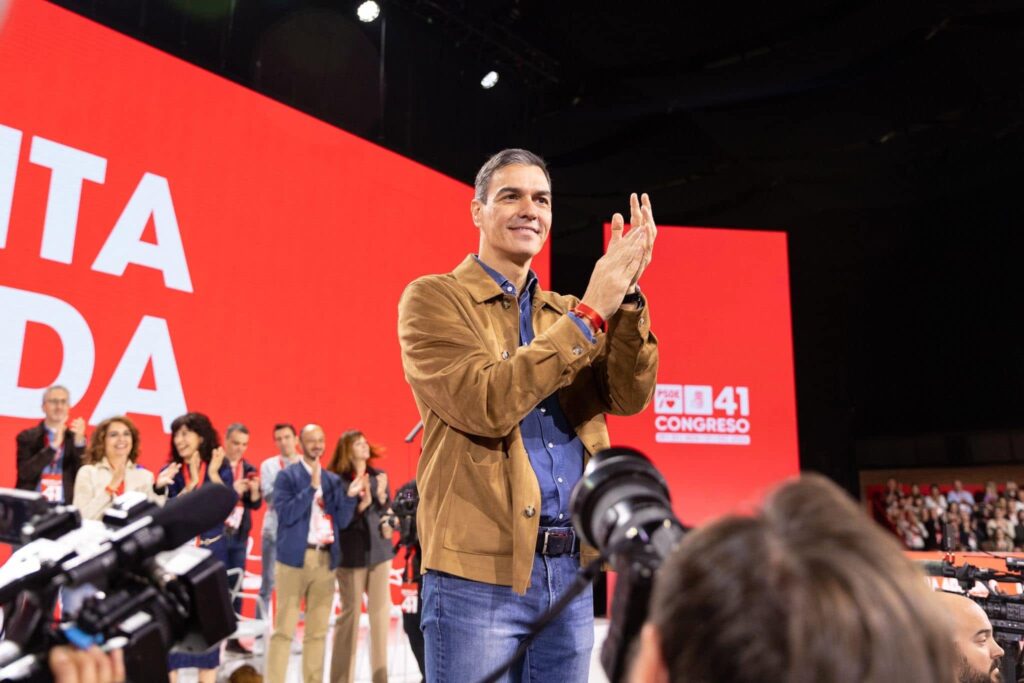
Spanish Prime Minister Pedro Sánchez called an early election for 29 November on Monday, betting voters will give him the parliamentary majority he has lacked. The result could also reshape Spain’s positions on migration, the Green Deal and the EU’s approach to Israel.
“To do more, we need to renew and expand people’s support,” Sánchez said in his statement from Moncloa Palace. He acknowledged mistakes and unfinished reforms, but argued that a larger progressive majority would allow his government to deliver further changes.
The announcement followed Friday’s rejection of two housing decrees, including measures extending protection against evictions until 2030. The conservative People’s Party, far-right Vox and Catalan separatist Junts voted against them, exposing the fragility of the government’s parliamentary support. The election had previously been expected in 2027.
Scandals and migration add to Sánchez’s troubles
Sánchez has governed in coalition with the left-wing Sumar alliance while relying on regional parties to pass legislation, often after difficult negotiations. Junts’ decision to vote against the housing measures alongside the opposition highlighted how quickly that parliamentary arrangement could unravel.
The government has also faced corruption investigations involving figures close to the Socialist Party and Sánchez’s family circle. Those cases have given the opposition another line of attack alongside its criticism of Sánchez’s difficulty passing legislation
Migration into Ceuta has added another political fault line. Opposition parties have challenged Madrid’s handling of arrivals from Morocco and its relationship with Rabat. Vox leader Santiago Abascal returned to the issue on Monday, accusing Sánchez of serving Moroccan interests.
Opposition welcomes the contest
People’s Party leader Alberto Núñez Feijóo welcomed the election, calling for a “national reconstruction”. In his response on Monday, he framed the contest around the government’s record and corruption allegations, rather than the housing measures that triggered the announcement.
“Finally, we will be able to choose. Spain has the floor,” Feijóo said, according to Canarian public broadcaster RTVC.
Abascal also welcomed the decision. “I am deeply pleased, because we have been demanding them for a long time,” he said in an Antena 3 interview reported by EFE. But he warned supporters against relying on favourable polling and described the coming vote as “very uncertain”.
To do more, we need to renew and expand people’s support.
— Pedro Sánchez, Spanish Prime Minister
Sánchez is taking a political risk: most opinion polls put his Socialist Party behind the opposition. A right-wing majority could give Vox a route into national government through an agreement with the People’s Party. Sánchez is seeking to mobilise voters against that prospect, presenting his government as a defence of social rights and environmental progress.
Spain’s next government will shape its voice in Brussels
The result could also change Spain’s positions in EU-level negotiations. The People’s Party belongs to the European People’s Party, while Vox campaigns for tougher migration controls and the reversal of substantial parts of the Green Deal. Any influence Vox gains would depend on the parliamentary arithmetic and the terms of a governing agreement.
Migration is also likely to shape the next government’s dealings with Brussels. Spain’s borders with Morocco, including Ceuta and Melilla, make cooperation on arrivals and returns an important part of its European agenda.
A change of government could also weaken Spain’s advocacy for stronger pressure on Israel. Sánchez’s administration has called for suspension of the EU–Israel Association Agreement. The election will determine whether he returns to those negotiations with renewed authority or whether a successor sets a different course.