Lawmakers from Greece and Cyprus wanted sanctions, funding cuts and an end to defence talks. The Commission answered with solidarity, engagement and a push for Cyprus settlement talks.
The European Union sanctions Russia for aggression. It does not sanction Türkiye, which occupies part of an EU member state — Cyprus, that is. That double standard was the charge MEPs levelled at the Commission at Thursday’s plenary session in Strasbourg. MEP Geadis Geadi (ECR/CYP) put the case bluntly. “Principles that are selective are not principles. It’s the worst kind of hypocrisy.”
His fellow Cypriot, MEP Costas Mavrides (S&D/CYP) asked the Commission to explain why the EU punishes Russia, “the aggressor”, but not Türkiye. “However, the appeasement policy does not work,” he added, calling for economic and political sanctions and for a straight answer to European citizens.
Money without conditions
Money became the second line of attack. MEP Christophe Bay (PfE/FRA) pointed to the EU’s pre-accession funding. “We have set aside billions for Türkiye to help it with its pre-accession journey,” and called this a contradiction (when set against Ankara’s current assertive behaviour, presumably).
For reasons known only to him, he then went off the rails and unleashed a truckload of bile at “people smoking joints” and perform other despicable acts “in the name of Allah”. Some of his colleagues found the analysis of societal evil too schematic, putting it charitably.
Principles that are selective are not principles. It’s the worst kind of hypocrisy. — MEP Geadis Geadi (ECR/CYP)
Others, however, were on the same page. Another French Patriot, MEP Angéline Furet (PfE/FRA) said the EU had sent almost €10bn to Ankara since 2016. Meanwhile, the Commission begs for gas from Qatar or Azerbaijan. Ms Furet argued that the Aphrodite and Calypso fields off Greece and Cyprus could cover Europe’s needs. “That gas is European.”
Some wanted the money cut. The idea found many a supporter, particulary among Greek MEPs whose country is famously broke. MEP Georgios Aftias (EPP/GRC) urged “significant deductions” from funding to Türkiye. His compatriot MEP Nikolaos Anadiotis (NI/GRC), whose side jobs include modelling, objected to Turkish participation in EU defence programmes. “I want Türkiye to stay out of every EU project.” MEP Yannis Maniatis (S&D/GRC) asked whether the Commission would end talks on that participation.
A contested map
Many speakers returned to Türkiye’s newly official ‘Blue Homeland’ doctrine, which they found unacceptable. MEP Elissavet Vozemberg-Vrionidi (EPP/GRC) said it puts 152 Greek islands in dispute. This year Türkiye introduced a draft maritime bill to formalise the doctrine in the Aegean, Eastern Mediterranean, and Black Seas. Greece and Cyprus dismissed it as a unilateral move with no legal weight.
Ms Vozemberg-Vrionidi said Türkiye threatens war if Greece extends its territorial waters beyond six miles. MEP Emmanouil Kefalogiannis (EPP/GRC) rejected that threat. “Greece has the right to extend its territorial waters to 12 nautical miles.” He said Türkiye has threatened war over this since 1996. This probably makes autumn of 2026 the right time to bring the issue to some prominence.
Without a comprehensive settlement of the Cyprus issue, it would be impossible to bring sustainable de-escalation in the Eastern Mediterranean. — Raffaele Fitto, European Commission vice-president
MEP Pierre-Romain Thionnet (PfE/FRA) saw a larger aim. “What Türkiye is asking for really is to take over maritime space and to establish a new legal order at sea.” Ms Vozemberg-Vrionidi cited Turkish plans, announced on 15 August, for two natural parks in international waters. (Türkiye has declared new marine parks beyond its territorial waters. Athens sees them as a challenge to its continental shelf.)
Cables, jets and parades
The Great Sea Interconnector cable drew sharp words. Türkiye says parts of the Crete-Cyprus-Israel link cross its exclusive economic zone. It wants to be informed, and to consent, before seabed surveys resume. Reports say Greece has contingency plans involving its navy if surveys are obstructed.
Mr Thionnet said nothing must block the cable. “It’s such an essential infrastructure in order to guarantee energy supply to the island.” MEP Giorgos Georgiou (The Left/CYP) said Türkiye blocks a project of European interest. Mr Maniatis said Türkiye had begun building a gas pipeline to what he called “the occupied territories in Cyprus”.
Cyprus supplied further grievances. In June, Cypriot officials said Turkish F-16s intercepted or interfered with aircraft carrying visiting European defence ministers, including Greece’s Nikos Dendias, to an informal EU meeting in Nicosia. Türkiye also condemned a status-of-forces agreement between France and Cyprus, signed that month. In October it criticised the Cypriot independence day parade.
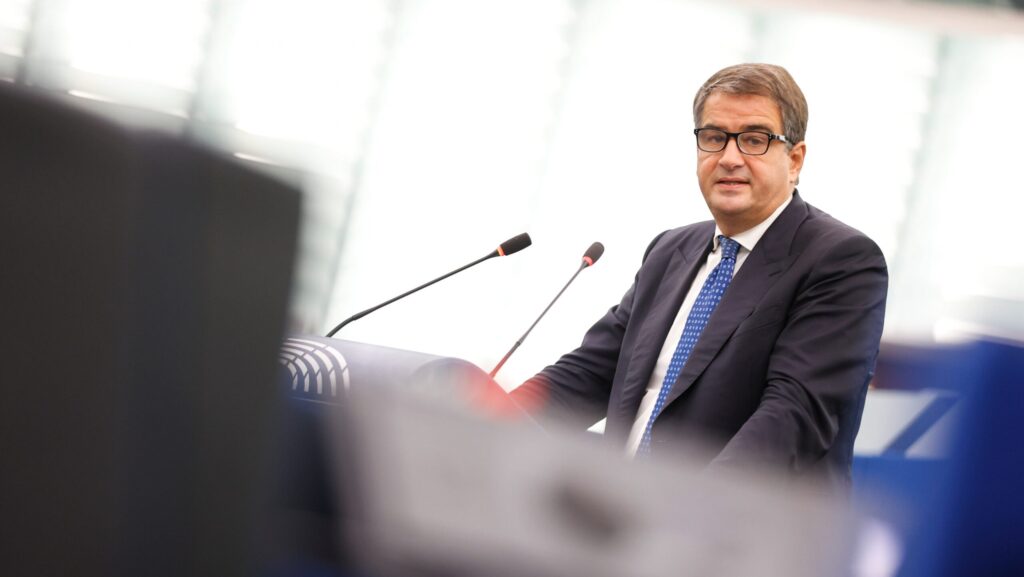
European Commission Vice-President Raffaele Fitto answered for the Commission. Greece and Cyprus, Mr Fitto said, can count on the EU’s solidarity. Yet Mr Fitto linked calm to Cyprus. “Without a comprehensive settlement of the Cyprus issue, it would be impossible to bring sustainable de-escalation in the Eastern Mediterranean.” He is the Commission’s special representative for the issue. Settlement talks, he said, must resume within the UN framework.
Voices for restraint
Critics found this a weak argument. Mr Georgiou had already given a verdict: “And Europe is absent.” Mr Maniatis asked what the promised solidarity means in practice, since Commission replies to written questions only repeat that member states’ rights are safeguarded.
Not everyone wanted sanctions. MEP Leoluca Orlando (Greens-EFA/ITA) said the two countries disagree on airspace and on search-and-rescue zones. He wanted a clear message to Ankara and dialogue. Others stressed Europe’s unity, saying things like “international law is not optional” and “Europe is not a powder keg”.
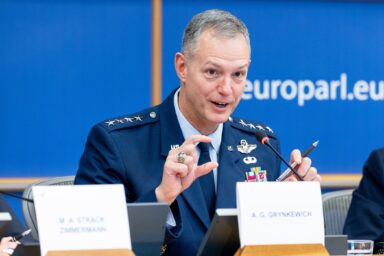
MEP Marie-Agnes Strack-Zimmermann (Renew/DEU) invoked NATO. She called Türkiye an important member of the alliance, and said Greece belongs to the Greeks. Her warning was blunt. “If we start digging out historical maps, we can kiss goodbye to the most important peace project in the world.”
MEP Özlem Demirel (The Left/DEU) rejected both sides. “I would say we don’t need a new front.” She asked whether the EU will back escalation alongside the United States and Israel, or pursue its own policy for peace. MEP Konstantinos Arvanitis noted that Greece and Türkiye both belong to NATO.
No exceptions for Ankara?
A third camp wanted firmness paired with talks. MEP Željana Zovko (EPP/HRV) who is elected for Croatia even as her citizenship is Bosnian, backed dialogue based on certain terms. “We support dialogue, but dialogue cannot deliver results under intimidation.” She said continued provocations must carry consequences.
The plenary thus produced nothing apart from delineating a split. Most speakers wanted the EU to stop treating Türkiye as an exception. The Commission stayed with engagement and Cyprus talks. The gap between them is the story.