A lawyer exposed a $230m fraud and died in a Moscow jail cell. Almost 17 years on, the US, Canada, the UK, and Australia can freeze the assets of corrupt officials worldwide. The EU still cannot. Lawmakers now want the Council to close the gap.
“The fact that the EU is the one bloc of countries that doesn’t deal with corruption through this kind of regime, while the United States does, Canada does, the UK does, Australia does, is a black mark against the EU that needs to be fixed,” said Bill Browder, head of the Global Magnitsky Justice Campaign. He made the appeal at the European Parliament, flanked by lawmakers from three political groups.
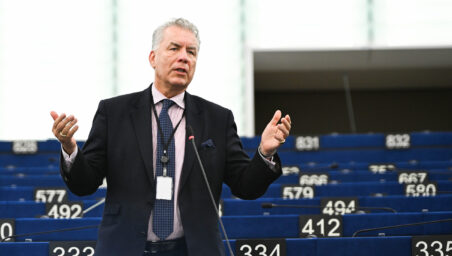
Petras Auštrevičius (Renew/LTU), Antonio López-Istúriz White (EPP/ESP), the rapporteur on the file, and Thijs Reuten (S&D/NLD) share his goal. They want the EU to introduce targeted sanctions against corruption and to formally attach Sergei Magnitsky’s name to its human rights sanctions regime. Next week, Mr Auštrevičius will send a letter to the Council of the EU, urging it to add corruption to the global human rights sanctions regime.
Gap in the EU sanctions toolbox
The initiative seeks to amend the EU’s global human rights sanctions regime, commonly known as the EU Magnitsky Act. Corruption would become a standalone ground for restrictive measures, the EU term for sanctions such as asset freezes and travel bans. The legislation would also formally carry Sergei Magnitsky’s name.
The EU adopted the regime in December 2020. It already allows the bloc to sanction individuals and entities responsible for serious human rights violations worldwide. The European Parliament has repeatedly supported targeted sanctions against corruption. Yet the choice of legal instrument and the final decision lie with the Council, where foreign policy requires the unanimous backing of all 27 member states.
“Almost exactly 17 years ago, Sergei Magnitsky, my Russian lawyer, was murdered in Russian police custody after he uncovered a $230m Russian government corruption scheme,” Mr Browder recalled. Since then, he has sought justice outside Russia. “Those people don’t keep the $230m they stole in Russia. They keep it abroad. That’s why I said if we can freeze their assets and ban their travel, it may not be true justice, but it’s better than the total impunity that these people have been enjoying.”
The United States passed the first Magnitsky Act in 2012. According to Mr Browder, the US model later inspired similar laws in Canada and the United Kingdom. Both countries can now target people involved in human rights abuses and corruption.
New tune from Budapest
Mr Browder blamed the EU’s delay on Hungary. In his account, Budapest resisted both adding corruption to the regime and attaching Magnitsky’s name to it. “We got to this point because Viktor Orbán was a friend of Putin inside the European Union, a Trojan horse,” he said of Hungary’s former prime minister, who lost power in April’s election.
According to Mr Browder, the new government of Prime Minister Péter Magyar would now be willing to support an amendment. That is his own reading of the negotiations, not an assessment that all sides share. The warning signs remain, however, Mr Browder said. In France, which elects a new president in 2027, some candidates are very close to Russia and to Mr Orbán’s circle.
Illicit enrichment is a golden rule of authoritarian rulers: grab public money, reward close entourage, and rule the rest, suppressing human rights. — Petras Auštrevičius, Renew Europe MEP
For Mr Auštrevičius, corruption “is not merely a matter of public money being stolen”. It can also serve as a tool for authoritarian rule, letting leaders reward allies and suppress opponents. “Illicit enrichment is a golden rule of authoritarian rulers: grab public money, reward close entourage, and rule the rest, suppressing human rights,” he said.
Price of looking away
Mr Auštrevičius put the global economic cost of corruption at 2–5 per cent of world GDP. Yet the damage is not only economic. He also pointed to the risks faced by journalists who investigate graft. “Since 2012, around 150 journalists have been killed in non-conflict zones while covering corruption-related stories. In 2025, five journalists alone were murdered.”
He urged the EU to seize the current political moment and complete its sanctions framework. “It’s high time to do things. We have this unique opportunity to do what other Western countries did before us. We have to catch up and complete our work.”
Call for faster action
Mr López-Istúriz White stressed the cross-party support behind the initiative. “I’m very proud that we are represented here also by the Social Democrats, Renew and the EPP in this common struggle,” he said. He noted that the Parliament had already done its part to strengthen the European framework and urged member states to move forward.
“We have done our homework in Parliament,” Mr López-Istúriz White said. “There was a great majority of parliamentarians who supported this initiative. Timing is essential. This has to be approved by the Council. There’s no longer any kind of excuse. It’s time for the Council to move quickly.” Mr Reuten echoed him. “The European Parliament is not the problem. The ingredients are on the table. It’s the member states who have to move and who have to act.”
Eyes on 2027
The cross-party group plans to push for a new parliamentary resolution in November and to issue a public appeal to EU institutions and member states. Its goal is to amend the existing framework and secure a decision as soon as possible, ideally by 2027.
The US is no longer the North Star. Europe should be the North Star. — Bill Browder, head of the Global Magnitsky Justice Campaign
Mr Browder urged the EU not to postpone the reform any longer. “When I started this campaign, the US was the North Star when it came to fighting corruption and human rights abuse. The US is no longer the North Star. Europe should be the North Star.”