Europe wants reliable satellite connections and faster broadband, but Finland warned on Tuesday against giving Brussels more control. The talks in Limerick were disrupted when chair Patrick O’Donovan became unwell and was taken to hospital by ambulance.
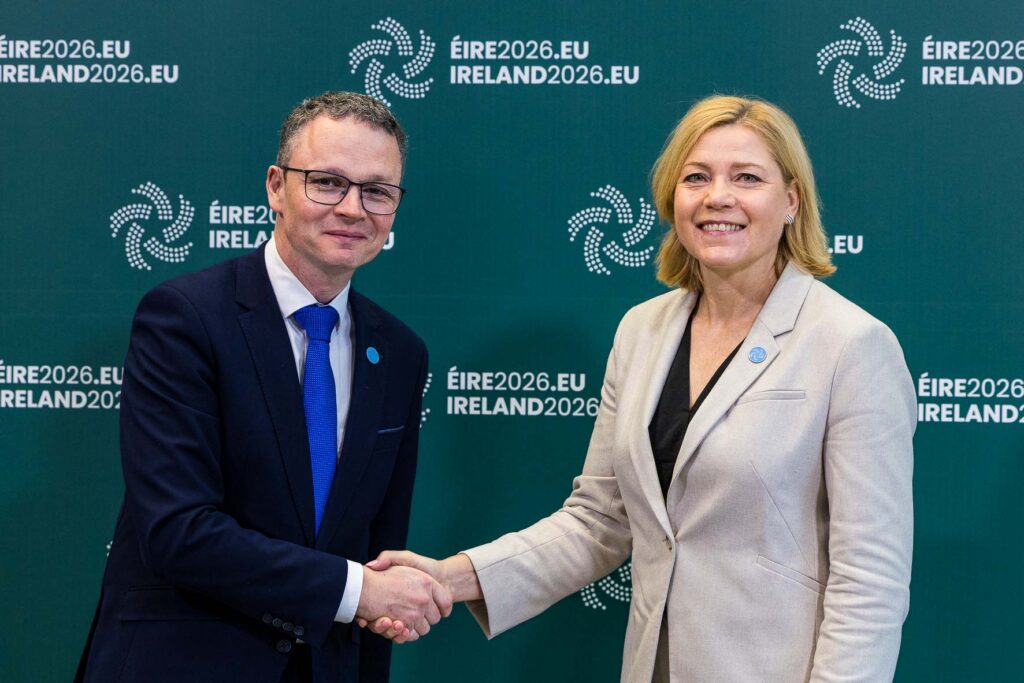
“We also have to have our own tech sovereignty when it comes to satellites,” European Commission Executive Vice-President Henna Virkkunen said at a Tuesday meeting of ministers reponsible for telecommunications. She wants the Digital Networks Act to simplify rules and strengthen the European telecoms market. Governments brought different priorities: Germany sought reliable satellite services and competition, while Czechia emphasised opportunities for European companies.
Opening the roundtable, Irish Communications Minister Patrick O’Donovan stressed protection against extreme weather, cyberattacks and hybrid threats, including securing subsea cables. “Greater security, diversity and redundancy can help reduce strategic vulnerabilities,” he said.
Ireland wants the discussions to shape a first compromise on the legislation ahead of December, when the Telecommunication Council will meet in Brussels.
Finland wants faster networks without more Brussels control
The Commission’s proposed Digital Networks Act seeks to simplify the telecommunications framework, strengthen the European market and accelerate the replacement of copper networks with fibre. For households and businesses, that transition concerns the connections used for work, education and everyday services. The legislation remains under negotiation.
Finland’s Transport and Communications Minister Lulu Ranne supported stronger infrastructure, but questioned whether countries already far through the transition should face additional requirements. She estimated that only around 5–10% of Finland’s copper system remained.
“We have to make sure that the national decision-making is in our hands,” Ranne said. She warned against adding bureaucracy or increasing Commission powers for countries that had already largely moved away from copper. Her argument was about how Europe should manage the transition, rather than opposition to faster connections.
O’Donovan also acknowledged the balance between a more integrated market and national authority. “We want to have as cohesive a platform as possible, but we also have to be very conscious of member states’ sovereignty,” he said in his arrival remarks. He nevertheless argued that European countries were stronger acting together in telecommunications than individually.
Germany wants satellite guarantees, Czechia sees a growing market
Germany’s Thomas Jarzombek, parliamentary state secretary at the digital ministry, wanted satellite services that Europe could depend on even under difficult circumstances. He also called for competition between at least two providers, arguing that it would encourage innovation.
Asked about allocating frequencies to Starlink, Jarzombek pointed to Ukraine as evidence of the dependence such technology can create. Access to frequencies should come with obligations to provide a reliable service, including at critical moments, he argued. Satellite links would complement terrestrial networks, rather than replace them. “They need a partner on the ground,” he said.
We also have to have our own tech sovereignty when it comes to satellites.
— Henna Virkkunen, European Commission Executive Vice-President
Czech Deputy Industry and Trade Minister Jan Sechter placed greater emphasis on opening opportunities for European companies. Services connecting satellites directly to phones and other devices were developing rapidly in the United States and China, he said. Europe needed rules that would allow its businesses to participate. “We need to be prepared for it,” Sechter said, describing an opportunity to catch up with Starlink and other providers.
Sweden’s Public Administration Minister Erik Slottner supported reducing dependence on countries outside the EU, including for satellites, cloud services and other digital technologies. But he declined to give detailed positions on frequency allocation, explaining that Sweden’s interim government lacked an agreed mandate. His remarks supported the broader objective of European independence without committing Stockholm to a particular regulatory solution.
Ireland’s broadband rollout shows what is at stake
O’Donovan used the opening session to present Ireland’s National Broadband Plan as an example of connecting communities that commercial investment would otherwise leave behind. The government aims to cover all Irish homes and businesses with a gigabit network by 2028 and all populated areas with 5G by 2030.
“It was established to address market failure in areas where commercial investment alone would not deliver high-speed connectivity,” he said. The programme illustrated the practical issue beneath the regulatory debate: whether people outside commercially attractive areas can obtain the same reliable connections as those in cities.
O’Donovan was later taken to hospital by ambulance after becoming unwell during the meeting. Local broadcaster Live95 reported that the afternoon press conference was cancelled. His spokesperson said he had been taken off-site for assessment and treatment. No detailed outcome was available at the time of writing.
Ireland’s planned compromise will now have to reconcile calls for stronger European networks with governments’ demands to retain national control.