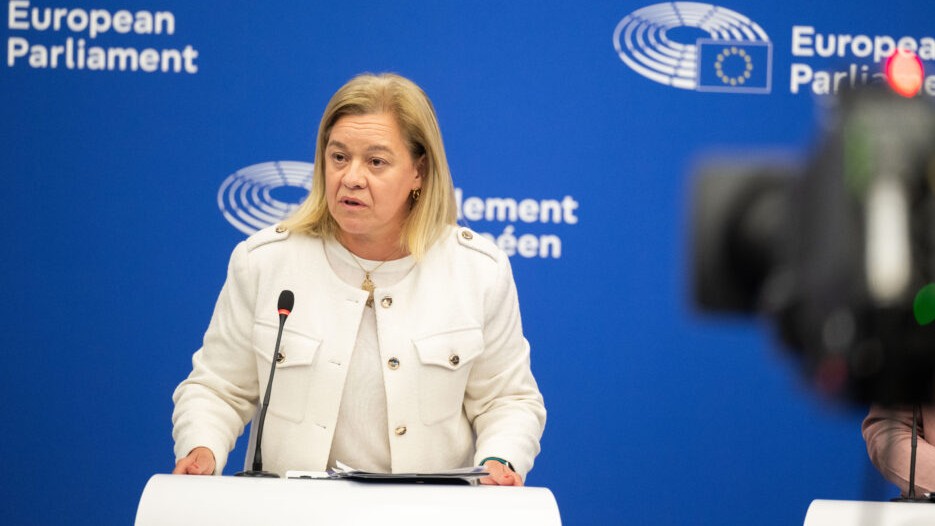
Parliament wants more money for Europe’s next long-term budget; member states want less. Portuguese socialist Carla Tavares, one of Parliament’s two lead negotiators, explains why the Irish presidency’s €1.622tn compromise misses the mark and why new EU revenue holds the key to any deal.
For Carla Tavares (S&D/PRT), one of Parliament’s two co-rapporteurs on the multiannual financial framework (MFF), the numbers do not add up. On 10 October, the Irish presidency put forward €1.622tn for 2028–2034. That is €141bn less than the European Commission proposed and far below Parliament’s own position. Parliament’s lead negotiators “firmly reject” the text.
Ms Tavares wants an ambitious budget that keeps traditional spending such as farm funding and also covers new priorities such as competitiveness. Ahead of the EU leaders’ summit on 15–16 October, she argues that member states must agree on new sources of EU revenue. Without them, the bloc cannot meet its ambitions in a world of multiple crises.
Same budget, smaller in real terms
Ms Tavares expects tough talks but remains optimistic. Parliament is ready to compromise, she says, as long as the final package is balanced, with realistic numbers, a basket of new EU revenue sources, and enough flexibility to react to crises.
What is your first reaction to the Irish presidency’s proposal?
The feeling is not positive. The Irish presidency says its proposal represents an increase of 28 per cent compared with the current MFF, but that sketches an incorrect picture.
€390bn of the €1.622tn proposal would disappear into inflation compensation, as well as the repayment of €150bn in debt incurred through the EU’s post-pandemic recovery fund — leaving no room to also finance new priorities.
In the end, it is the same level as the current MFF, with a real value that has been reduced by €161bn, or 10 per cent. We are talking about a budget that does not give us the additional resources we need.
Instead, we see cuts to cohesion, the European Social Fund, and competitiveness. That is completely against not just Parliament’s position, but also the Commission’s urgent message it has been spreading over the past two years: we need to make Europe more competitive.
On top of that, there is also no possibility to react to crises in the proposal. We have previously seen that this leaves an open risk of, for example, cohesion funds needing to be redirected because of a crisis.
To have a strong position vis-à-vis, for example, Russia, China, and the United States, we need to have a strong budget as well. — Carla Tavares, MFF co-rapporteur, European Parliament
The EU needs to have a strong role in this new geopolitical reality. To have a strong position vis-à-vis, for example, Russia, China, and the United States, we need to have a strong budget as well. So the reaction of Parliament is not positive.
No progress on new revenue
The Irish presidency has also put forward a proposal on new EU revenue sources. How do you see the Council’s progress so far?
There has been no progress in the Council on new resources, and that is a big problem. Of course, it is impossible to do more with less. We have ambitions, and we need to pay for that. We only have two ways to do that: either member states pay more, or we find new revenue streams.
Where do you see the most room for negotiation: in new own resources (EU-level revenue streams) or in higher national contributions?
New own resources are easier to talk about. Member states are very clear that they do not want to pay more. And those new resources are urgent. We need to have them.
Parliament has suggested several alternative revenue streams, including a digital levy on large digital platforms, a levy on online gambling and betting, an extension of the carbon border adjustment mechanism (CBAM), and a levy on capital gains from crypto-assets. They provide alternatives if some of the Commission’s more controversial proposed revenue sources, such as a tobacco tax, fail to gain support from member states.
Which of Parliament’s proposals are member states most likely to accept?
At the end of the day, it’s a basket; a bundled package of various income streams, and not a matter of choosing one. However, parliamentary proposals, such as the digital levy, might be easier than others. Member states seem to be open to discussing the digital levy, that could increase the revenue stream by €25bn.
The Irish proposal protects cohesion and agriculture from the deepest cuts, in line with Parliament’s priorities. It also gives national governments a role in deciding how that money is allocated. Is that something you welcome?
Yes, this is a good thing. However, we still need to work on the model of governance. Parliament, however, wants to preserve the existing approach to these policies, leaving control with the regions that the funding is intended to support.
Racing the election calendar
European Council President António Costa wants to secure a deal before the end of the year, but France and Italy are already resisting a firm deadline. How important is it to reach an agreement by December?
It is important. Next year there will be elections in France, Italy, Finland, and Poland, for example, and that will complicate the process. It is better to reach a deal this year.
With tough negotiations ahead, where is Parliament willing to compromise, and where will it hold its ground?
The big challenge is really the new own resources. Without them, we cannot support people over the next seven-year budget cycle. For us, this is the big question. But also ensuring that cohesion funding remains a priority, and that the EU budget has enough flexibility to respond to unexpected events.
Are you optimistic about the road ahead? What would a realistic compromise look like?
Yes. It will be very difficult, but we are completely open to the negotiations, with a balanced package, realistic numbers, a basket of own resources, and flexibility to react.
It will be very difficult, but we are completely open to the negotiations. — Carla Tavares
What does a realistic number mean to you?
A number where we do not need to reduce spending on important issues such as competitiveness, cohesion, or security and defence.
And if you were to give a concrete figure?
We need a 10 per cent increase on the Commission proposal and at least €60bn per year from new own resources on the revenue side.