Cutting off finances, entering the Zaydi Shia group on a terrorist list, stricter sanctions, withdrawal, stronger protection through Aspides, more diplomacy — Kaja Kallas did not leave Tuesday’s evening parliamentary debate short of recommendations.
“For that we need all the member states on board,” said High Representative Kaja Kallas in reply to many an MEP’s demand that the EU list the Houthis as a terrorist organisation. Ms Kallas said she had heard those calls, but the listing needs every member state. She spoke to the European Parliament’s Strasbourg plenary session on 20 October.
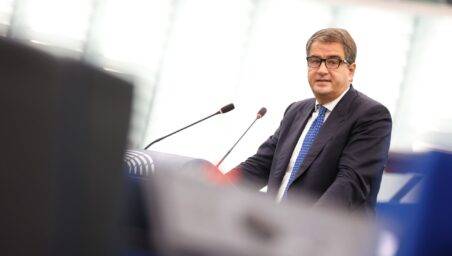
MEP Antonio López-Istúriz White (EPP/ESP) made the demand on behalf of his group. He said the Houthis are not a political movement with a grievance. Defence alone, he argued, is insufficient. “You cannot only defend against terrorists. You must also name them, isolate them and cut their money,” Mr López-Istúriz White said.
Leave Yemen to the Yemenis and let’s just withdraw from this region. — MEP Marc Botenga (The Left/BEL)
Hana Jalloul Muro (S&D/ESP) and Abir Al-Sahlani (Renew/SWE) joined the demand. Ms Jalloul Muro said the resolution asks for broader sanctions and for the Houthis to join the EU terrorist list. Parliament votes on it on Thursday, she said. “It’s time to put the Houthis on the EU terrorist list,” Ms Al-Sahlani said.
Ms Kallas agreed with members who said the Houthis do not operate alone. “They are being financed, equipped and trained by Iran,” she said. MEP Arkadiusz Mularczyk (ECR/POL) wants Europe to act on that. “We must strike at the source of finance and cut them off from arms,” he said. He called for effective sanctions against Iran.
Terror in Riyadh, misery in Yemen
The debate followed a fortnight of Houthi attacks on Saudi Arabia and Yemen. Ms Kallas listed the targets: Yemen’s presidential palace in Aden, King Khalid International Airport in Riyadh, and residential areas in Riyadh. Dozens of civilians died at the airport, she said, and hundreds suffered injuries. She voiced solidarity with Saudi Arabia and Yemen’s government.
She called the strikes terrorism. “These are textbook terrorist tactics designed to sow fear among ordinary people in the region and also in the international community,” Ms Kallas said. She added that the Houthis want to change the balance of power, and use civilian targets to do it. International humanitarian law strictly prohibits indiscriminate targeting, she said.
The attacks have also disrupted EU diplomacy. Ms Kallas said a summit between the EU and the Gulf Cooperation Council, planned for Saturday, has been postponed because of the escalation. It would have let the EU talk with Gulf partners about the emerging security situation. “The Gulf is where Europe’s best hopes are for diversifying trade supplies,” she said.
The impact on the people of Yemen is already catastrophic, Ms Kallas said. More than 22 million people in Yemen need some form of aid. Since August, 200,000 people have fled their homes, on top of over five million already displaced. The EU gave €85m this year and mobilised another €2.5m in emergency funding since September.
Europe’s credibility
Ms Kallas said the region matters to Europeans because of trade. “Around a fifth of EU’s trade already passes through the Red Sea,” she said. That is why the EU set up Operation Aspides in 2024, when the Houthis started striking vessels there. “The security of the region is our core interest,” the High Representative said.
Aspides has since escorted hundreds of vessels to safety, she said. It is now under strain. The EU faces what she called a two-strait crisis, so the mission is more visible and its ships are more in demand. Many companies request support — the EU lacks ships for all of them. Member states have pledged more frigates.
You cannot only defend against terrorists. You must also name them, isolate them and cut their money. — MEP Antonio López-Istúriz White (EPP/ESP)
Pledges matter, she said, but they are not enough. “But we need to get those ships to the sea, otherwise we undermine our own credibility,” Ms Kallas said. In her closing remarks, she rejected the idea that Aspides draws Europe into the war. “It’s just protecting our own trade and commercial shipping,” she said.
MEP Seán Kelly (EPP/IRL) put numbers on the cost. Houthi attacks, he said, have helped push oil above $100 a barrel. EU household energy prices are up almost 19 per cent. He wants Europe to replace fossil fuels with renewables and storage. “Every conflict means a price crisis. That’s the key lesson,” Mr Kelly said.
How far should Europe go?
The Red Sea risk reaches shoppers, Ingeborg Ter Laak (EPP/NLD) said. Vessels that make huge detours push up transport costs, energy prices and the price of household goods. Europe, she argued, must invest in stability on the Arabian Peninsula. “Our prosperity ought not to depend on the caprices of terrorists,” she said.
Nicolás Pascual de la Parte (EPP/ESP) wants a tougher Aspides. He called its mandate purely defensive and suggested a more robust one, so that ships can respond to attacks. He also wants training for the Yemeni coast guard so it can defend itself. Ms Kallas said the EU already supports the coast guard in tackling arms smuggling.
MEP Pierre-Romain Thionnet (PfE/FRA), speaking for his group, argued for caution. He said the EU should engage only in defensive initiatives and escort its own merchant ships. “We do not want to get directly involved in this conflict because it’s not in the interest of European countries, certainly not in the interest of France,” he said.
Ville Niinistö (Greens-EFA/SUO) backed Aspides but said Saudi-led airstrikes must also comply with international humanitarian law. He wants tougher targeted sanctions on those responsible for serious violations. “Civilian lives cannot be treated differently depending on who is responsible,” he said. He also wants independent UN investigations into abuses by all sides.
Withdrawal or diplomacy
MEP Marc Botenga (The Left/BEL) urged withdrawal. He said Europe’s wars end in chaos and its workers pay for them. “Leave Yemen to the Yemenis and let’s just withdraw from this region,” he said. His party colleague Merja Kyllönen (The Left/SUO) condemned the Saudi attacks on Yemen. She said Europe should stop arms exports to the conflict zone.
Military strength is necessary but cannot replace diplomacy, Hannah Neumann (Greens-EFA/DEU) said. “A naval mission can protect a ship, but it cannot reopen a road into Taiz,” she said. In response, Ms Kallas agreed that diplomacy matters. She called on the Houthis to re-engage with the UN-led mediation process. “Escalation will have everyone worse off,” she said.
We must strike at the source of finance and cut them off from arms. — MEP Arkadiusz Mularczyk (ECR/POL)
That was as much as what parliamentarians were able to identify as common ground on Tuesday. Then again, a plenary session on a situation afflicting intertwined pressing issues like security and trade could not have possibly harboured an ambition to sound a harmonious accord.