The EU foreign policy chief battled for the International Criminal Court, put on a brave face when it came to Russia sanctions, and had to split legal hairs on Israel. Yet she defended Europe’s imperfect unity.
Europe’s premier naval mission in the Red Sea is under-resourced, and Kaja Kallas, the EU’s foreign affairs and security policy head, said so plainly. Operation Aspides—launched in February 2024 to escort merchant vessels, monitor threats, and protect commercial shipping across the Red Sea, the Gulf of Aden, and parts of the Arabian Sea—was designed around a minimum of ten warships. As of this week, the mission does not have them. And the threat has grown.
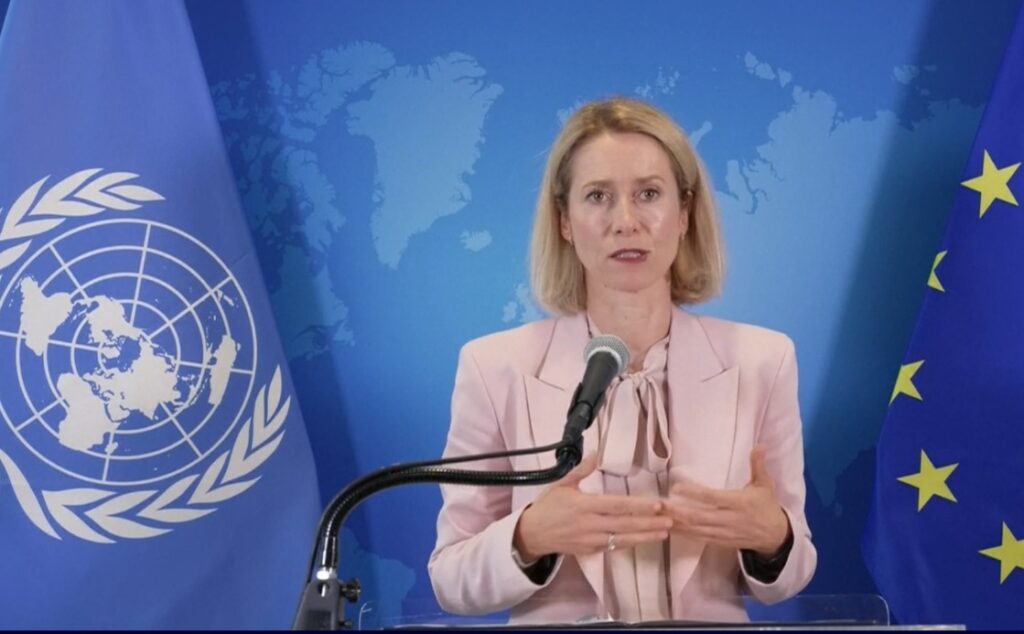
“The operation needs more naval assets and more air assets to address the increased level of threats in the region,” Ms Kallas told reporters at the EU delegation in New York on 22 September. She gave a press conference after chairing a meeting of EU foreign ministers (“and some partners”) on the sidelines of the 81st UN General Assembly.
The Strait of Hormuz, she noted, was closed. The Strait of Bab-el-Mandeb and the Black Sea were both under pressure. “The situation is even more grave right now as we see increased attacks,” she said. “I would assume that it’s more than ten (ships needed to carry out the mission), but we don’t have that much right now.”
Disagreements acknowledged
Houthi attacks, carried out by the Iran-backed Yemeni rebel group, were sabotaging the global economy, Ms Kallas said. The three chokepoints (Hormuz, Bab-el-Mandeb, and the Black Sea) send disruptions “far beyond their regions” when blocked. The gap between the mission’s mandate and its means is, in miniature, a portrait of the EU’s broader defence predicament.
Her agenda in New York was ambitious: Russia’s war against Ukraine, the Middle East, global food security, accountability, maritime security, and the future of multilateralism. She projected European solidarity on each front; and on each front, the cracks showed.
It is fundamental that there is accountability for the international law to function properly, and therefore we stand behind the ICC. — Kaja Kallas, the EU’s High Representative for Foreign and Security Policy
On sanctions, she insisted that the EU’s position had not shifted. Its Ukraine sanctions regime (the bloc’s largest, covering around 3,000 listings) was up for renewal, and internal discussions were ongoing.
Certain member states had raised objections to specific listings. Ms Kallas did not deny this, but she framed it as process rather than fracture. “Nothing has changed,” she said. “That is very clear.” The EU was simultaneously renewing existing measures and building a new package targeting Russia’s military-industrial complex and shadow fleet.
Accountability and its discontents
She welcomed the passage of the late US Senator Lindsey Graham’s sanctions legislation, signed by US President Donald Trump. Co-ordinated pressure, she argued, was the most effective kind: “When we impose sanctions together with our US and UK partners, these are most effective, including secondary sanctions.” Asked whether Mr Trump might use the bill’s new tariff authority against European partners, she declined to engage. “I hope it’s not true,” she said.
The sharpest exchange came on accountability. Ms Kallas had called for a special tribunal on the crime of aggression against Ukraine, stressing that accountability is not selective. A journalist from Arab News asked why the EU had not pursued a similar mechanism for Gaza, and whether the bloc’s continued ties with Israel constituted the very selectivity she had warned against.
Her answer drew a legal distinction. The crime of aggression (one state attacking another) cannot be prosecuted against sitting leaders under existing international mechanisms, including the International Criminal Court. The special tribunal for Ukraine fills that specific gap. War crimes, by contrast, fall within the ICC’s existing remit. “If that works and hopefully we get this rolling, then it could be also a good example for others,” she said.
ICC must stand
On the ICC itself, the stakes were immediate. Reports had emerged that the US was considering sanctions against the court. Ms Kallas was unequivocal: “It is fundamental that there is accountability for the international law to function properly and therefore we stand behind the ICC.” She added that the EU had tools available should matters deteriorate (without specifying what they were) and said the bloc was “rallying countries behind supporting the ICC’s functioning.”
On Ukraine, she was equally direct. Asked about diplomatic prospects and US President Donald Trump’s criticism of Ukrainian strikes on Russian energy infrastructure, she placed the burden squarely on Moscow. Ukraine, she noted, had agreed to an unconditional ceasefire two years earlier. “The pressure should be on the aggressor to stop attacking civilians, civilian infrastructure,” she said.
It is very popular to talk about things that we are not united about, but there are actually a lot of things that we are united about in the European Union. — Kaja Kallas
The final exchange of the press conference cut to the heart of the session. A journalist noted that Europe was not united on UN Security Council reform, and asked whether finding a common European voice was not precisely Ms Kallas’s job.
The limits of 27 democracies
In response, Ms Kallas offered a careful, if slightly strained, defence of imperfect unity. “It is very popular to talk about things that we are not united about,” she said, “but there are actually a lot of things that we are united about in the European Union.” She cited support for international law and the multilateral system. But she did not deny the disagreements. “We are 27 countries, 27 democracies for that matter, which means that we have discussions and we are not always of the same opinion.”
It was, in a way, the most revealing line of the press conference. The EU commands the world’s largest sanctions regime, funds the UN system as its biggest contributor, and runs a naval mission in one of the world’s most contested waterways. It also cannot always agree on who to sanction, how many ships to send, or what to say about reforming the body it most loudly champions.
Ms Kallas drew on the EU’s own history for comfort. The bloc, she noted, had always built from smaller agreements outward, and could do the same on the global stage. It was an optimistic framing — and a tacit admission that the larger agreements remain, at the moment, out of reach.