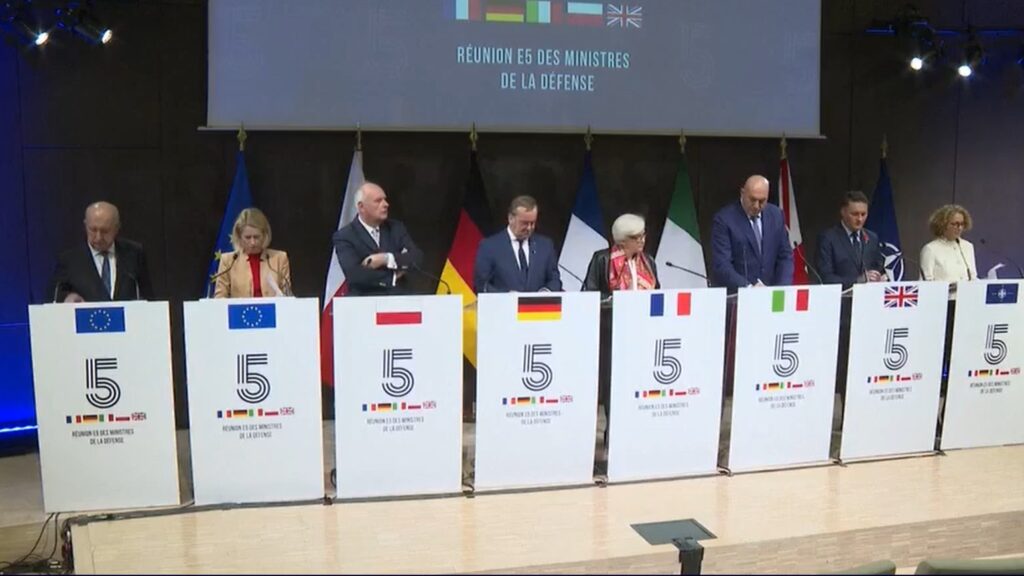
Europe’s five biggest military powers discussed the Russian military threat. They saw little hope for negotiated peace, and said little new.
Europe’s top defence ministers discussed on Monday the threat coming from Russia, as well as their support for Ukraine. Officials from the EU and NATO joined them. The mood was as sober as the message was bland.
Catherine Vautrin, French defence minister, hosted the talks. She said the group’s aim was a stronger Europe in a stronger NATO. “As far as we’re concerned, it’s very important not to allow ourselves to be intimidated and to never become disunited.”
Boris Pistorius, German defence minister, was blunter about Moscow. He noted that Russian President Vladimir Putin had agreed to a meeting with America and Ukraine. He saw little reason for hope. “There’s no signals whatsoever that would say that Putin is looking for peace.”
Mr Pistorius argued that Russia’s army is suffering heavy losses. He said the Ukrainian minister had confirmed this. “Putin cannot win on the battlefield.” Even so, he said, Mr Putin is making conditions on the ground harder for Ukrainian civilians. Mr Pistorius said Russia is hitting Ukraine’s energy and water grids. Attacks on big cities are rising. “This is all about terror.” He added that children and elderly people are among the targets.
Pressure without letup
Kaja Kallas, EU foreign policy chief, said Mr Putin’s actions contradict the goal of reaching any solution through diplomacy alone. Russia has recently attacked Kyiv heavily and sunk civilian ships in the Black Sea. “There is little hope for imminent peace in Ukraine.”
Radmila Shekerinska, NATO deputy secretary-general, said the pressure never lets up. She urged allies to deliver more air defence. “And we need to do it now because every night the pressure from Russia is felt in almost every Ukrainian city.”
There’s no signals whatsoever that would say that Putin is looking for peace. — Boris Pistorius, Germany’s defence minister
Wes Streeting, Britain’s defence secretary, was attending his first such meeting. He said Russia is paying a heavy price. “The front line has barely moved and Russian casualties are of a magnitude and scale that none of us would tolerate for any of our service people.”
Moscow’s pressure is not confined to Ukraine. Ministers spoke at length about hybrid attacks across Europe. Mr Pistorius cited the drones seen over Leipzig. He said the aim is to instil fear and insecurity. The German minister listed three Russian goals. Mr Putin wants to stop Europeans making decisions, erode trust in institutions and the rule of law, and break their cohesion. “He needs to know that our societies are more resilient than he might think.”
A hidden war
Guido Crosetto, Italian defence minister, described the same threat with more colour. “And there is also a hidden war by cowards where no one is guilty, where it’s hard to react.” He listed drones, cyber-attacks, and efforts to sway public opinion.
Mr Streeting prefers a harsher label. “I would prefer to call it ‘state-sponsored terrorism’,” he said in one of the liveliest moments of the press conference. In his opinion, Russia tries daily to provoke NATO members and sow disunity. Yet he argued that Mr Putin has achieved the opposite, producing a larger and stronger NATO.
Mr Crosetto said Europe had let its guard down. Governments put money into education and retirement systems rather than arms. “But we heard the wake up call and now we are investing more.” He said no country can cope alone. Even the biggest spenders—Germany, Britain, and France—need one another. “This is not a challenge that we can overcome alone.” Together, he offered a shocking insight, they have the industrial, economic, and military strength.
Mr Streeting singled out Britain’s own effort, in a move obviously targeted at a domestic audience, just in case there was any. Defence spending stood at 2.3 per cent of GDP when his government took office (and will reach three per cent soon), he said, ignoring the fact that nobody outside the UK cares about the said Cabinet’s lousy polling. The path leads to the 3.5 per cent NATO requires by 2035.
Credibility and Washington
The British minister insisted that money alone is not the test. Europe must out-innovate and out-produce its adversaries. “It’s the capability that gives us credibility. And that’s why it’s not just about spending more, it’s also about spending more, wisely pushing the frontier of innovation, but also making sure we can outproduce our adversaries as well,” he cared to mention. “And that’s very much the conversation we’ve been having together today.”
Władysław Kosiniak-Kamysz, his Polish counterpart, said America remains a vital partner. He said a new approach, NATO 3.0, would be presented to Europe. “The US wants to reduce its presence in Europe, but we want to make sure that the process is coordinated.”
Russian casualties are of a magnitude and scale that none of us would tolerate for any of our service people. — Wes Streeting, UK defence secretary
The Polish minister said Europe must shoulder more. “Europe has to take more part in conventional defence.” He was also confident of a deal with Washington. “We are convinced that we will find an agreement with our American allies again.” Ms Vautrin made a similar point, calling for Europe to produce more and more quickly.
Andrius Kubilius, EU defence commissioner, set out Brussels’ goals. The first is delivery of a support loan for Ukraine. He wants contracts honoured on time, not delayed until 2028 or 2029. The second is space services for Ukraine, where he hopes America will continue its help.
Shipping lanes and staying power
Mr Kubilius also flagged a new call for €21bn left unspent from a first round. The money would fund joint projects with Ukraine, including an anti-ballistic effort called Freya. Mr Kosiniak-Kamysz said Ukraine had joined an anti-ballistic coalition meant to deliver cheap air defence. The fact that a large chunk of money was left on the table, however, casts some doubt on the shared sense of urgency the officials were stressing.
The Middle East also featured. Ms Vautrin said Europe is committed to restoring freedom of maritime circulation, which she called decisive for supplies. Mr Crosetto said Italy stands ready to join mine-hunting operations in the Strait of Hormuz. He linked the region to rising energy prices. Mr Streeting noted the effect on the cost of living in Europe.
Ms Kallas warned that tensions between Washington and Tehran could flare up again. “There is a serious risk of renewed escalation between the United States and Iran.” She said more than 60 countries have joined an EU pledge against tolls and fees on shipping routes. “Navigation must be unimpeded.”
The group will now meet more often. Mr Pistorius said policy planning talks and meetings of chiefs of staff will be added, with first steps in Berlin this year. Mr Streeting offered the closing pledge. “And we will be with Ukraine for as long as it takes.” If it means more sessions like this one, it begs a question how much reason for celebration it offers Kyiv.