Artificial intelligence, better care and heatwave preparedness will shape the EU’s health agenda in 2027. A new AI blueprint will cover five sectors, including health, but no new health legislation is planned, with Brussels focusing instead on proposals already on the table.
The European Commission will propose a blueprint for artificial intelligence (AI) in five industrial sectors. Health is one of them. The plan is part of the Commission’s work programme for 2027, presented on 4 November.
The blueprint will cover “health, transport, agri-food, advanced manufacturing and defence and space”. It will also include actions to strengthen Europe’s position “from chips, to data, to compute”.
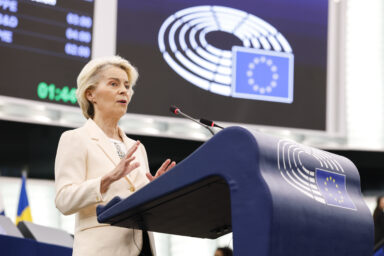
Commission President Ursula von der Leyen named the same five sectors in her 2026 State of the Union address, as EU Perspectives reported. “In November, we will announce game-changing initiatives across these sectors,” she said in September.
In her speech, von der Leyen used breast cancer screening as an example. “AI-supported mammography can identify earlier and more cancers during screening,” she said. “The point is that AI needs to empower our doctors. Not to replace them,” she added.
Care and heatwaves
The Commission also plans two new initiatives on care and on heat. Neither is a law. Both are due in the second quarter of 2027. The European Care Deal will aim to “promote affordable, quality care, reduce staff shortages and improve careers for care workers”.
According to the Commission, almost half of people aged 65 and over with care needs do not get the help they need. More than 50 million Europeans, “primarily women,” care for relatives or friends, “often with little support”.
The European Heatwave Plan will address the impacts of heatwaves, “especially for the most vulnerable.” The Commission describes it as an integrated plan with “a cross-sectoral approach.”
Von der Leyen announced both initiatives in her State of the Union address. “We need better early warning systems and better health preparedness,” she said of the heatwave plan.
On health systems, the work programme says one thing: “We will continue to strengthen the resilience of our health systems and the robust framework on food safety and animal and plant health.”
Medical devices and biotech
The Commission also wants the European Parliament and the Council to move quickly on proposals already on the table. Two of them are health files: the revision of the medical devices rules and the European Biotech Act.
On the Biotech Act, Parliament’s negotiators meet next week to discuss the most sensitive issues. These include the scope of the proposed extension of supplementary protection certificates (SPCs), which give medicines extra patent protection, and the conditions attached to it.
In the Council, member states discuss a first compromise on the SPC chapter on 5 and 6 November. Insiders do not expect the Council to agree its position before the Lithuanian Presidency starts in January.
On medical devices, health attachés from the member states are discussing a fourth compromise text. The hopes are high there will be a deal by the end of the year.
Research, startups and scaleups
The work programme adds no new health research initiative for 2027. Its main research and education proposal is European Universities alliances 2.0. This includes a legal status for the university alliances, due at the end of 2027.
On funding, the Commission will propose a reform of the EU’s venture capital framework as part of its Savings and Investments Union. The AI blueprint will also include “innovative funding instruments, in particular equity”.
The Commission also wants Parliament and the Council to adopt two pending files quickly. One is EU Inc., a proposed EU-wide legal framework for companies, also known as the 28th regime. The other is the next research programme, Horizon Europe 2028–2034.
A new charter of access to research infrastructures should help startups, scaleups and SMEs use “advanced laboratories, pilot lines, testing environments and large scientific instruments”, according to the Commission report.
In her September State of the Union address, von der Leyen said Europe’s deep-tech startups “are on track to attract record venture capital investment in 2026”. She pointed to the Scaleup Europe Fund, which she announced last year.
Nurses, pharmacies and health data
In its 2026 overview report on simplification, implementation and enforcement made available the same day, the Commision shared its enforcement action led 11 member states to improve how they recognise the qualifications of nurses trained in Romania.
The Commission opened infringement procedures against eight member states. They had not transposed updated minimum training requirements for healthcare professionals.
France, Malta and Portugal acted after Commission enforcement action. Between them, they removed restrictions on psychotherapists and lifted registration bans for healthcare professionals. The Commission also acted against a “prohibition on advertising pharmacies and their activities”.
Some problems remain. According to the report, member states still need to transpose simplified rules on patients’ rights, among other areas.
Companies and other groups also told the Commission about extra national rules on health data. Brussels calls this “gold-plating”, meaning national rules that go further than EU law requires.