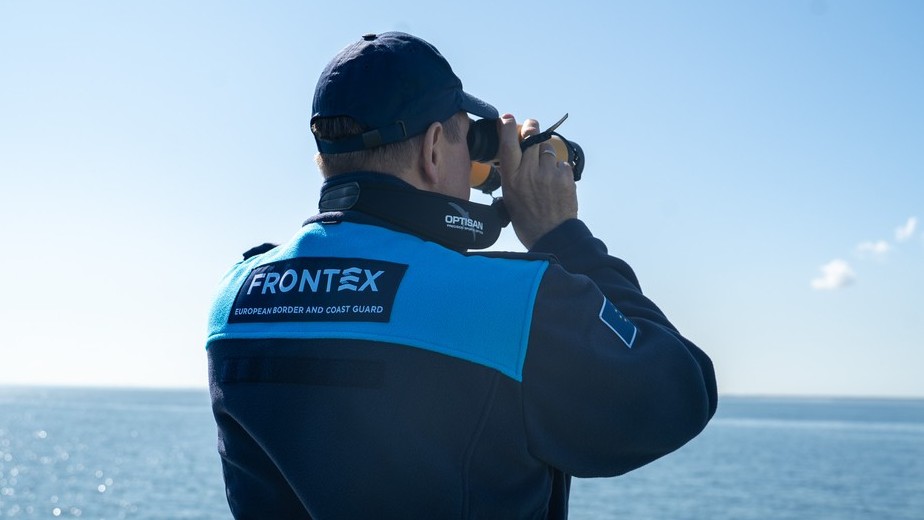
Your social media posts could soon become a matter of EU border security. Under a new proposal, Frontex would monitor online content related to irregular migration, flag potentially illegal material and request its removal. “It will necessarily affect large numbers of people using social media,” warns Chloé Berthélémy of European Digital Rights in an interview with EU Perspectives.
The proposal follows the migration crisis in Ceuta, which the Commission says showed the need for Frontex to act before situations escalate. But giving a border agency eyes on people’s social media comes with serious implications for privacy and free speech. Chloé Berthélémy of European Digital Rights (EDRi) argues that the plan could amount to mass surveillance.
Where do you draw the line between legitimate border security intelligence and the surveillance of people who are considering migrating to the EU?
Since the reception crisis in 2015, the EU has committed itself to a policy of deterrence, aggression and incarceration against asylum seekers and migrants arriving in Europe. This has created a “Fortress Europe” that controls and militarises its borders to prevent, control and criminalise people moving across and between them.
In this context, movement is criminalised and subjected to intrusive surveillance. The Venn diagram between border management and surveillance and control of people coming to the EU is almost a full circle. With the Protect Not Surveil coalition, we demand that the EU addresses migration issues by tackling inequality, conflict, climate change, or the reasons people move.
You might be interested

This requires a radically different approach to human movement: one that recognises movement as a human reality, protects people’s rights, and invests in safety, solidarity and community rather than deterrence and control.
Dramatic real-world consequences
How can Frontex’s online monitoring plans avoid becoming a form of mass surveillance, particularly when the people being monitored have not committed any crime?
It is impossible for Frontex’s online monitoring plans not to turn into mass surveillance. The very purposes of this monitoring are to gather intelligence across the board in order to detect and analyse movements at the borders and beyond, in countries of origin and transit, and to target online content that is supposedly illegal in relation to border-security.
It will necessarily affect large numbers of people using social media, including those outside EU territory. Their personal data will be processed to inform the deployment of border control forces, shape migration-deterrence strategies that may lead to illegal pushbacks, and guide content moderation actions by online platforms and national authorities.
It is impossible for Frontex’s online monitoring plans not to turn into mass surveillance.
— Chloé Berthélémy, EDRi
This data collection is not based on the presumption of innocence, as its purpose is to gather intelligence. Yet it could have dramatic legal and real-world consequences, including detention at borders, violations of the right to seek asylum and the criminalisation of free expression.
How will Frontex’s new social media monitoring activities interact with the Digital Services Act (DSA)?
Frontex will be given the power to request national authorities to issue orders for the removal of content or for information on users “where appropriate”. Under DSA Article 9 and 10, only national authorities designated by member states can issue these orders; there is no mechanism for another authority to prompt national authorities to issue such orders.
Contrary to Frontex, national authorities are subject to transparency and compliance obligations, which give affected users the means to seek redress. Frontex’s new powers to target online content put these procedural safeguards at risk and raise questions about how national authorities will independently assess such requests and comply with fundamental rights, including the principles of necessity and proportionality
What are the risks of designating Frontex as a trusted flagger under the DSA, and what safeguards would prevent the agency from bypassing the Act’s transparency and accountability requirements?
Frontex will also be designated as a trusted flagger under the DSA. However, the designation of trusted flaggers falls under the responsibility of national Digital Services Coordinators. In this case, the Commission is imposing the designation of an EU agency, compromising the balance of powers between the Commission and Member States.
Furthermore, the possibility for a trusted flagger to request content removals through national authorities was never envisaged under the DSA. Combining the power to request online platforms and national authorities to take down content goes far beyond the DSA-defined mission of a trusted flagger. It effectively creates an all-powerful status. Yet, the Commission itself has highlighted the absolute need of a clear separation between these two roles foreseen in the DSA in its Draft Guidelines on Trusted Flaggers.
Frontex’s online monitoring and content reporting activities will likely lead platforms to over-censor online expression, ultimately chilling the speech of migrants and those who stand in solidarity with them.
Once banned, now back in the picture
If Frontex monitors social media posts, online discussions and digital networks to identify people planning to enter the EU, how can it ensure that this intelligence does not undermine the right to seek asylum?
Frontex’s new mission to detect movements way before people reach the EU borders via social media monitoring is an essential part of the Fortress Europe policy. The legislative proposal is clear: the goal is to identify “suspicious behaviours or trends” in people’s movements at the EU borders, and before that, in the countries of origin and transit. Aggregated data collected online will be fed into Frontex’s “risk analysis” to guide border forces’ deployment and reaction.
Frontex’s online monitoring and content reporting activities will likely lead platforms to over-censor online expression.
— Chloé Berthélémy, EDRi
Social media monitoring was already declared as carrying high-risk for violating the fundamental rights of people affected, and was banned by the European Data Protection Supervisor in 2019 when first implemented by the EU Agency for Asylum.
This practice not only threatens the right to privacy but also the international right to seek asylum and the principle of non-refoulement.
European governments increasingly frame migration as a security threat and, in some cases, accuse third countries of instrumentalising or weaponising migration for political purposes. Could social media monitoring reinforce this securitised narrative by treating migration-related online activity as a potential security threat?
The securitisation of migration-related online content is already part of the Commission’s framing to justify Frontex’s expanded powers. The goal of Frontex’s online monitoring and response centre is to target content that “facilitates, promotes or provides instructions for unauthorised crossing of the external borders of the Union, in a manner likely to endanger the security of those borders”.
The provision lists the types of content to be targeted and, under point e), includes content calling for the “instrumentalisation and weaponisation of migration”.
There is no definition of what constitutes instrumentalisation or weaponisation. Such measures could therefore target legitimate expressions of support and solidarity, the sharing of legal information and counselling. Recital 18, for example, mentions the coordination of movements and the provision of logistical guidance.