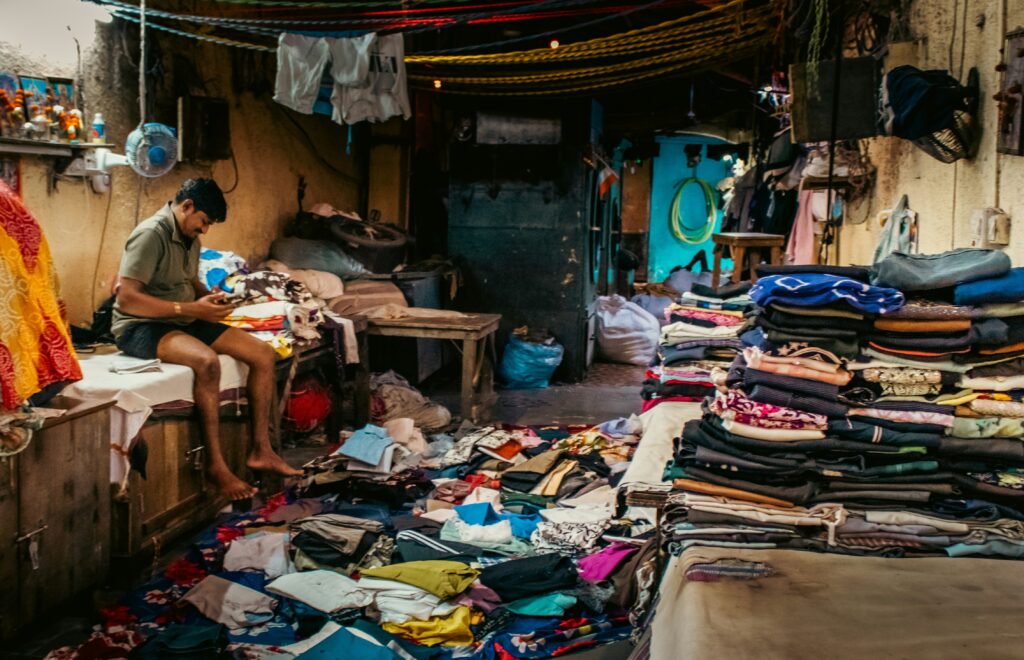
A knitted top collected in Denmark ended up in Nigeria. A Norwegian jacket travelled through Poland and Lithuania before reaching Togo. New research tracking 200 discarded garments across 23 countries reveals the long, often opaque journeys of Europe’s second-hand clothes and raises questions about whether the growing trade in textile reuse is delivering on its promises.
The findings come from a six-month study by Eunomia and Mepex, which tracked 200 garments collected in five Nordic countries. They offer a glimpse into a largely opaque international trade, just as the EU is preparing new rules to improve textile collection, reuse and recycling.
“What we’ll actually likely see is more items going to charity shops that are reusable and aren’t going to wear so quickly,” Eunomia sustainability consultant Vita Ellis told EU Perspectives.
A collection bin can start an international journey
Researchers placed digital trackers in clothing collected in Denmark, Finland, Iceland, Norway and Sweden. The devices recorded locations across 23 countries. Poland accounted for 30% of the last recorded locations, followed by Slovakia at 18% and Pakistan at 14%.
High labour costs encourage Nordic collectors to export clothing unsorted. European facilities then assess garments for different markets and uses. The Danish knitted top that reached Lagos passed through a wholesaler in Włocławek, Poland. A Norwegian jacket travelled through Poland and Lithuania before reaching Togo.
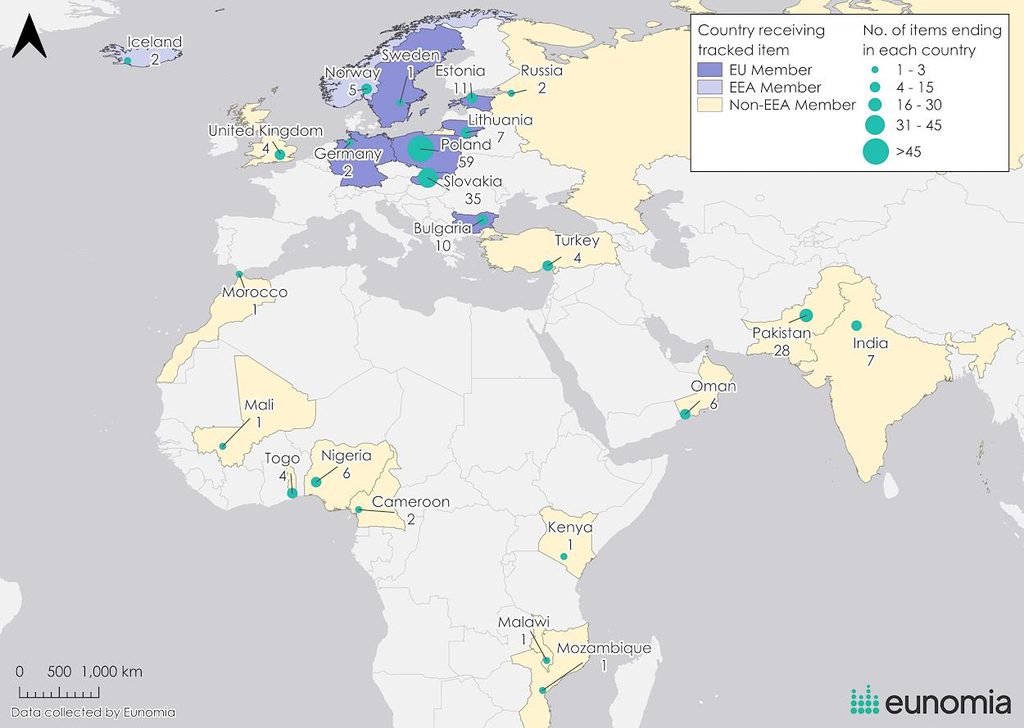
Overall, 71% of trackers last reported from Europe, but some garments were still travelling when the study ended. Sorters may also remove tracking devices while checking clothes, leaving a tracker behind as the garment moves on. Even arrival at a second-hand shop did not establish that somebody bought the item: some remained there for months or returned to wholesalers.
“The findings show that textile exports play an important role in supporting reuse and extending garment lifetimes,” said Kathrine Kirkevaag, senior strategic adviser at Mepex, in the report’s announcement. The research also exposes gaps in what collectors know after export. It did not directly document dumping or uncontrolled burning at African or Asian destinations.
Poorer-quality clothes travel further
The quality of a garment also influenced how far it travelled. Researchers found that lower-quality items were more likely to have their last recorded location outside Europe. This was the case for 56% of Grade D garments, compared with just 24% of Grade A items. Researchers found a statistically significant difference between Grade D and the other grades, although the results describe this sample of 200 items rather than all Nordic textile exports.
| Clothing quality grade | Last recorded in Europe | Last recorded outside Europe |
| A — highest quality | 76% | 24% |
| B | 83% | 17% |
| C | 67% | 33% |
| D — lowest quality | 44% | 56% |
Several heavily worn or stained garments reached markets or storage areas in Pakistan. Better-quality clothing also reached African and Asian markets, while some remained unsold in European shops. Quality influences a garment’s prospects, but demand, trading relationships and available processing facilities also shape its journey.
Ms Ellis sees the consequences of declining quality in second-hand shopping. “I think at the moment, in charity shops, certainly in the UK, you’re seeing a lot of fast fashion items,” she told EU Perspectives. In the report’s announcement, she warned: “As collection volumes increase and product quality declines, improving the quality and durability of textiles is becoming just as important as improving collection rates.”
Better clothes need more than a label
The findings also raise a broader question for EU policymakers: collecting more clothes will not necessarily reduce textile waste if the garments are too poor in quality to be reused.
The revised Waste Framework Directive requires EU countries to establish extended producer-responsibility schemes for textiles by April 2028. Under these schemes, producers will help finance the collection, sorting and treatment of textile waste.Member of the European Parliament Rasmus Nordqvist (Greens/EFA/DNK) welcomed the change but wants stronger requirements for how clothes are made. “We need, for example, recycled content targets,” he told EU Perspectives.
How can we actually make virgin materials at the same price level as the secondary and the recycled ones?
— Rasmus Nordqvist (Greens/EFA/DNK)
Mr Nordqvist also wants garments designed to last longer and be repaired. He voiced concern about rumours that forthcoming ecodesign measures could rely heavily on labels and information, while stressing that he had not seen the final proposals. He wants the Circular Economy Act to strengthen demand for recycled materials and address their price disadvantage against virgin materials. “How can we actually make virgin materials at the same price level as the secondary and the recycled ones?” he asked.
The report recommends expanding regional recycling capacity, improving checks on exported clothing and using producer-responsibility funding to support reuse and repair. For shoppers, better manufacturing could improve clothing on both sides of the second-hand market. “With this new regulation, that should affect things that people can buy second hand as well as things that they can buy firsthand,” Ms Ellis said.