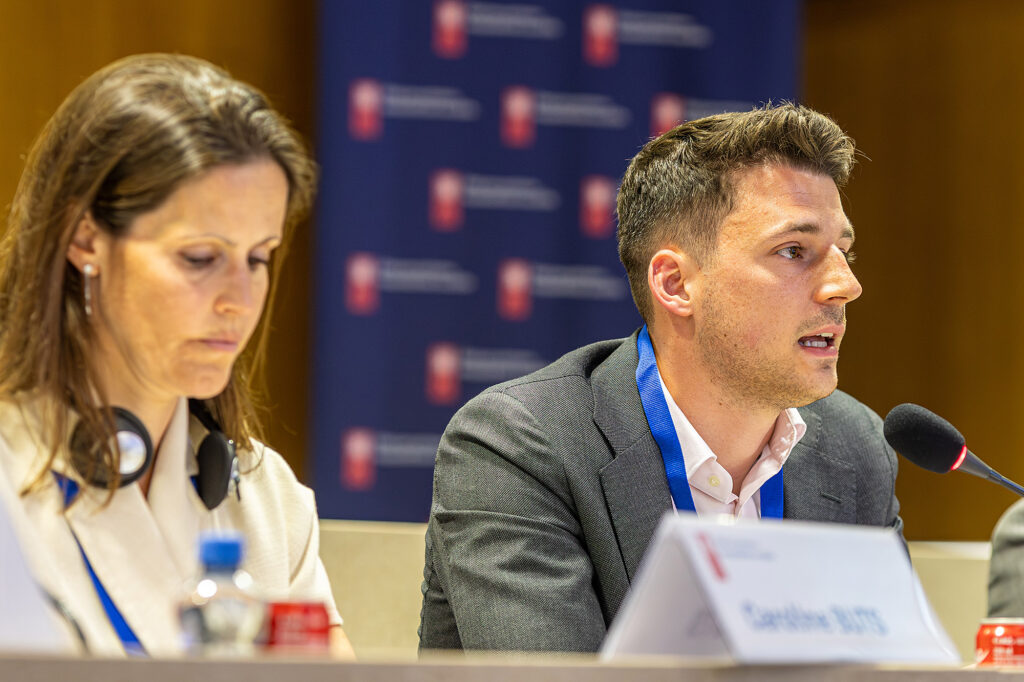
Public money alone will not deliver Europe’s clean transition. Instead, the European Commission is increasingly using state aid rules to encourage private investment alongside government funding, according to Belgian state aid expert Seppe Maes from the Vrije Universiteit Brussel.
That shift lies at the heart of the Clean State Aid Framework (CSAF), the Commission’s new rulebook governing public support for clean technologies after the expiry of the Temporary Crisis and Transition Framework.
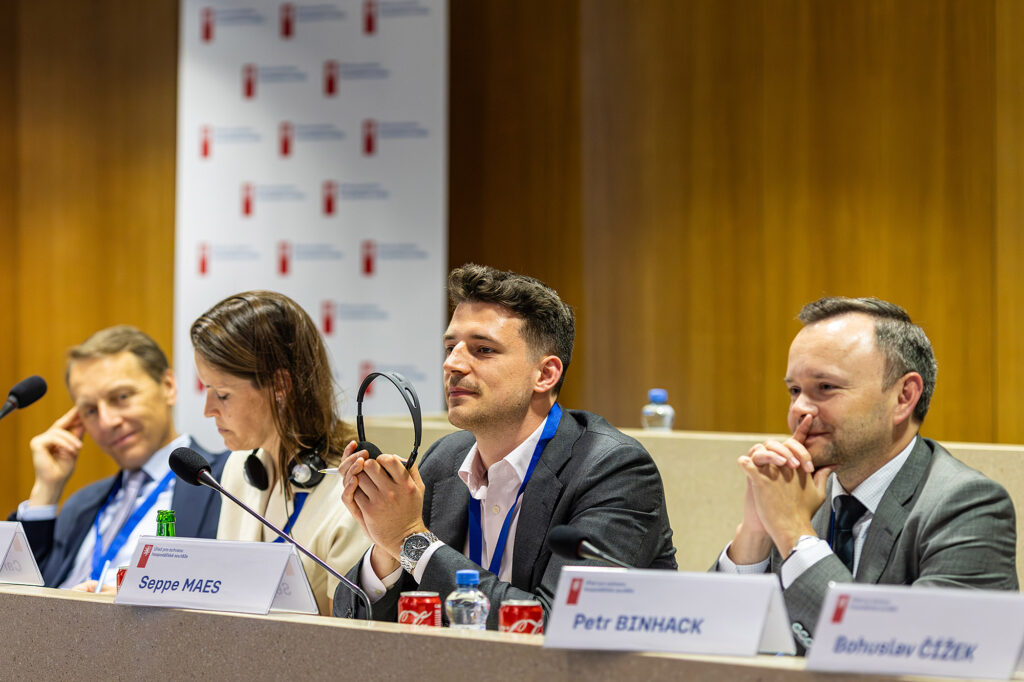
Speaking at a conference called State Aid in Motion hosted by the Czech Office for the Protection of Competition, Belgian state aid expert Seppe Maes argued that the framework reflects a broader change in European economic policy. Public funding alone, he said, will not be sufficient to meet the EU’s strategic objectives, making private investment an essential part of the bloc’s industrial strategy.
“The question is no longer simply how governments spend public money,” Maes suggested. “It is how they can use public money to reduce risk and attract much larger volumes of private capital.”
From grants to financial instruments
For decades, grants have been the dominant form of state aid across Europe. Under the CSAF, however, the Commission is signalling a preference for loans, guarantees, equity investments and other financial instruments.
The reasoning is straightforward. Unlike grants, loans can be repaid and reused, creating what policymakers call a “revolving effect.” Guarantees are even more efficient: if a company never defaults, the public funds backing the guarantee are never actually spent.
“The question is no longer simply how governments spend public money. It is how they can use public money to reduce risk and attract much larger volumes of private capital.”
— Seppe Maes
Perhaps more importantly, these instruments reduce investment risk for private financiers. If public authorities absorb part of the potential losses, commercial banks and investment funds become more willing to finance projects that might otherwise appear too risky.
According to Maes, this “leveraging effect” is one of the framework’s most significant innovations because it allows relatively limited public budgets to mobilise substantially larger private investments.
Financial intermediaries also bring technical expertise in assessing projects and managing investments. Expertise that governments themselves often lack.
Why governments still prefer grants
Despite the Commission’s ambitions, grants continue to dominate state aid schemes across Europe. The reason, Maes argued, is less ideological than practical.
Financial instruments are simply more complex to design and administer. Many national authorities remain reluctant to use them because they require calculating the value of aid embedded in loans or guarantees, known as the Gross Grant Equivalent.
While these calculations are often perceived as highly technical, Maes argued that the process is considerably less daunting than many administrations assume. The Commission itself provides much of the necessary methodology, meaning the administrative barrier is often more psychological than real.
Keeping electricity systems stable
The CSAF is not only about financing. It also introduces guidance for so-called capacity mechanisms: government schemes designed to ensure electricity systems remain reliable as Europe increasingly relies on intermittent renewable energy.
Maes described two broad approaches. One involves maintaining strategic reserves, where generation capacity is held back and activated only during periods of exceptional demand. The other is a broader market-wide system in which electricity producers are paid for guaranteeing that sufficient capacity will be available when needed, regardless of whether it is actually used.
These mechanisms have become increasingly important as solar and wind power expand across Europe, creating greater challenges for balancing electricity supply and demand. However, because capacity payments can distort competition, member states must demonstrate that such schemes address genuine market failures and are proportionate to the problem they seek to solve.
The nuclear misconception
One of the most politically sensitive questions surrounding the CSAF concerns nuclear energy. According to Maes, a widespread misconception has emerged that the framework creates a fast-track for subsidising new nuclear projects. It does not. Instead, the Commission has adopted a position of technological neutrality.
Unlike previous temporary frameworks, which largely ignored nuclear energy, the CSAF leaves the door open for support but provides no dedicated approval pathway. Each project will continue to be assessed individually under existing state aid rules.
Belgium illustrates the broader shift in political thinking, Maes describes. Having spent nearly two decades pursuing a nuclear phase-out, the country is now reassessing whether retaining nuclear generation should form part of its future energy mix.
Romania offers a glimpse of the future
A recently approved Romanian state aid scheme demonstrates how the Commission increasingly expects member states to address weaknesses in the clean energy transition.
Romania invested heavily in solar and wind generation but found that electricity storage capacity lagged behind. Without sufficient storage, renewable electricity cannot always be used when it is generated, limiting the effectiveness of clean energy investments.
The new scheme therefore supports energy storage rather than additional generation capacity — a sign that EU industrial policy is becoming more targeted and focused on removing bottlenecks instead of simply expanding renewable deployment.
Competition policy remains central
The conference concluded with a broader debate about whether state aid law has become an instrument of industrial policy rather than competition policy.
Maes rejected the notion that the two objectives are mutually exclusive. State aid rules, he argued, exist to preserve the integrity of the EU’s single market by preventing wealthier member states from outspending smaller ones while still allowing governments to pursue legitimate strategic objectives.
Industrial policy determines where Europe wants to go. Competition policy ensures member states do not undermine one another while getting there.
As the EU seeks to strengthen its strategic autonomy, accelerate decarbonisation and compete with increasingly interventionist powers such as the United States and China, that balance is likely to become one of the defining questions of European economic policy.