Disinformation is one of the core challenges facing European democracies. But it is only part of a much bigger problem. Digital platforms are built to keep users hooked by amplifying the content most likely to spark conflict, outrage and division rather than constructive debate.
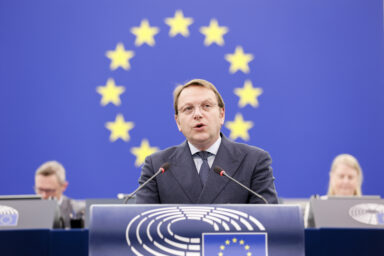
Last week, the European Parliament hosted Mario Scharfbillig, co-author of the Joint Research Centre (JRC) report Fractured Reality: How Algorithms Fuel Polarisation and Affect Democracy. The discussion explored how the attention economy and recommendation algorithms are transforming Europe’s information ecosystem, weakening the common factual ground on which democratic debate depends.
Focusing solely on misinformation and disinformation means addressing the symptom rather than the underlying cause, according to the JRC. Several MEPs echoed this point during the debate. They argued that citizens are increasingly living in separate information environments, exposed to different narratives and less likely to share common facts or cultural references.
Attention economy
Today’s digital platforms and their recommendation systems are not inherently biased toward particular political ideologies, the report argues. Rather, they are optimised to maximise user attention. As a result, algorithms systematically amplify emotionally charged, divisive and confrontational content because it keeps users engaged for longer.
“The type of content that’s prioritised is disagreement. Information quality doesn’t matter to the algorithm as long as it creates engagement and locks us in,” he explained. For Mr Scharfbillig, this business model represents a serious threat to democratic societies and it’s “extremely dangerous”.
He stressed that the issue is deeply structural. “We agree very much that it’s about the structure of the platforms that we need to address. What we say is that it is important to change the business model fundamentally.”
Even if Europe were to develop its own digital infrastructure or create European social media platforms, he warned, it would not solve the problem if they relied on identical economic incentives. “If it’s run on the same model, it will result in the same thing.”
Information quality doesn’t matter to the algorithm as long as it creates engagement and locks us in. — Mario Scharfbillig, Joint Research Centre
One of the report’s key conclusions is that media literacy (recently discussed in Strasbourg), fact-checking and debunking campaigns is important. However, it cannot solve a problem that is rooted in the architecture of digital platforms.
Instead, the JRC argues that the platforms themselves need to change. It calls for greater algorithmic transparency, stronger user control over recommendation systems, and the development of alternative digital public spaces designed to foster deliberation rather than outrage. “Pre-bunking, debunking, media literacy, putting the emphasis on citizens to do all of this while they’re exposed to this fracturing of reality is not the right solution.”
Is DSA enough?
The report also links these recommendations to Europe’s broader ambitions for digital sovereignty. It argues that democratic resilience depends on regulating platforms and on developing independent European digital infrastructures. Several MEPs pointed out that the EU already possesses important regulatory tools, particularly through the Digital Services Act (DSA).
Alexandra Geese (Greens/DEU) described today’s online environment as “engineered”. In her view, engagement-based ranking, behavioural profiling and addictive platform design as the three main drivers of polarisation. She called for engagement-based recommendation systems to be recognised as a systemic risk under Article 34 of the DSA, allowing regulators to intervene more decisively.
Other lawmakers focused on foreign interference, asking how the EU could better tackle Russian and Chinese bot networks and coordinated influence campaigns. Mr Scharfbillig acknowledged these concerns but insisted they should not distract from the systemic issue. “Whether these users are in the EU or not is not relevant to this. We do know there’s an incentive to create polarising content.”
In other words, foreign actors exploit incentives that already exist within the platforms’ business models rather than creating the problem themselves.
Democratic public spaces
Among the report’s more ambitious recommendations is the creation of new European digital public spaces where citizens can engage in meaningful discussions based on shared evidence rather than algorithmically amplified conflict.
Whether these users are in the EU or not is not relevant to this. We do know there’s an incentive to create polarising content. — Mario Scharfbillig, Joint Research Centre
According to Mr Scharfbillig, technology itself is not inherently polarising; it is the way current platforms are engineered that drives division. “There are other options for technology that work, to find common ground rather than to disagree. But this is not how these platforms are designed.”
The report also stresses the need for significantly greater access to platform data. Despite recent regulatory efforts, independent researchers still struggle to understand the real impact of recommendation algorithms because access remains limited.
Trust is the key
David Mair, Head of Unit at the Joint Research Centre, cautioned against expecting a purely technological solution. The health of democracy, he argued, ultimately depends on rebuilding citizens’ trust in democratic institutions, governments and professional journalism.
Polarisation and disagreement are natural features of democratic societies, he said. The real challenge is ensuring that citizens continue to share enough common ground to engage in constructive debate.
Disinformation is not the primary threat, the report argues. Instead, the architecture of the attention economy itself has become a democratic challenge. As long as online platforms continue to reward outrage, conflict and emotional engagement above information quality, fragmented realities will increasingly replace the shared public sphere on which democracy depends.