The European Union is discovering that defending against drones is easy to say, hard to systematise, European Council on Foreign Relations paper argues.
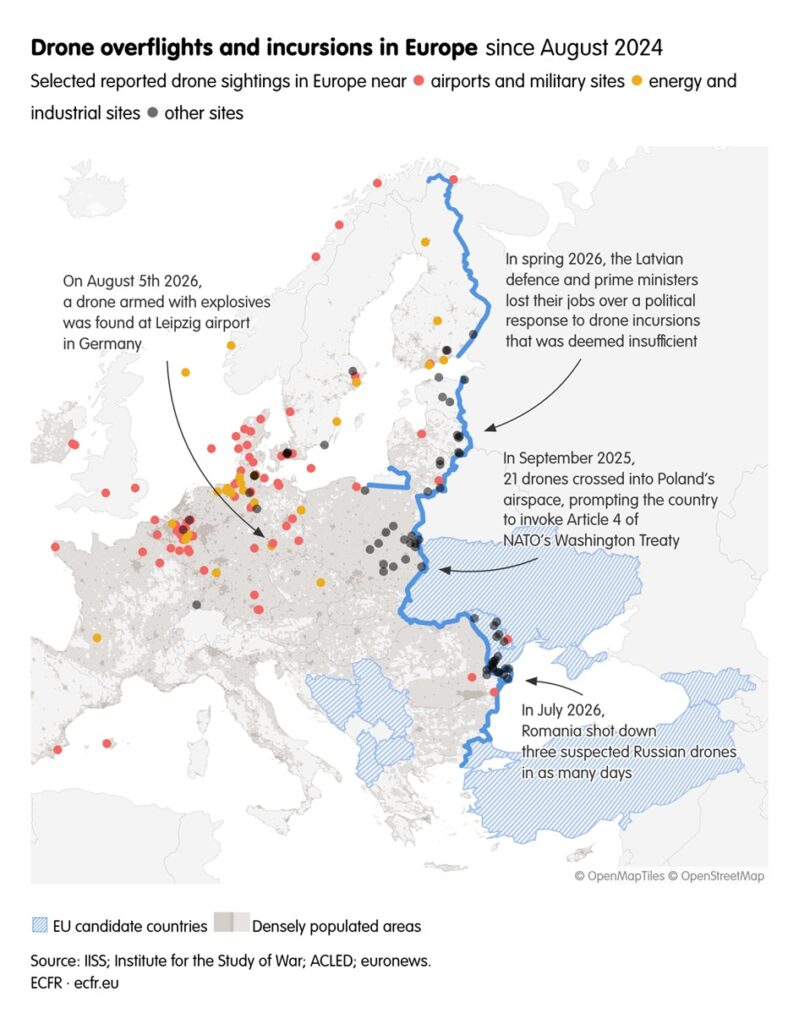
Europe has a drone problem, and it is getting worse. Along the eastern flank, military drones now cross borders with grim regularity; on August 5th a small explosives-laden drone turned up at Leipzig airport, and weeks later, another was found nearby. The threat has split into two distinct but related crises. One is civil and often shadowy: small drones over airports, nuclear plants and liquefied natural gas terminals, mostly linked to Russia’s broader campaign of nuisance, sabotage and intimidation.
The other is overtly military. A new paper by Ulrike Franke, senior policy fellow at the European Council on Foreign Relations, argues that Europe is no longer dealing with a marginal nuisance but with a continent-wide structural security challenge. The paper says the east is already becoming a testing ground for the rest of the continent.
A wall of problems
“Drones are a whole-of-Europe problem,” Ms Franke writes, “which means all European countries need to invest in counter-drone capabilities.” The eastern flank has become the sharp end. In September 2025 around 20 Russian military drones crossed into Polish airspace, prompting Warsaw to invoke Article 4 of NATO’s Washington Treaty and the alliance to launch Operation Eastern Sentry. The attribution problem is different here from the civil threat.
The paper notes that origin is rarely in doubt, but intention often is. Russia can claim, sometimes plausibly, that incursions are accidents for which the war against Ukraine is to blame. That ambiguity is convenient for Moscow as well as costly for everyone else. That is exactly what the Kremlin wants.
The paper identifies a particularly painful asymmetry. Europe’s existing air-defence systems fight cheap, disposable drones at ruinous expense. The Polish operation against the September 2025 incursion used F-16s, helicopters and missiles costing vastly more than the Russian Gerbera drones they went to stop.
The civilian side of the problem is no less alarming, if less dramatic. Germany’s aviation agency reported 227 drone sightings by pilots in 2025, a figure rising steadily since 2020. The Leipzig case, where a quadcopter roughly the size of a microwave oven was carrying explosives near a Ukrainian cargo plane, may have been Europe’s closest call yet.
The architecture of defence
As the paper notes, had the Leipzig device detonated, the consequences could have been catastrophic. Romania has also faced repeated incursions, including one in which a drone crashed into an apartment building in Galați, injuring two people and forcing the evacuation of 70 residents.
What lifts the paper above a threat inventory is its insistence on architecture. Ms Franke argues that Europe should not chase a single silver bullet or a grand all-purpose drone wall. Instead it should build layered defences: detection, defeat and command-and-control, all adapted to different contexts and environments.
That design logic resembles military procurement doctrine, but it doubles as a political argument. If the eastern flank is Europe’s outer shield, its cost becomes a European rather than merely national responsibility. The paper says the EU should fund more of those defences precisely because they protect the whole continent, not just the border states.
The coordination imperative
Yet the paper’s most interesting claim is not about hardware. It is about governance. The eastern flank, Ms Franke argues, should serve as Europe’s proving ground: a bounded theatre in which systems can be tested, standards agreed and data shared before lessons travel west.
No build-up of European defences can replace diplomatic, political and military efforts to end the Russian aggression against Ukraine.
— Ulrike Franke, European Council on Foreign Relations
This is where the paper becomes almost bureaucratically radical. It wants Brussels not to micromanage every interception but to do the dull, difficult work that makes interoperability possible. That means common standards, legal guidance, procurement coordination and data exchange across the entire flank, from Nuorgam in northern Finland to Burgas in southern Bulgaria.
That is a more plausible ambition for Brussels than inventing a continent-wide drone superweapon, and it fits the political reality that Europe already has a patchwork of national responses. Poland is building what it describes as Europe’s largest anti-drone system, estimated at €3.8bn. Finland has allocated €44m to border drone detection.
Fragmentation as failure
The problem is fragmentation rather than absence of activity. The paper warns that if projects develop separately, Europe risks overlapping technologies, incompatible data systems and legal confusion over when drones may be intercepted. A drone defence architecture is not only sensors and interceptors. It is a common legal and institutional language.
After one incursion in Romania, a military representative explained that the drone had not been intercepted partly because of uncertainty over the legality of doing so. “Ukraine is at war,” he said, “but Romania is at peace.” All eastern flank states share that dilemma, and the paper argues the EU is well placed to resolve it. After all, the fact that Romania is not at war should not be read as a carte blanche for whomever to fly military-grade stuff in its airspace.
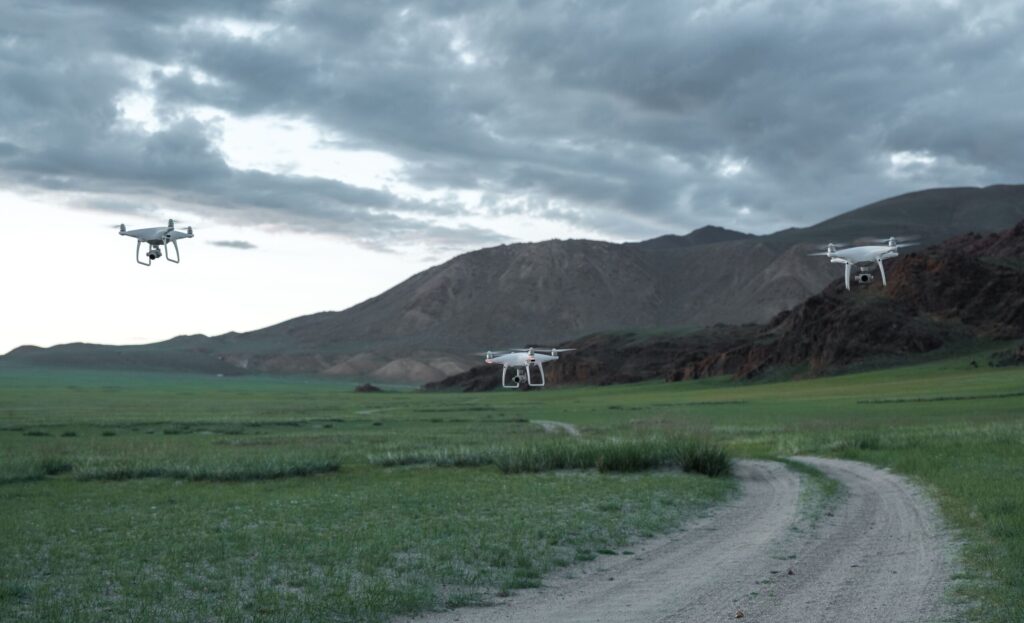
The paper also cautions against overlearning from the eastern flank. Military incursions and critical-infrastructure overflights are different problems requiring different solutions. In civilian settings, electronic countermeasures and cyber-takeover tools may be more appropriate than missiles or cannon fire.
Lessons that must travel west
This, of course, is a two-way street. Deputy defence minister Cezary Tomczyk of Poland made the point bluntly when describing his country’s multi-barrel machine guns: “Some of this is for use only in extreme or war conditions. For example, these multi-barrel machine guns are difficult to use in peacetime, because everything that goes up must go down,” he said. (The deputy minister deftly sidestepped the somewhat obvious point that machine guns, multi-barrel or otherwise, tend to encounter fewer difficulties finding good use in war than in peacetime.)
Ms Franke resists the temptation to generalise from the most dramatic case. A drone wall may be useful on a border; it is not a universal answer for airports, ports and power plants. The EU’s job is to help member states understand that distinction rather than paper over it with a single grand initiative.
These multi-barrel machine guns are difficult to use in peacetime, because everything that goes up must go down.
— Cezary Tomczyk, Poland’s deputy defence minister
The paper’s final logic is hard to dispute. If drones are cheap, numerous and increasingly adaptable, Europe cannot rely on prestige platforms alone. It needs layered, legal, institutional and technical resilience. The eastern flank should be defended first, but not only for its own sake. The lessons learned there must travel west. Europe’s drone problem is no longer episodic; it is structural.
The paper cocludes that “Better option than to defend against overflights and incursions is to stop them from happening in the first place: no build-up of European defences can replace diplomatic, political and military efforts to end the Russian aggression against Ukraine and Russia’s hybrid attacks against European nations.” But, like anti-drone defence itself, this is easier said than done.