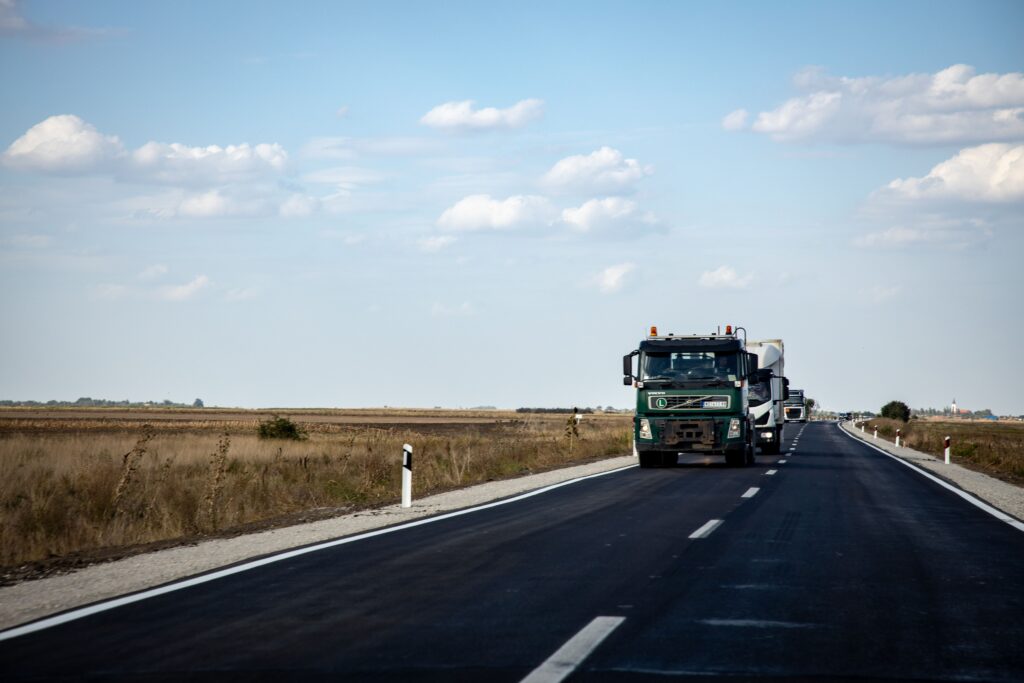
Germany has all but abandoned Sunday rest for its lorry drivers. The Rhine has fallen too low to carry the coal, ore and chemicals the country needs. Trucks are taking over instead. It is the clearest sign yet of a drought reshaping how Europe moves its goods.
By Wednesday, 15 of Germany’s 16 states had suspended the ban. It normally keeps lorries off the roads on Sundays and public holidays. The wave began in the west more than a week ago. It swept east this week, picking up Berlin, Brandenburg, Thuringia and Saxony. Only Saxony-Anhalt is still holding out.
The trigger is a river running out of water. Brussels was not prepared for this. Cologne’s Rhine gauge sank last week to its lowest reading since 1816. It is one of the two most important gauges on the river, alongside Kaub. The European Commission’s own Water Resilience Strategy was meant to help member states handle exactly this kind of shock. It was adopted a little over a year ago.
A patchwork with one holdout
The exemptions are not identical. In Berlin, Brandenburg and Hesse, lorries may only use the extra hours for goods that would otherwise travel by river. Thuringia and several other states have lifted the ban for all freight. Where an end date has been set, it falls at the end of August or September, depending on the state.
Saxony held out longest. Days ago, it said it saw no need for an exemption. It changed course on Wednesday without explanation. It joined the states that had already acted. For now, only Saxony-Anhalt keeps the old rule in full.
At the Kaub chokepoint, the navigable depth fell to 12 centimetres on Wednesday. That is below the previous record of 25 centimetres, set in 2018. Most vessels can no longer pass through in either direction, according to one commodity trader. Some are turning back north. Others are stranded to the south. On the river’s northern stretches, ships are sailing only around a fifth full, to avoid running aground.
The strain shows clearly at Germany’s steel plants. Logistics operator RheinCargo normally ships around 24,000 tonnes of coal and ore a day from Rotterdam to the Huettenwerke Krupp Mannesmann works in Duisburg, part of the Salzgitter group. Low water has cut that to about 14,500 tonnes. To close the gap, RheinCargo is now running three freight trains a week between Rotterdam and Duisburg, until the end of September. Each one carries around 2,000 tonnes of coal. Germany’s transport minister, Steffen Bilger, pointed to cases like this. In a television interview with RTL/ntv, he called for greater investment in the country’s waterways. He described low water as a recurring test for supply chains.
Forums, not floods of investment
Environmental groups, trade unions and hauliers are all sceptical that the extra lorries achieve much. A single barge can carry up to 100 times as much cargo as a truck, industry figures point out. Even a large jump in road traffic replaces only a sliver of what the river cannot carry this summer. The same gap between ambition and effect shows up one level higher, in Brussels.
The Commission’s Water Resilience Strategy leaves member states to decide for themselves how to cut water use, whether by fixing leaks or expanding reuse. Its own tracker shows only four of 30 main actions completed so far. Among them are a stakeholder forum and an advisory facility at the European Investment Bank. The strategy’s headline goal is a 10 per cent efficiency gain by 2030. The methodology for measuring it is not due to be reviewed until 2027.
Simply deepening the rivers cannot be the answer to today’s problems.
— Carsten Schneider, Federal Minister for the Environment, Germany
Germany’s environment minister, Carsten Schneider, pushed back this week against a purely engineering-led response. “Simply deepening the rivers cannot be the answer to today’s problems,” he said. He argued that Germany should move away from building shipping canals. Instead, it should restore riverbeds closer to their natural state, including oxbows and meanders.
For lorry drivers already working through their Sundays, that debate can wait. The rivers will not recover until it rains.