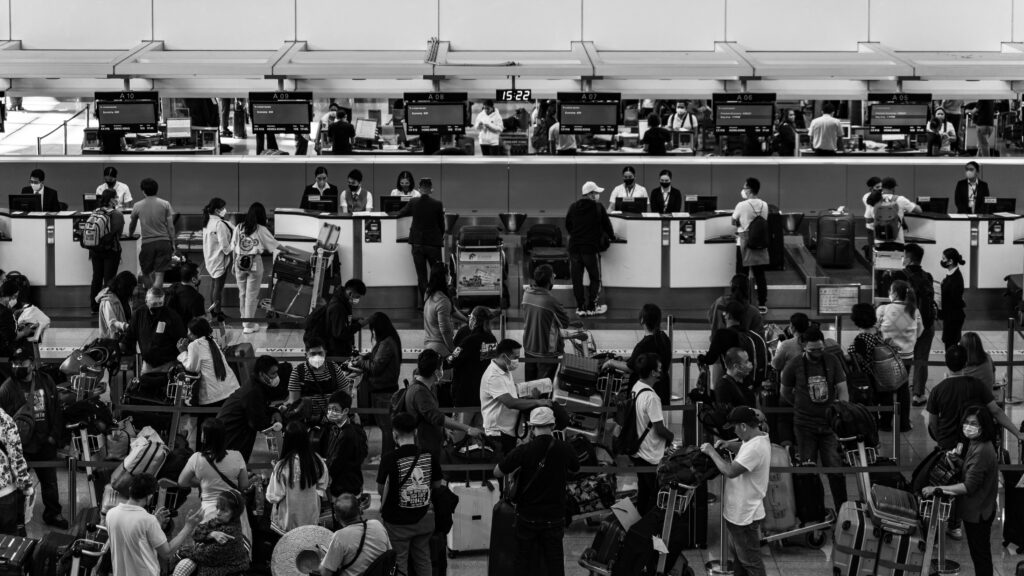
Landing in Frankfurt or Amsterdam this month? At peak times, your wait at passport control could stretch to two hours. Airlines and airports begged Brussels to ease border checks during the busiest weeks. Brussels said no.
Six weeks ago, airports across Europe warned Brussels the situation had reached breaking point. Nothing has changed since, except the queues. At some hubs, including Rome and Faro, processing times have nearly tripled compared with the old manual stamping system. Passengers arriving at two of the continent’s busiest hubs, Frankfurt and Amsterdam, now wait up to two hours just to have their fingerprints scanned and their face checked against a database, before they even reach the baggage carousel.
This is not a new problem. In July, three aviation groups told the Commission the system had reached a critical point, with waits stretching to seven hours at some airports. What is new is the answer they got back this week: no relief, not even during the busiest weeks of the year.
Brussels holds the line
Airlines and airports asked for one specific thing: permission to switch off border checks whenever queues spiral out of control. The Commission refused. The system stays on, whatever the wait outside the terminal.
The scale of the operation explains why airports are worried. Since going live in April, the system has logged over 160 million border crossings across the Schengen area. At Frankfurt, peak queue times reached 120 minutes in July, double what they were a year earlier. Amsterdam saw a similar jump, from 80 to 120 minutes, while Munich’s peak wait rose from 31 to 60 minutes.
Olivier Jankovec, head of the Airports Council International Europe (ACI Europe), put it bluntly in July: the technology simply is not working as promised. “The processes need to work better,” he said. “We need the self-service tills to work, and at the moment they don’t work.” The International Air Transport Association (IATA), another signatory of the July letter, declined to comment further when approached by EU Perspectives this week.
We are in close and constructive contact with those few member states where there are challenges.
— European Commission spokesperson
The Commission sees it differently. “We are in close and constructive contact with those few member states where there are challenges at certain border crossing points,” a spokesperson said this week. Officials maintain the system was launched successfully and is largely functioning as intended, and that flight schedules concentrated at busy hours, not the technology itself, are driving the delays. The aviation industry rejects that explanation outright: airlines plan their schedules a year in advance, so peak hours are hardly a surprise.
A deadline nobody can move
Border authorities have had one safety valve since April: the option to pause biometric checks when queues get out of hand. That valve closes at the start of September, right as the last wave of summer travellers heads home.
After that, there is no more pausing, no matter how long the line outside the terminal gets. The Commission has also scheduled a formal review of the system for 6 September, giving Brussels a chance to reassess, but not before millions more travellers pass through the queues this refusal has left in place.
For now, Brussels has not shut the door entirely. Eight member states, along with Switzerland, have asked for the flexibility to be extended beyond September, and the Commission says it is in close contact with the countries facing the biggest challenges. But it has not confirmed an extension, and the clock is still running out.