From semiconductor supply chains to research funding, a closer EU-Canada alliance may start taking shape. Legislation is still scrambling to catch up.
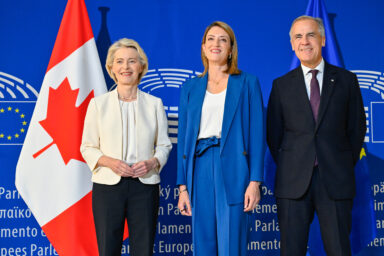
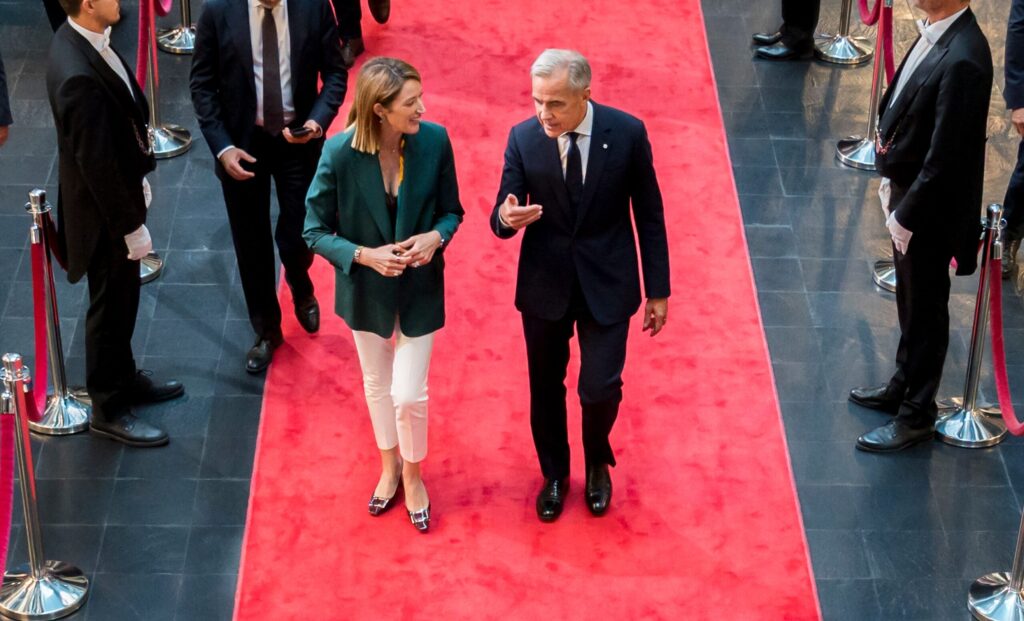
“Sovereignty today goes beyond being able to feed, fuel, and defend ourselves,” Canadian Prime Minister Mark Carney told the European Parliament on 17 September. “It now requires secure access to AI, semiconductors, critical minerals, payment systems, clean energy technologies, vaccines, and space-based communications. And we all have important gaps in these strategic capabilities.”
The Canadian came with a groundbreaking proposition. If the vulnerabilities of Europe and Canada are impossible to close separately, let us tackle them together, in an “alliance for the future”, he said. The next EU-Canada summit, scheduled for Montreal on 29-30 October 2026, will begin translating the rhetoric into specifics.
The sovereignty stack
Some of the areas where translation matters most include artificial intelligence, scientific research, and semiconductors and payment systems. They are distinct in their technical detail. They share a common denominator. Each represents a domain where neither partner is self-sufficient. Dependence on a single supplier, state or corporate, creates exploitable vulnerability. Combining complementary strengths produces something neither can build alone.
Mr Carney was precise about the logic. “The institutions we’ve inherited are organised by geography,” he said. “The strategic capabilities that we need are organised by function. We can ally by function if we are bold and deliberate.” That framing matters. It suggests the alliance should not wait for a comprehensive treaty architecture. It should build functional partnerships now, in parallel, across each strategic domain.
The argument rests on a frank assessment of collective weakness. Europe and Canada each rely on “individual nations or individual companies” to fill gaps in strategic capabilities. That reliance creates vulnerabilities, particularly when supposedly global companies prove national in the breach. The reference to technology platforms that “aspire to sovereignty” and “want to control our data” was pointed. Everyone in the hemicycle understood it; most agreed.
Diversification through depth
The response Mr Carney proposed is not protectionism. It is diversification through depth. “The economics of this are clear,” he said. “The leverage of the powerful in an exploitative relationship collapses well before complete independence is achieved. Because diversity confers advantage.” The goal is not to replicate every capability on both sides of the Atlantic. It is to build enough redundancy that no single chokepoint can be used as a lever of coercion.
The leverage of the powerful in an exploitative relationship collapses well before complete independence is achieved. Because diversity confers advantage. — Mark Carney, Canada’s prime minister
Europe brings market power, regulatory reach, and advanced manufacturing. Its defence industrial base is being rebuilt at speed. Canada brings energy at scale and one of the world’s largest endowments of critical minerals. It also has Arctic geography and, less often noted in European capitals, deep capabilities in AI, quantum computing, and space.
On artificial intelligence, the foundation already exists. A bilateral AI Memorandum of Understanding, signed in 2025, established a Digital Partnership Council. It committed both sides to standards dialogue and compute-access pilots, with first deliverables due in June 2026. Canada’s Scale AI super-cluster and the EU’s AI Factories, funded under the Digital Europe Programme, could interconnect. They could reserve high-performance computing capacity for small firms and research consortia on both sides of the Atlantic.
The AI imperative
A September 2026 EU-Canada Matchmaking Event in Montreal brought together participants from 12 EU countries and Canadian AI firms across five technology areas: artificial intelligence, advanced manufacturing, digital technologies, quantum technologies, and defence and security. Annual repeats could grow into a rolling accelerator with dual market listings. Mr Carney proposed going further. “Canada and Europe can join forces to develop AI safety protocols, coordinate common standards, and strengthen transparency, all while developing applications so that our governments and our companies can serve our citizens better,” he said.
That sentence does a great deal of work. It links the governance agenda, safety, standards, and transparency, directly to the delivery agenda: applications that serve citizens. The two are often treated as separate conversations. Mr Carney’s framing insists they are the same one.
The EU’s AI Act is now in phased implementation between August 2026 and August 2028. It governs this space on the European side. It establishes risk-tiered obligations and transparency requirements for general-purpose AI models. Crucially, Article 48 provides a mechanism for recognising equivalent third-country conformity-assessment schemes. An implementing decision in 2027 could deem Canada’s Artificial Intelligence and Data Act governance framework equivalent for low- and medium-risk AI systems. That would eliminate duplicative certification for firms operating in both markets.
Rewriting the rules
Article 57 of the AI Act provides for national regulatory sandboxes. A delegated act could extend this to cross-border sandboxes. These would run jointly by the European AI Office and Canada’s Innovation, Science and Economic Development department. Firms would test once and file results to both supervisors. It is a straightforward change with significant commercial consequences.
The data layer requires a parallel fix. The General Data Protection Regulation already grants adequacy status to Canada’s commercial sector. But health-research and financial-model data transfers still require standard contractual clauses or bespoke agreements. That friction slows joint AI development and raises costs for smaller firms. An amendment to the adequacy decision under Article 45 GDPR, extending coverage to public-sector bodies engaged in joint research, would remove it at a stroke.
Who is Canada’s most important international partner
The European Health Data Space Regulation begins rolling out primary-data obligations from 2027. Full cross-dataset exchange follows by 2029-31. Aligning Canadian provincial health-data hubs with EHDS infrastructure from the outset would allow joint deployment of multilingual clinical AI tools across both jurisdictions. Pooled EU-Canadian health datasets could cut model-training times and improve diagnostic accuracy across more diverse patient populations.
The NIS2 Directive and the Cyber-Resilience Act set the cybersecurity baseline that any such shared infrastructure must meet. Extending their logic to a bilateral framework, with common incident-reporting timelines and shared threat-intelligence repositories, would reduce systemic risk considerably.
The resilience deficit
The semiconductor question is starker. Europe’s chip production remains heavily dependent on non-allied suppliers for advanced nodes. Canada holds deposits of over 34 critical minerals. It ranks among the top producers of the ten most essential for the energy transition and chip manufacturing. An alliance combining Canadian mineral endowments with European advanced manufacturing and processing capability closes a loop that neither partner can close alone.
The EU Chips Act targets a doubling of Europe’s global semiconductor market share to 20 per cent by 2030. Its ambition is clear. Its international-cooperation provisions are thin. The regulation focuses on mobilising European public and private investment and building pilot production lines. It does not provide a framework for integrating allied third-country firms into EU semiconductor projects. Amending it to do so would require a targeted legislative revision, expected in the 2027 review of the Chips Act.
If you ask our young people what they associate the European Union with, I would tell you Erasmus is the first thing they mention. Horizon is the second thing. — Roberta Metsola, president of the European Parliament
A legally binding Digital and AI chapter added to CETA as a side instrument would provide the broader trade architecture. Such a chapter could create expedited customs-duty waivers for AI chips and quantum-hardware exports. It could guarantee bans on data-localisation requirements for anonymised training data. Mutual recognition of each side’s cyber-resilience and operational-risk frameworks should be possible. It would provide a legal basis for the joint semiconductor supply-chain initiative that both sides have discussed in outline but not yet committed to in detail.
An integrated financial market
On payment systems, Mr Carney’s ambition was the most expansive of any he outlined. “Canada and Europe should consider exploring an integrated market for financial services,” he said, “to broaden choice and reduce costs for our citizens, to improve access to capital for our companies while maintaining our world-leading financial resilience.” An integrated financial-services market would be a significant undertaking. But its building blocks are identifiable.
The EU’s Digital Operational Resilience Act has applied to all financial entities since 17 January 2025. Canada’s Office of the Superintendent of Financial Institutions Guideline B-13 on technology and cyber risk management covers similar ground from a similar philosophical starting point. The two frameworks are compatible. A mutual-recognition memorandum of understanding between DORA and the OSFI framework could let financial technology firms certify cloud and AI controls once and operate in both markets. Compliance costs would fall significantly.
Interoperability between the EU’s T2 settlement system and Canada’s Lynx high-value payment system would reduce transaction costs and settlement times for cross-border commerce. Trade in goods between the EU and Canada has risen 75 per cent since CETA’s entry into force.
The payment infrastructure has not kept pace. The Payment Services Directive II governs payment service providers across the EU. Its successor, PSD3, currently in legislative process, offers an opportunity to include provisions for recognised third-country payment providers. Canadian firms, operating under a compatible regulatory regime, could plausibly occupy that category.
The research dividend
Of all Mr Carney’s proposals, Canadian membership of the next generation of the Horizon research programme may be the most consequential for long-term competitiveness. “Canadian membership of the next generation of Horizon would allow us to pool resources, cooperate on frontier technologies, and leverage our world-class research institutes and universities,” he said. The current Horizon Europe framework does not provide for full third-country membership on the terms Canada would require.
Its successor—Horizon 2027+, currently partly operational—offers the opportunity to design that architecture from the outset. Membership would require agreement on financial contribution formulas, governance rights, intellectual-property ownership, and the handling of sensitive dual-use research. None of those questions is insurmountable. All of them require negotiating time that should start now, not after the Montreal summit.
Who will be Canada’s most important international partner in 3-5 years
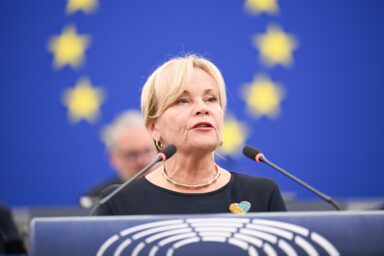
European Parliament President Roberta Metsola, who holds institutional authority over the Horizon budget as co-legislator, was direct about the Parliament’s appetite. “If you ask our young people what they associate the European Union with, I would tell you Erasmus is the first thing they mention,” she said at the post-speech press conference. “Horizon is the second thing they mention. In terms of opportunities, with Canada, it could only get bigger.”
The legal infrastructure
Canada already holds a template for deeper research integration. Its status as the first non-European member of the SAFE framework for research-infrastructure access demonstrates that the legal and institutional architecture for third-country participation in EU research programmes can be built.
Horizon 2027+ membership would go further. Data-sharing agreements addressing GDPR compliance for joint projects, and mutual recognition of AI and research credentials, the latter already mentioned in outline in the 2025 Digital Partnership MoU, would complete the legal infrastructure.
The research partnership would generate returns across all three strategic domains. Joint AI safety research, conducted through shared institutes with access to pooled computing infrastructure, would accelerate the development of common standards. Both sides want to set those standards globally. Joint semiconductor research, combining Canadian materials science with European chip-design expertise, would reduce dependence on non-allied technology. Joint financial-systems research would build the evidence base for the integrated market Mr Carney proposed.
What the alliance is not
Mr Carney was careful to define the limits of his proposition. “I am not proposing a third bloc in order to become a great power rival only with better manners,” he told MEPs. The alliance he described is not about dominance or exclusion. It is about removing specific vulnerabilities that make both partners susceptible to coercion, whether through supply-chain concentration, platform monopolies, or the weaponisation of trade and finance.
That distinction has practical implications for legislative design. The changes required, amendments to the AI Act, GDPR, the Chips Act, DORA, PSD3, and the Horizon regulation, alongside a new Digital and AI chapter in CETA, are not about building walls. They are about building interoperability: common standards, mutual recognition, shared infrastructure, and joint governance.
Sovereignty now requires (…) secure access to AI, semiconductors, critical minerals, clean energy technologies, vaccines, and space-based communications. — Mark Carney
The legislative agenda is long. The timeline is short. Both sides understand that the window of political alignment—a Canadian prime minister who has staked his premiership on the European partnership, a Commission president who has publicly opened the door to associate membership, and a Parliament whose members rose to applaud—will not remain open indefinitely.
The Montreal summit on 29-30 October must produce not declarations but deliverables: a negotiating mandate for the CETA Digital and AI chapter, a joint working group on Horizon 2027+ participation terms, a DORA-OSFI mutual-recognition process, and a roadmap for AI Act equivalence decisions. The goal, as Mr Carney put it, is “collective respect, resilience” — not self-sufficiency. An alliance open enough that others can join, and principled enough that its strength reinforces international law rather than seeks to replace it.