Europe’s response to Russian attacks must cause equivalent pain, Andrius Kubilius says in a sign of an apparent hardening of European thinking about the Russo-Ukrainian war. And when it comes to procurement, he is “not afraid to go big”.
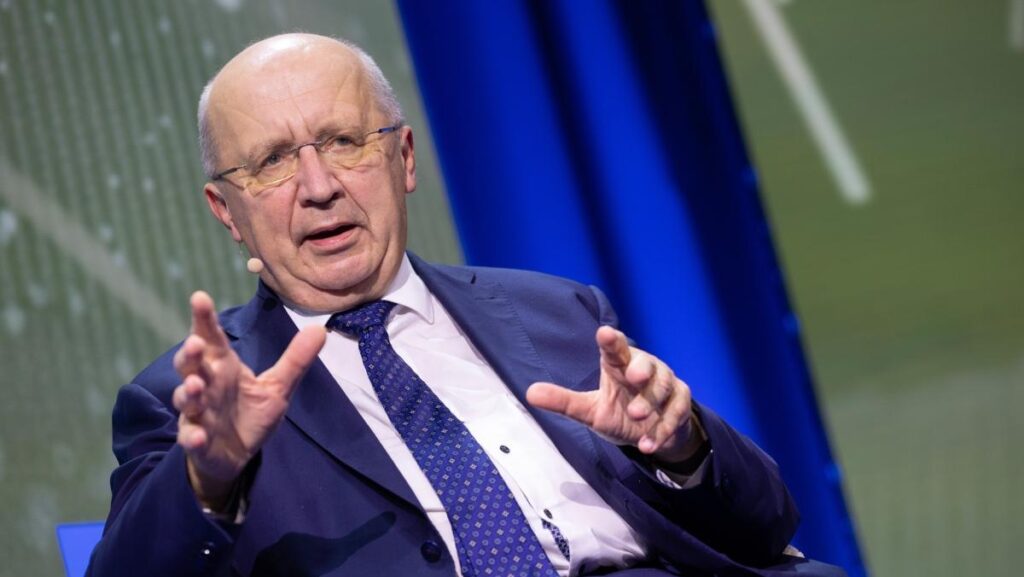
War needs a voice. To make a difference, the voice needs three attributes: moral clarity, practical resolve, and sufficient power behind it. That is, enough power to tell off anybody from a prevaricating Bulgarian prime minister to a rogue US president. Andrius Kubilius spoke with such a voice on Wednesday, on the fringes of the Euronews Defence & Space Summit 2026.
The EU defence commissioner has a simple test for anyone who calls for diplomacy with Russia. “When somebody is saying let’s go for diplomacy and maybe forget supporting Ukraine,” he said, “what does it mean? It means that somebody is offering Ukraine to surrender.”
The remark was directed, with some precision, at the Bulgarian prime minister. Rumen Radev had argued earlier this month that the war was stalemated and that diplomatic channels deserved priority. Mr Kubilius was unimpressed. The exchange captured the central tension in European defence thinking. Russia is escalating, and diplomatic efforts have produced nothing.
Russia’s war without borders
A growing number of voices, some in government and some in the press, are suggesting that the cost of continued support may outweigh the benefit. Mr Kubilius, a former Lithuanian prime minister who now holds the defence brief in Brussels, rejects that framing entirely. He is also willing to say so at some length.
In a rapid-fire exchange with Euronews’ Maria Tadeo, he ranged across hybrid warfare, industrial consolidation, procurement rules, and the question of what Europe owes Ukraine. Mr Kubilius began with doctrine. Russia, he explained, does not distinguish between hybrid operations and conventional war.
Putin needs to feel that war is coming to Russia itself. — Andrius Kubilius, EU defence commissioner
“Russians have the so-called famous Gerasimov Doctrine,” he said, referring to Valery Gerasimov, chief of the Russian general staff. “According to which Russia is not making any kind of difference—there is a continuation from hybrids, whatever propaganda, sabotage and so on, to a real, traditional, kinetic war.” The implication is that a drone over a Baltic capital and a tank column crossing a border are, in Russian strategic thinking, points on the same line.
Territory follows mind
The goal, Mr Kubilius continued, is explicitly stated. “They are saying openly that occupation of the hearts and minds of the people diminishes the need of occupation of the territory.” If Russia can, through disinformation, sabotage, and intimidation, break the political will of a country’s population, it need not send soldiers. The territory follows the mind.
Europe’s answer, he argued, must match the method. “If we are facing hybrid war against us, we need to have hybrid defence.” What that means in practice, he declined to spell out entirely. Responses need not always be visible, he said, and need not be discussed in advance.
“If we are hit by Russian hybrid attacks, our answer should be as painful as their attack. How that pain can be created, it’s up to us to find the way.” He pointed to a paper by Italian Defence Minister Guido Crosetto on hybrid threats as worth reading. He did not elaborate further.
Drones, nukes, and nerves
On the question of whether a Russian attack on a NATO member was imminent, Mr Kubilius was measured. He said he had grown tired of reading predictions each morning about how and when Russia might strike. One drone, ten drones, or three hundred flying into Lithuania: he would not be surprised. Russia has the capability. Whether it has made a political decision to act is another matter. “We need to be ready. That is what is our task now.”
The Bulgarian prime minister’s remarks drew a sharp response. Mr Kubilius did not name him directly at every turn, but the target was clear. The prime minister had argued that Brussels branded anyone questioning the mainstream as pro-Russian, and that diplomatic channels were the only realistic path forward. US President Donald Trump had made similar arguments.
(The Russians) are saying openly that occupation of the hearts and minds of the people diminishes the need of occupation of the territory. — Andrius Kubilius, EU defence commissioner
Mr Kubilius was blunt. “Diplomacy at the moment is not bringing any kind of outcome. Russians are standing with their position very clear: Ukraine needs to surrender.” He asked his audience to imagine the situation in reverse. Would he want to see Lithuania attacked by Russia, with Europeans counselling calm and restraint? The answer, he made plain, was no.
On nuclear threats, he was equally direct. Fear of Russian escalation does not deter Russia. It encourages it. “If we shall keep being afraid of Russian escalation, we shall encourage (Russian President Vladimir) Putin to escalate more.” He applied the same logic to Ukrainian strikes on Russian territory.
The refinery question
When Mr Trump objected to Ukrainian hits on Russian refineries on the grounds that they were disrupting global energy markets, Mr Kubilius noted the tension with existing EU policy. “Our policy is not to allow Russia to sell oil and gas outside of Russia and not to get access to financial resources to continue the war. So I don’t know how it fits into what the American president is saying.”
The commissioner was being very diplomatic here. After all, he spoke of Mr Trump, the man who first single-handedly raised oil prices the world over by an unprovoked attack on Iran and then questioned the methods Ukraine uses to fight for its very survival. Mr Kubilius did not attempt to resolve the contradiction. He noted that Ukrainians would likely work it out with the Americans themselves.
On Ukraine’s battlefield prospects, Mr Kubilius pointed to developments that he said could shift the dynamic. Ukraine is producing its own ballistic missiles. It is also developing, with European partners, an anti-ballistic system called Freya (combining Ukrainian missiles with European radars) and a system called Blixem, produced by Ukrainian company Destinos, designed to counter Russia’s Oreshnik hypersonic missile.
“Putin needs to understand at the end that he will not achieve anything with this war,” Mr Kubilius said. “And Putin needs to feel that war is coming to Russia itself.” On deep-strike capability in particular, he argued that Ukrainian advances could change the battlefield calculus and, ultimately, bring Russia to the negotiating table.
I am not afraid to become big
The third theme of the conversation was industrial. Europe buys around 35 per cent of its defence products from the US. Washington buys roughly one per cent from European industry. Mr Kubilius cited both figures without apparent rancour, but the implication was clear: the relationship is not reciprocal.
The question of a potential mega-merger between three major European aerospace and defence companies (the names were not spoken aloud, though Airbus was mentioned in passing) gave him an opening. He reached, as he often does, for the language of Mario Draghi’s competitiveness report. Europe’s defence industry is fragmented. Its largest company, Leonardo, ranks 13th globally. All companies above it are American or Chinese.
When somebody is saying let’s go for diplomacy and maybe forget supporting Ukraine (…), it means that somebody is offering Ukraine to surrender. — Andrius Kubilius, EU defence commissioner
“If we want to compete, we should not be afraid of size,” Mr Kubilius said. He was careful not to prejudge the Commission’s competition assessment. Its services would evaluate any proposed merger against existing rules, and he could not intervene in that process. But his direction of travel was unambiguous.
“I am in favour of becoming big according to the rules, but not to be afraid of becoming big.” He added that Commission President Ursula von der Leyen had shown, in her State of the Union address, considerably more flexibility about what a merger needed to look like — less emphasis on restrictions, more on making the case for European scale.
Trillions and percentages
On procurement, he drew a distinction between European money and national budgets. The EU’s SAFE loans and Ukrainian support loans carry eligibility criteria that prioritise European industry. But national defence budgets, which dwarf EU-level spending, are not subject to the same rules.
Over the next decade, if member states meet their NATO pledge of 3.5 per cent of GDP on defence, the total will exceed €6tn. The entire next multiannual financial framework allocates around €130bn for defence and space. “Six trillion and 100 billion,” Mr Kubilius noted dryly. “So it’s quite a difference.”
He acknowledged the tension between buying European and buying what works now. Some capabilities Europe simply does not yet produce in sufficient quantity. Governments building defence readiness before 2030 may need to look elsewhere in the short term. But the long-term direction is settled, in his view.
“In 20 years, looking forward, you’d say for sure, if there’s an American product and a European product that can equally do the same thing, the contract will go for the best product, and that will be the European one,” he said with a healthy dose of optimism.
The US, meanwhile, has its own complication. American ITAR regulations, controls on the export of defence-related technology, function as a barrier for European companies trying to build without American components. Mr Kubilius noted, with evident approval, that some European firms now advertise their products as ITAR-free. The market, it seems, is already voting.