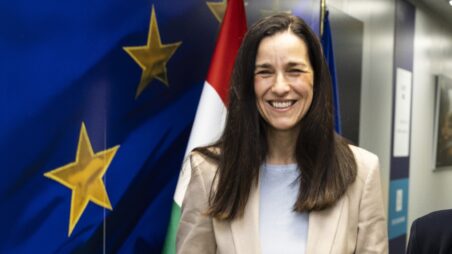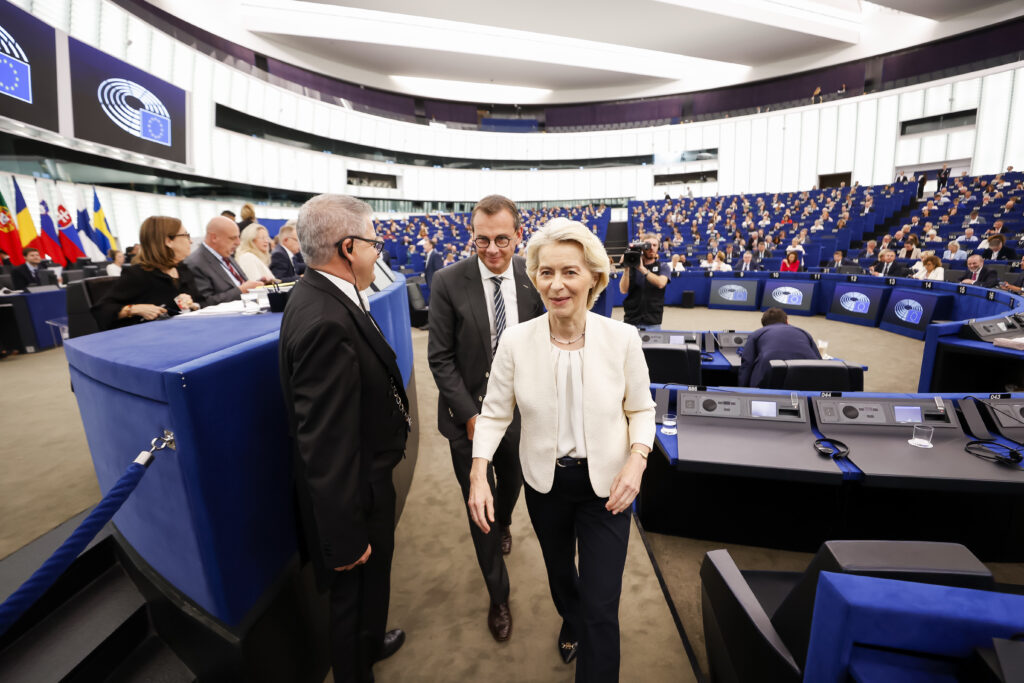
Ursula von der Leyen wants Europe to stop worrying about survival and start thinking about winning. Her State of the Union speech tied together industrial AI, capital markets, banking reform and energy investment into one pitch: catch up with America and China. She named neither rival out loud.
Von der Leyen delivered her annual address at a moment of pressure from outside and within: trade tension with Washington, competition from Beijing and growing domestic frustration over the slow pace of reform. Rather than list crises, she chose the language of opportunity, a tone meant to convince Europe’s leaders that the Union can still set its own terms instead of merely reacting to everyone else’s.
Artificial Intelligence
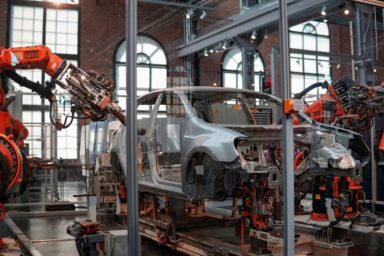
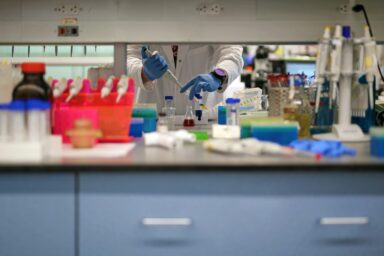
Europe’s pitch, as she framed it, is to win the applied race rather than the frontier one – to put AI to work where it changes daily life. “We are now focusing on five of the highest-value sectors in which industrial AI has the biggest potential… health, transport, agri-food, advanced manufacturing, and defence and space,” she said, promising “game-changing initiatives” across those sectors in November. “We must do it in a European way,” she added.
She also backed industry efforts to rein in self-improving systems and said she would personally bring the leading frontier labs together to discuss how public authorities can help ‘pace the frontier’, alongside a new safety coalition with partners such as Canada and the UK covering model evaluation, verification and early warning.
“CEOs of the most advanced companies tell us that it is time to slow down on the self-recursive models. To pace the frontier. If the people developing the technology are clear, then we should be too,” she said.
Banking sector reform
On financing growth, she leaned on two reforms. “We must create the conditions for our companies to attract investment and grow. This is why our work on the Savings and Investments Union is so critical,” she said. The Savings and Investments Union (SIU) package is now being negotiated in Brussels, aiming to knit together Europe’s fragmented capital markets.
On lenders, she was blunt that stability is no longer the sole test: “We need a banking system that is built for growth, not just stability.” The Commission tabled a banking review in July aimed at easing cross-border operations and reducing the fragmentation holding European lenders back, with a legislative proposal to follow next year.
Fix the grid
She reaffirmed the goal of doubling electricity’s share of the energy mix by 2040, a level the Commission has previously put at around 46 per cent, as a route to cutting Europe’s fossil-fuel import bill by €260bn a year. But she was candid that generation is not the choke point; connecting it is. “Last year, we installed more than 80 gigawatts of renewable capacity.
But six times more capacity is still waiting to be connected. This is why we need the grids package so urgently,” she said, calling for faster investment, quicker connections, and more storage.
On the supply mix, she stayed deliberately technology-neutral: “We need to double down on our affordable, homegrown, clean energy. Be it renewables and nuclear, or biomethane and others.”
Simplification
The cost-cutting drive of the last mandate carried over intact. “This is why, when we took office, we put in place a bold plan. To build an economy where innovation and energy flow across borders. Where companies compete and grow across Europe, and savings finance our future. This is the logic of the Draghi and Letta reports. And together we are delivering,” she said.
All of this can determine where an investment is made. — Ursula von der Leyen, President of the European Commission
“We now have the political agreement on the One Europe, One Market Roadmap. And together, by the end of next year, we can and must complete this historic overhaul of the Single Market.”
Speed, she argued, is the whole game: “A permit or a form, a grid connection or a financing decision. All of this can determine where an investment is made.” She pointed to the twelve omnibus packages “reducing the administrative burden by around €17bn a year” as proof of intent.