Uncrewed reconnaissance aircraft have become a necessity. Europeans want them urgently, cheaply, and on their own terms. They cannot have all three.
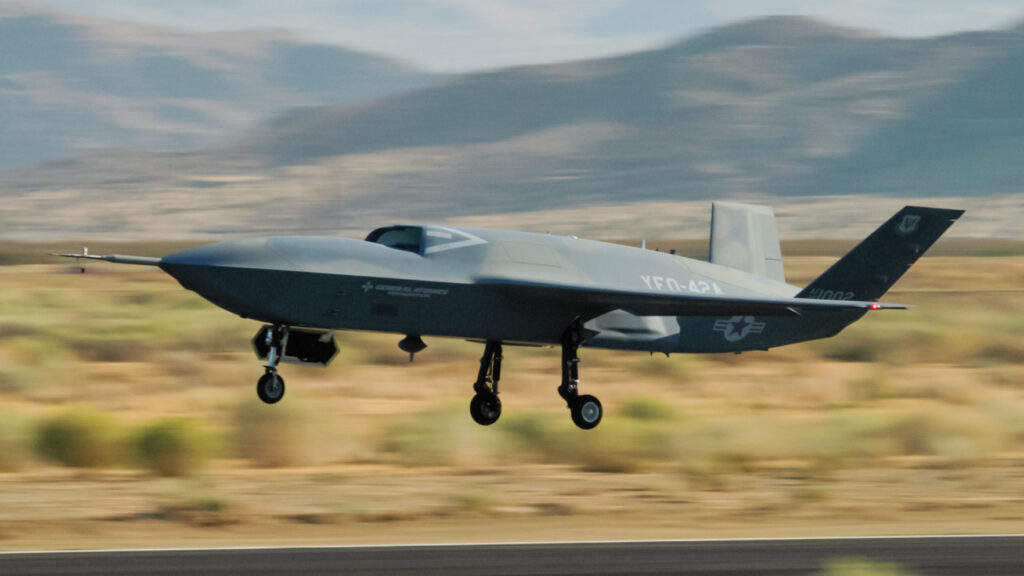
Europe’s security landscape has changed faster than its procurement systems. That realisation has triggered a continent-wide scramble for reconnaissance and combat drones. It has also fuelled a transatlantic tug-of-war over who builds them. At the centre of that contest sits General Atomics Aeronautical Systems, Inc. (GA-ASI), the California-based firm behind the MQ-9B and the newer Gambit series of collaborative combat aircraft (CCA).
GA-ASI’s pitch to Europe is straightforward: proven platforms, modular payloads, and a unit cost for the Gambit ISR (intelligence, surveillance, and reconnaissance) variant of roughly €15–20m — compared with over €90m for a Eurofighter Tranche 4. European-assembled airframes, built through GA-ASI’s German affiliate General Atomics AeroTec Systems (GA-ATS) in Oberpfaffenhofen, are promised from 2027.
A market in motion
The economics are hard to argue with. The politics is a tougher nut to crack; Germany illustrates the tension well. The Luftwaffe fast-tracks a Loyal Wingman requirement, benchmarked explicitly against Gambit’s price and performance, with Airbus and Kratos XQ-58 Valkyrie competing for the contract.
Simultaneously, GA-ASI has teamed with INTEC Group to pitch Gambit directly, offering German final assembly and export rights. “(We) will build Gambit aircraft in Europe, partnered with European-based companies, with airframes available for international procurement starting in 2027,” the company said in a statement. Berlin thus finds itself courted by both sides of the Atlantic at once.
Airbus has not stood still. In 2026, its FCAS ‘Remote Carrier’ demonstrators launched from an A400M. They are missile-sized expendable scouts designed for reconnaissance and suppression of enemy air defences, integrated with the broader Future Combat Air System cloud. The test was a statement of intent. Europe, Airbus argued implicitly, need not outsource its drone future.
London’s expensive hesitation
Norway, meanwhile, pursues a different path. Andøya Test Range now hosts a nationwide U-space sandbox permitting 100 parallel beyond-visual-line-of-sight flights, giving Oslo a head start in certifying high-altitude ISR drones for operational use. GA-ASI already deploys MQ-9B SeaGuardian there. Gambit trials could follow.
The United Kingdom offers a cautionary tale. The RAF cancelled Project Mosquito in 2026, redirecting funds toward smaller, cheaper CCAs. In July 2026, the government unveiled the £300m ‘Storm Fighter’ Loyal Wingman; it is to escort Typhoon, F-35, and the future Tempest.
(We) will build Gambit aircraft in Europe, partnered with European-based companies, with airframes available for international procurement starting in 2027.
— GA-ASI statement
The aircraft has influential fans. “The Storm Fighter will make the RAF’s Europe’s first 6th generation air force, (would act) as both guardian angel and an attack dog for RAF combat aircraft,” said Luke Pollard, the man in charge of defence readiness at the defence ministry (he has since moved to become minister of state for defence procurement).
State coffers, safety concerns
UK MoD planners have come to view Gambit as an off-the-shelf fallback should Storm Fighter slip. Analysts are sceptical. Without sustained industry funding, the programme risked repeating the ill-fated trajectory of the Mosquito.
Critics in Westminster question whether simultaneously funding Tempest, Storm Fighter, and a possible Gambit lease is fiscally coherent. No one has yet answered that question publicly, while Ukraine sharpens the urgency. Kyiv seeks high-endurance ISR assets to replace attrited Bayraktar TB-2s. Gambit—with its 2027 delivery promise—is cited unofficially as a candidate.
Germany’s new export rule (the Allgemeine Genehmigung Nr. 48) already simplifies export of military drones to Ukraine. But Berlin’s political debate remains intense; opposition parties demand stricter end-use monitoring, fearing technology leakage if Russian forces capture downed aircraft.
Brussels rewrites the rules
Regulation compounds procurement. The EU Commission’s 2026 Action Plan on Drone and Counter-Drone Security reframes uncrewed aircraft as strategic assets rather than innovation tools, tightening air-traffic integration and critical-infrastructure protections. Critics warn the shift risks a surveillance-state trajectory and imposes disproportionate compliance burdens on small and medium-sized drone manufacturers.
EU dual-use Regulation 2019/945, as amended by 2020/1058, requires C5/C6 classification for military-capable drones sold on the civil market. GA-ASI proposes a dedicated military category to sidestep the additional certification costs. Brussels has not yet agreed.
Storm Fighter will make the RAF’s Europe’s first 6th generation air force, (would act) as both guardian angel and an attack dog for RAF combat aircraft.
— Luke Pollard, UK defence ministry
Longer term, data-sovereignty rules could impose what analysts describe as ‘digital customs’ on U.S. autonomy software. GA-ASI’s Gambit autonomy stack derives from USAF CCA reference code, i.e, something European governments do not control. If Brussels mandates on-shore source-code escrow, GA-ASI faces a choice: comply at cost, or watch orders migrate to Airbus and Kratos.
The autonomy question
Beneath the procurement rivalry lies a deeper controversy. Gambit 6 (the most capable variant) carries an internal weapons bay, electronic warfare suite, and deep-strike capability. It is designed, in GA-ASI’s own framing, to suppress enemy air defences and conduct precision ground attack in contested environments. That is not reconnaissance. It is combat.
European governments have been cautious about deploying semi-autonomous strike-capable aircraft, particularly near Russia’s borders. The legal framework for lethal autonomous systems remains unresolved at both NATO and EU level. Buying Gambit for ISR today means acquiring a platform with strike potential tomorrow. This is a distinction parliamentary oversight committees in Berlin, London, and Brussels have barely begun to scrutinise
The Airbus Remote Carriers offer a nominally European answer, integrated with the FCAS architecture. But FCAS itself has lurched through years of Franco-German-Spanish disagreement. Remote Carriers will not reach operational status before the early 2030s at the earliest.
In short, the problem is familiar by now. Europe’s drone race pits urgency against sovereignty, and affordability against control. The continent needs mass; it is not just quite sure whose mass it wants.