Some ships have already paid for waiting. Unable to secure an EU escort in time, they crossed the Red Sea alone, and Houthi missiles found them. Now Italy says it will not risk that again: it is sending its own navy through the Bab el-Mandeb strait, instead of waiting for Brussels to decide when it is safe.
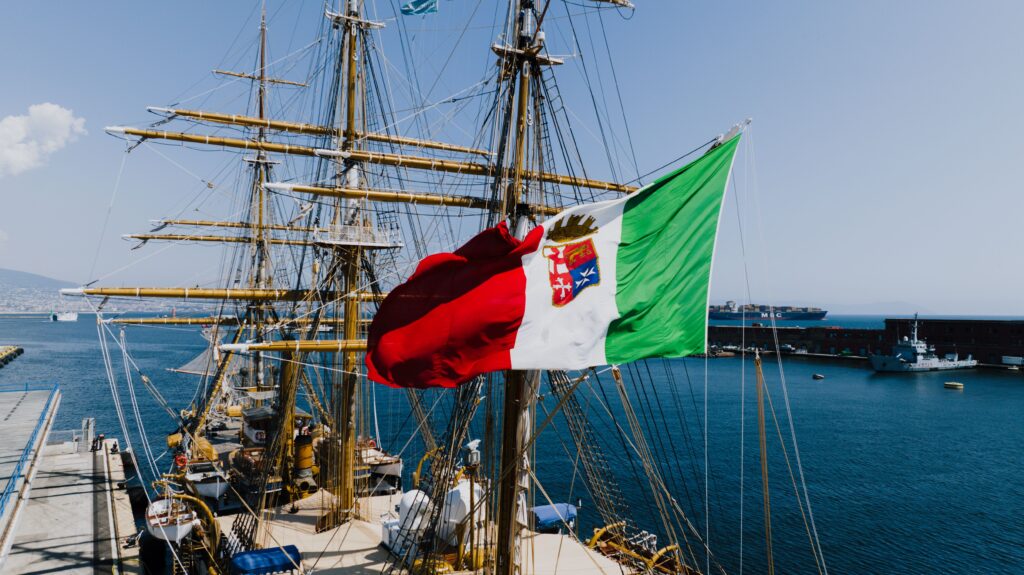
Guido Crosetto, Italy’s defence minister, made the announcement on 17 September at the Risorsa Mare forum in La Spezia. “Together with the Chief of Staff, we have decided not to wait for Aspides to decide whether ships can pass or not,” he said, referring to the EU’s naval mission in the Red Sea. Italian ships, he added, would begin to move again without European bureaucracy adding further delay.
The timing is no accident. Houthi fighters, backed by Iran, captured the Yemeni port of Mokha in early September and pushed on to the island of Perim, which sits inside the strait itself. Saudi Arabia has already rerouted some of its oil around the Cape of Good Hope rather than risk the crossing. Rome, it seems, has decided to stop waiting to see whether Bab el-Mandeb closes for good.
A mission short on ships
The EU built Operation Aspides in February 2024 for exactly this kind of moment: escorting merchant vessels through the Red Sea so no single country has to do it alone. The Council quietly renewed its mandate until February 2027 this spring, but renewing a mandate is not the same as filling it with ships.
The mission can point to real results. Over the past 29 months, Aspides has protected more than 720 merchant vessels and monitored over 2,300 transits, the Commission said on Friday. It has saved 128 seafarers and helped avert a major environmental disaster in 2024.
But its ships have always lagged behind its ambitions. Analysts estimate the mission needs around 10 naval units to do its job; it has rarely had more than three. Kaja Kallas, the EU’s foreign policy chief, made the same point after visiting the mission in Djibouti. “We need more vessels to be credible,” she told European lawmakers, floating the idea of widening the mandate to include minesweeping.
Italy is not a distant critic here. Its frigates and destroyers have taken turns leading Aspides since it began, and an Italian officer commanded the force for much of last year. When Rome says it is done waiting, it is talking about ships it normally deploys into the same waters under an EU flag.
Going it alone
Asked about the risk of acting alone, Mr Crosetto was unambiguous. “We will probably take action so that Italian ships can begin to pass through the Bab el-Mandeb Strait without waiting for European bureaucracy to add to our own,” he said, arguing that delay of this kind holds back the economy and makes existing problems worse.
We will probably take action so that Italian ships can begin to pass through the Bab el-Mandeb Strait without waiting for European bureaucracy to add to our own.
— Guido Crosetto, Italy’s defence minister
The Commission’s spokesperson, asked about the remarks at Friday’s briefing, would not be drawn in, citing the practice of not commenting on hypotheticals. He pointed instead to European Council conclusions welcoming efforts to secure the strait, and repeated Ms Kallas’ appeal to member states for more ships.
That gap, between what Brussels asks of its members and what they are willing to hand over, is not new. It is, in fact, the story of Aspides from the start: a mission built on the promise that no country would have to protect its ships alone, now facing the prospect that one of its founding members might do just that.
Rome insists it is not leaving Aspides, only filling in where the mission falls short. Whether Brussels can turn that distinction into something more than words, before the next ship is hit crossing Bab el-Mandeb, is the real test ahead.