Just 13 per cent of pupils in Greece attend a school with Wi-Fi. In the Netherlands, it’s 100 per cent. Two new EU reports show how uneven Europe’s classrooms already are, and warn AI could widen that gap.
Generative AI, or genAI, can already draft essays, solve equations and patiently tutor a struggling teenager one-on-one, tasks once reserved for an adult with time to spare. Used well, it can free teachers from paperwork and give shy or struggling pupils a private space to ask basic questions. Used badly, it lets pupils copy an answer without ever understanding it, and the difference between the two, according to Friend or foe? report, often comes down to how a teacher introduces the tool in the first place.
That worry predates genAI. Around three in four teachers in Serbia, Croatia, Czechia and Greece already say pupils use digital tools to copy material from the internet without attribution; in Hungary, only just over half do. The gap suggests some school systems are simply better equipped than others to teach pupils how to use digital tools, including AI, responsibly, rather than banning them outright.
A patchy digital landscape
The second report, Digital education at school in Europe 2026, looks beyond the AI headlines to the basics: does a school actually have working Wi-Fi, and does someone fix the network when it breaks? Wi-Fi for staff and pupils alike is close to universal in the Netherlands, Denmark, Luxembourg, Austria, Finland and Sweden. In Greece it reaches just 13% of pupils, in Cyprus 21%, and in Bosnia and Herzegovina a third.
Technical support follows a similar pattern. In Luxembourg, only 12% of pupils are in schools where staff say a lack of ICT support gets in the way of teaching. In Germany and Greece, roughly three in four pupils are. A broken smartboard or a login problem is therefore far more likely to derail a lesson in a German classroom than in a Luxembourgish one.
Digital equity extends beyond the school gate. More than half of pupils in Bosnia and Herzegovina and Romania report an unreliable internet connection at home, compared with roughly a fifth in Sweden and Finland. Poorer pupils fare worst everywhere: in Romania, those from homes with fewer than 26 books are 20 percentage points more likely to have connection problems than their better-off classmates, the widest such gap in the survey.
Teacher training shows the same divide. Nearly a third of teachers in Germany say they still need training on using digital tools in the classroom but have not received any in the past two years; in Romania, only 11% say the same. Nearly two thirds of the education systems surveyed, meanwhile, have already written an AI-specific strategy or guidance document for schools, a sign of how quickly the technology has moved from novelty to policy headache for ministries.
Shaping the coming Education Package
Both reports now feed into decisions being made in Brussels. Their findings will back the Commission’s Union of Skills initiative and shape the forthcoming Education Package, due this autumn, which is set to cover basic skills, the teaching profession and school digital infrastructure. The public is already on board: 78 per cent of Europeans want schools to teach digital skills with the same weight as reading, maths and science, a Eurobarometer survey found last year.
Digital technology should serve our citizens, and we must ensure these tools genuinely support learning.
— Roxana Mînzatu, Executive Vice-President for Social Rights and Skills, Quality Jobs and Preparedness
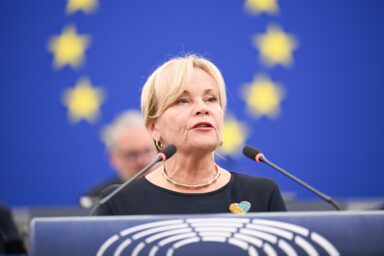
Roxana Mînzatu, the Commission’s Executive Vice-President for Social Rights and Skills, Quality Jobs and Preparedness, put it plainly: “Digital technologies, including Generative artificial intelligence are rapidly changing how we live, work and learn. While students and teachers stand to gain from these new possibilities, we must carefully address risks around bias, privacy, and overreliance. Digital technology should serve our citizens, and we must ensure these tools genuinely support learning.”
Neither report hands schools a ready-made answer. What both agree on is simpler, yet harder to legislate: whether a pupil in Athens ends up thinking more, or thinking less, than her counterpart in Amsterdam will depend less on the chatbot in front of her than on the adult standing beside her, and the Wi-Fi actually working.