Pandas, tech oligarchs, and the red carpet. As the US president focuses on pageantry, Europe emerges as the US–China détente’s biggest casualty.
“In return for China breaking nearly every trade promise it has made, Trump is rolling out the red carpet for President Xi,” US Senator Ron Wyden of Oregon summed up this week’s superpower summit. “There is no evidence that Trump is using this opportunity to push back on the Chinese policies hurting our businesses. Donald Trump is giving away the store to China and leaving American families with the bill.”
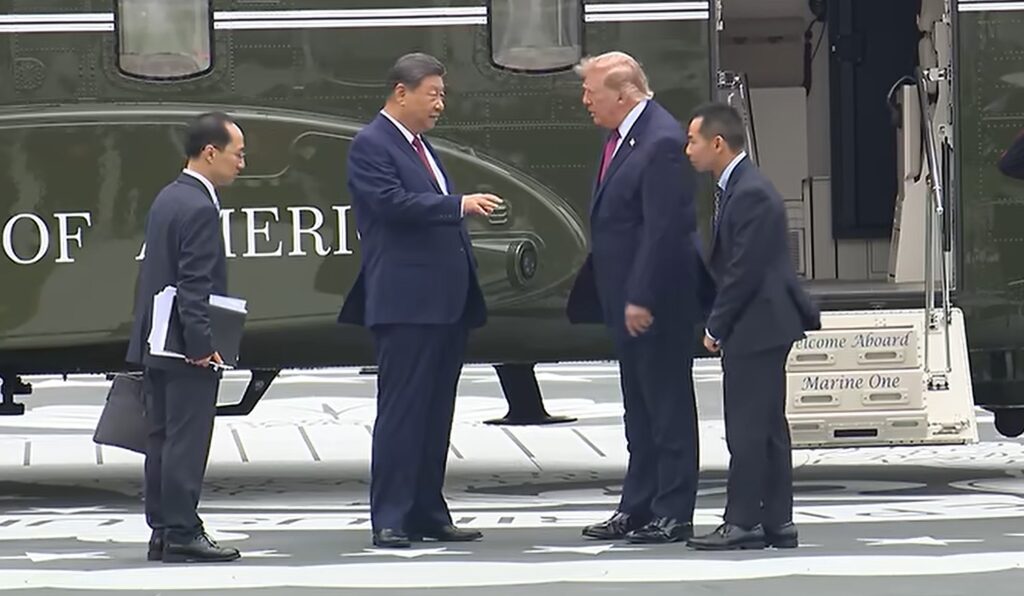
The senator has a point. US President Donald Trump welcomed Chinese President Xi Jinping to the White House on 23–25 September. The agenda included military flyovers, panda gifts, and a state dinner featuring the world’s most powerful technology executives. The pageantry was elaborate; the substance was not. And Europe is first in line among those who lose out.
The two leaders extended their shaky trade truce by two months, pushing the deadline to 10 January. That was the clearest concrete outcome. On artificial intelligence, Taiwan, Iran, and the broader architecture of US-China rivalry, the 90-minute closed-door session yielded no visible breakthroughs.
“Pageantry and protocol don’t add up to progress. Pandas are cute, but what America needs are rare earths,” said Danny Russel, a former US diplomat. “What we’re seeing isn’t diplomacy so much as ‘diplotainment’. It won’t do much to solve the serious problems in the US-China relationship.”
A host, not a rival
Mr Xi went straight to the point in his message. He warned against the Thucydides Trap, the theory that a rising and an established power are likely to go to war. “We do not need to avoid mentioning competition, but our competition should be a healthy one and should be within bounds,” Mr Xi said. “China and the United States must hold the line of no conflict and no confrontation between us.”
Mr Trump’s tone was warmer, and notably undemanding. “President Xi and I both understand that we represent different systems but the ties between our people endure,” he said at the state dinner. “Together we can continue to build a relationship that promotes prosperity and security for future generations.”
Beijing had scripted its objectives carefully. People’s Daily published a front-page article setting the tone: the summit should build on the “constructive strategic stability” agreed during Mr Trump’s visit to Beijing four months earlier. Chinese state media framed Mr Xi’s visit as “keeping the positive momentum going”. The message was consistent: that concept should guide relations “over the next three years and beyond”.
China and the United States must hold the line of no conflict and no confrontation between us. — Xi Jinping, China’s president
On Taiwan, Mr Xi pressed Mr Trump to oppose Taiwan independence, according to Xinhua. The White House provided no summary. (Senate Democrats, in a statement signed by at least 19 members, called on Mr Trump to deliver it immediately.) Mr Trump had already described a stalled $14bn arms package to Taiwan as “a very good negotiating chip”. That must have sent shivers down many an Indo-Pacific spine.
Xi’s doctrine and the double pivot
To understand why Beijing was so happy about the summit’s tone, one must understand what Mr Xi is actually trying to achieve. It also means understanding why a compliant, ceremony-focused Mr Trump suits him perfectly.
Steve Tsang, director of the SOAS China Institute at Chatham House, recently laid out Mr Xi’s global strategy with unusual clarity. Writing in The World Today in September 2026, Mr Tsang argues that Western powers have fundamentally misread China’s ambitions. “Recent American administrations have made the mistake of thinking that China wishes to replace the United States as the global hegemon,” he writes. That, his argument goes, is not the case.
Mr Xi’s doctrine—formally first announced at the Chinese Communist Party’s National Congress in October 2017 as ‘Xi Jinping Thought on Socialism with Chinese Characteristics for a New Era’—sets out something more subtle and more durable. Mr Tsang and his co-author Olivia Cheung call it “Sino-centric party state realism”. Its goal is not to impose a new world order by force. But as the doctrine nears completion of its first decade, the contours of what it means in real life are becoming clear.
A common destiny, forged by China
Mr Xi seeks to forge what English readers know as ‘a community with a shared future’. Mr Tsang flags the phrase as deliberately misleading in its official English translation. “A faithful translation of the Chinese is ‘a common destiny for humankind’, which reveals a more concerning vision,” Mr Tsang writes. “A common destiny for all does not emerge organically in a community of free and equal agents choosing to share a future; it needs to be forged by a leader, China.”
The strategy rests on what Mr Tsang calls a “double pivot”. The first is to establish China’s leadership of the Global South, using four global initiatives (on development, security, civilisation, and governance) alongside the Belt and Road Initiative, which committed close to $124bn in development loans in 2025 alone.
US vs. China, international trade…
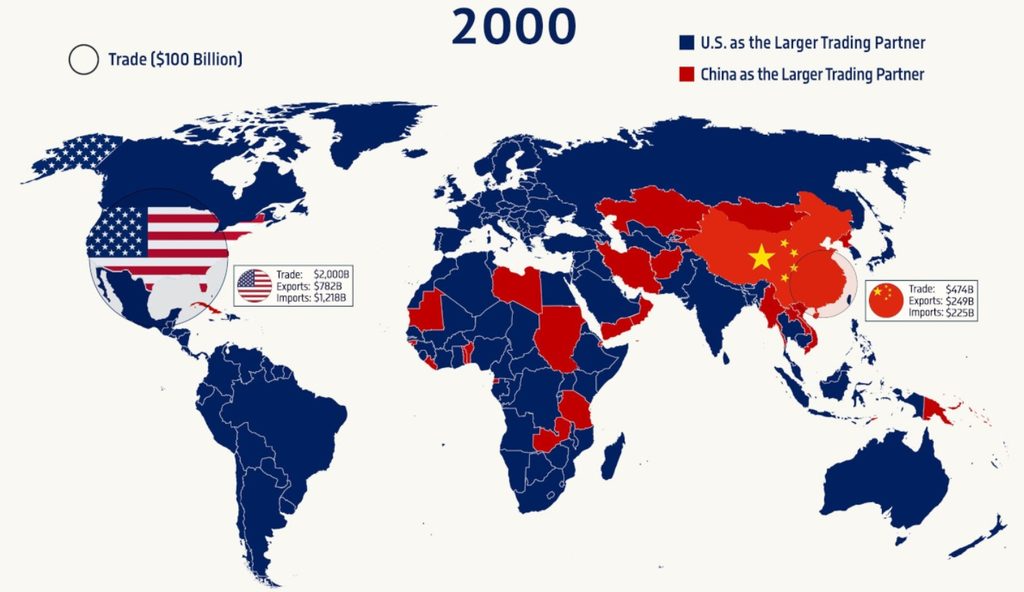
The second pivot is to take Taiwan by 2050, Mr Xi’s self-imposed deadline for his “China Dream of National Rejuvenation”. “If achieved, the taking of Taiwan, and the discrediting of the US in the process, would mark China’s assertion of its global preeminence,” Mr Tsang writes. Beijing’s preferred method is to demonstrate such overwhelming military superiority that Taipei submits without a shot being fired.
What deterrence requires
The Washington summit advanced both pivots quietly. Mr Trump’s reluctance to press China on Taiwan, his willingness to hold the $14bn arms package in abeyance, and his focus on personal rapport rather than structural demands all reduce the credibility of US deterrence. People’s Daily was explicit: “Managing ‘Taiwan independence’ is a key part of building constructive strategic stability between China and the US,” framing pro-independence forces as a “common enemy” of both capitals.
Mr Tsang is clear about what effective deterrence would require, and what the summit did nothing to activate. “Nearly half of China’s economic ties in value terms are with the US, the European Union, Britain, Japan, Korea, Australia, Canada and New Zealand,” he writes. “For a highly externally oriented economy such as China’s, suddenly losing its ties with those countries would bring cataclysmic consequences, with potentially dire repercussions for the CCP.”
The democracies of the West and elsewhere that are worried about Xi’s vision have, to a degree, time to devise effective countermeasures. — Steve Tsang, Chatham House
Coordinated economic deterrence, delivered privately and credibly, could give Mr Xi pause. A summit built on flattery and granite tours does the opposite. Mr Xi, meanwhile, invoked Nixon’s 1972 rapprochement at the state dinner — a pointed historical signal. “Such a friendship, forged in blood and fire,” he said, “will surely live on through the generations.” The message to Mr Trump was clear: re-establish ties with China, but on Beijing’s terms.
Europe watches, exposed
For the European Union, the summit’s implications are serious and largely unwelcome. Europe was not in the room. It is, however, very much affected by what was agreed and by what was not.
The most immediate consequence is trade diversion. The two-month extension of the US–China trade truce keeps American tariffs on Chinese goods at reduced levels. That redirects surplus Chinese production (such as electric vehicles, batteries, solar panels, and consumer electronics) towards the EU, intensifying price pressure and widening a trade deficit with China that already stood at €291bn.
Pageantry and protocol don’t add up to progress. Pandas are cute, but what America needs are rare earths. — Danny Russel, former US diplomat
Brussels is accelerating its response. The Anti-Coercion Instrument (Regulation 2023/2675), which allows the EU to impose counter-measures against any state that weaponises trade, is now its primary defensive tool. The first screening case targeting Chinese EV price undercutting could be triggered by early 2027, with European Commission guidance on counter-measures due by March of that year.
An asymmetric exposure
A forthcoming ‘Over-Capacity Instrument’, expected as a Commission proposal in the fourth quarter of 2026, would go further. creating a permanent mechanism to address state-subsidised dumping. In the longer term, the Anti-Coercion Instrument may evolve into a standing deterrent applicable not only to China but, if necessary, to the US itself.
The technology dimension is equally fraught. The summit produced an agreement to establish a US–China dialogue on artificial intelligence. If that leads to any relaxation of US semiconductor export controls on China, it would create a transatlantic asymmetry. European chipmakers (ASML, Infineon, and STMicroelectronics) would remain exposed to Chinese retaliation while US firms regained market access.
…and a quarter of a century later
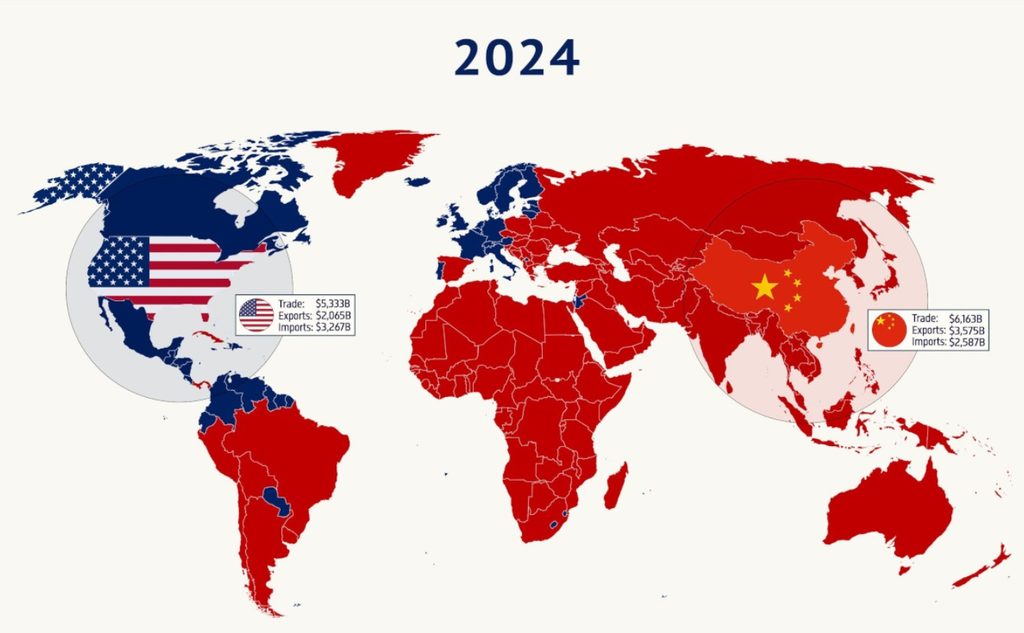
The EU Chips Act (Regulation 2023/1781) entered its full crisis-monitoring phase in September 2026, with supply-chain mapping now extended to gallium and germanium. A new delegated act on mid-tier AI processors is under preparation, designed to close any gap that US-China technology diplomacy might open.
From stockpiles to strategy
The gallium and germanium question sits at the intersection of technology and defence. In October 2025, China tightened export licences on both metals. Both are critical inputs for EU solar panels, 5G chips, and infrared sensors. The move caused European spot prices to triple within six weeks. The November 2025 détente brought a one-year suspension of those licences, relieving battery producers in Germany, France, and Sweden, as well as missile manufacturers including MBDA and Saab.
But the suspension is conditional and reversible. EU procurement officials now treat both metals as ‘defence-critical’. The European Defence Industrial Strategy and the European Defence Industry Programme (EDIP) are being shaped accordingly, with plans to establish EU refining capacity by 2030 and a strategic stockpile modelled on the US Defense Production Act reserve. The European Defence Fund is expected to co-finance a €1bn recycling plant for both metals by 2029.
Donald Trump is giving away the store to China and leaving American families with the bill. — Ron Wyden, US senator
On defence more broadly, the summit’s most consequential signal was the one Mr Trump did not send. His decision to hold the Taiwan arms package in abeyance (and his public description of it as a “negotiating chip”) rattles European capitals for reasons that go beyond Taiwan. Mr Tsang identifies the mechanism: success in taking Taiwan “would force key US allies such as Japan and South Korea to calculate if they can still rely on their respective defence treaties with the US for their security”. Europe draws the same conclusion about its own position.
The legislation Brussels is writing
The March 2024 European Defence Industrial Strategy, and the EDIP that follows it, were already designed to reduce that dependence by deepening the European Defence Technological and Industrial Base. The summit accelerates the political case for doing so. Joint ventures in Poland, the Baltic states, and the UK are becoming prerequisites for qualifying for national export-financing support, not optional extras.
On sanctions, the EU’s 18th package of restrictive measures already targets seven Chinese firms over arms sales to Taiwan. A potential 19th package is under discussion. But if the US–China détente endures, the political will for further EU sanctions on China may fracture along familiar lines within the bloc. The sanctions tool may ultimately need automatic ‘snap-back’ provisions triggered by Chinese restrictions on critical minerals, rather than relying on political consensus that a prolonged détente makes harder to sustain.
EDIP implementation is moving to prioritise EU-only supply chains for rare-earth magnets. The Critical Entities Resilience Directive (2022/2557) is being used to classify gallium and germanium processing as an “essential service”. Critical Raw Materials clauses are likely to be inserted into future EU trade deals (with Australia and Chile among the priority partners) to diversify supply away from China.
The conclusions are sobering. Mr Xi is not in a hurry. His deadline is 2050. “The democracies of the West and elsewhere that are worried about Xi’s vision have, to a degree, time to devise effective countermeasures,” Mr Tsang writes. But that time is not unlimited. A US president who greets his guest at the airport, shows him a helipad, and calls it diplomacy is not using it wisely. And there is precious little Europeans can do about it.