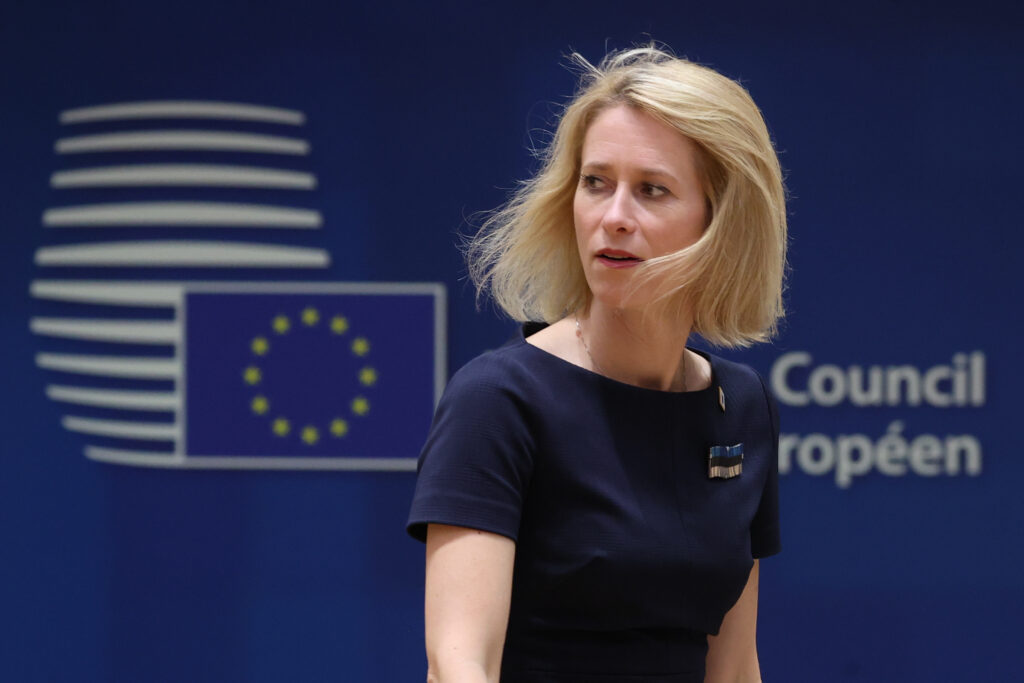
The EU today rejected any suggestion that a Russian strike near Poland’s border should soften its support for Ukraine. Foreign policy chief Kaja Kallas said the attack was designed to frighten Kyiv’s Western backers into pulling back. Brussels’ answer, she said, must be the opposite.
A Russian drone hit a passenger train just two kilometres from the Polish border on Sunday. It struck the locomotive of a Kyiv–Warsaw service at Yahodyn station in Ukraine’s Volyn region. Ukrainian Railways said all 206 passengers escaped safely, and nobody was hurt. A separate train had passed through the same station shortly before. It carried former UK prime minister Boris Johnson and other European officials. Former CIA director David Petraeus was on a third train nearby.
“It is clearly meant to scare Western countries from supporting Ukraine,” Kallas told reporters in Rovaniemi, Finland, on the sidelines of a summit on Arctic strategy. “We should show that we are there for Ukraine and we are not scared,” she added. Hesitation, she warned, would only invite further pressure on the West.
Warsaw: escalation “becoming a fact”
Polish Prime Minister Donald Tusk struck a similarly grave tone. “The escalation of actions by the Russian Federation is becoming a fact, and its examples are increasingly close to our border,” he wrote on social media after a security meeting on Sunday. He expects Russia to escalate the war further in the coming weeks.
Just two kilometres from Poland and NATO territory.
— EU Perspectives (@EUPerspectives) September 14, 2026
The Russian drone strike near Yahodyn shows how closely the war is now touching the EU’s eastern border. The attack hit civilian rail infrastructure on one of Ukraine’s key connections with Poland, shortly after a diplomatic… pic.twitter.com/lRaVjT1Pgs
Foreign Minister Radosław Sikorski went further still. He called on allies to double their support for Ukraine rather than scale it back. The Kremlin denies deliberately targeting civilians. Moscow says it hit railway infrastructure that carries military cargo from European countries.
Brussels doubles down on air defence
Weeks before the strike, Brussels had approved €6.1bn in fresh funding for Ukraine’s air and missile defences, part of a wider €90bn loan package agreed earlier this year. The money will help Kyiv buy Patriot interceptors, drones and ammunition as Russian bombardments intensify before winter.
The strike also lands as the EU continues building a so-called drone wall along its eastern border, a project launched after a wave of Russian drone incursions into Polish and Danish airspace last autumn. Estonia, Finland, Latvia, Lithuania, and Poland are leading the effort, with defence commissioner Andrius Kubilius coordinating it.
We should show that we are there for Ukraine and we are not scared.
— Kaja Kallas, EU High Representative for Foreign Affairs and Security Policy
For Brussels, the message is clear: Western support for Kyiv must hold, whatever form Russian pressure takes next. Winter is approaching, and strikes on energy and transport infrastructure will likely intensify. EU officials say the coming months will test that resolve directly.