The EU and NATO heads condemned Russia and warned that they would not tolerate its increasing belligerence. But when it came to what happens next, they offered few specifics.
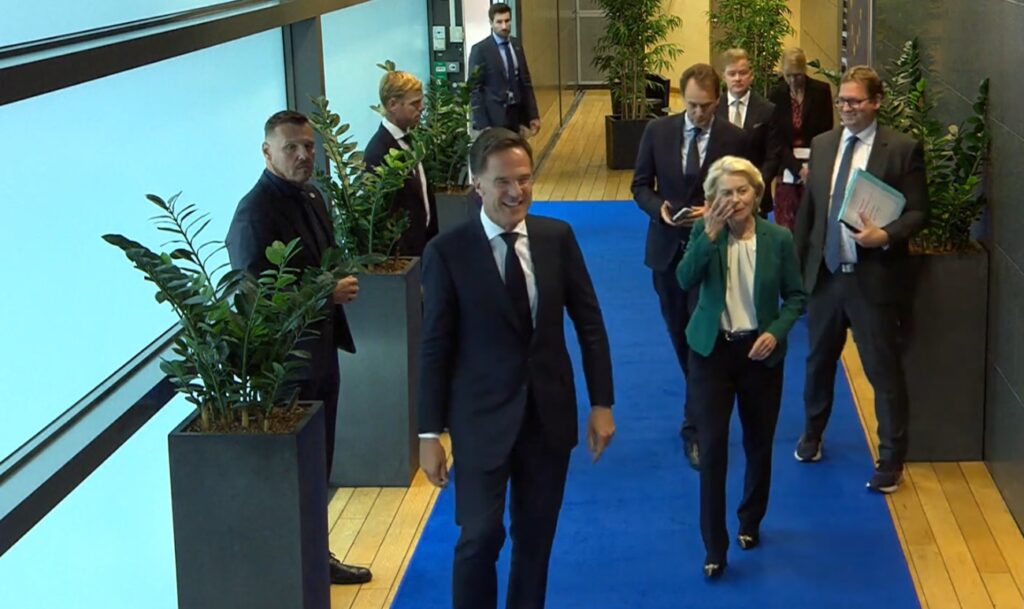
There is a familiar pattern to Western leadership communication since February 2022: solemn condemnation, pledges of unity, and a measured confidence that demonstrating solidarity is itself an important part of the response. European Commission President Ursula von der Leyen and NATO Secretary-General Mark Rutte offered a version of it on Wednesday, standing together in Brussels to respond to Germany’s formal attribution of the Leipzig airport drone attack to Russia.
One caveat is worth stating plainly at the outset. What follows is based on their prepared statements, issued before the two leaders sat down together. What they actually discussed behind closed doors remains unknown.
Words before meeting
Ms von der Leyen’s words were heavy with gravity. “This was an attack using military-grade material carried out by Russian operatives on European Union soil,” she said. “We will not tolerate it.” She was right to say so. The German government’s attribution, published on 1 September, described an attempt to destroy cargo aircraft at Leipzig-Halle Airport. Had it succeeded, the attack could have caused deaths and significant damage to a major European logistics hub.
Mr Rutte followed with characteristic efficiency. He announced, with some candour, that he could not but “completely agree” with everything Ms von der Leyen had just said, largely reiterating her earlier points. His contribution, however, was not without substance. He noted that European allies and Canada had spent more than $139bn extra on defence in 2025 alone. “That’s huge,” he observed.
The upbeat register was hard to miss. Mr Rutte closed by describing the close cooperation between the two of them as “making it great fun”. Ms von der Leyen, for her part, listed the EU’s financial commitments to Ukraine with the methodical enthusiasm of someone going through a particularly impressive set of figures.
The Leipzig attack did not occur in isolation. It fits a pattern that European governments have been documenting (and largely failing to deter) for the better part of two years. Repeated airspace incursions, drone disruptions at airports, interference with critical infrastructure, and suspected Russian sabotage of defence-related industrial facilities have become, as Ms von der Leyen herself acknowledged, “the new normal”.
Leipzig in context
The broader reaction to Germany’s 1 September attribution was swift and largely uniform. Polish Prime Minister Donald Tusk said Russia was “escalating tensions across the whole region” and that “Europe would not be intimidated.” Estonian Prime Minister Kristen Michal called the incident “a reckless act” that takes Russian hybrid attacks “to a new and dangerous level”.
Finnish President Alexander Stubb was rather blunt: “We are united. Russia’s attempts will not succeed.” Italian Prime Minister Giorgia Meloni added that “attempts to intimidate us or divide allies will not succeed”. Danish Prime Minister Mette Frederiksen said the plot “was intended to intimidate Europe but will have the opposite effect”.
(We need) faster, more integrated air defence alert system across Europe.
— Mark Rutte, NATO secretary general
EU High Representative Kaja Kallas, speaking from the informal defence ministers’ meeting in Wicklow, Ireland, described the drone plot as having “all the hallmarks of state-sponsored terrorism”. Mr Rutte, for his part, had already stated on 1 September that “NATO stands in full solidarity with Germany after the Russian hybrid attack in Leipzig. The evidence is clear.”
Substance beneath the solidarity
Strip away the ceremonial register, and there were genuine policy signals in the two statements. Ms von der Leyen confirmed that Ukraine had submitted a new payment request worth several billion euros, covering air defences including PAC-3 Patriot systems. She said it was “going in the right direction”. She also referenced Freya, a European project to develop indigenous anti-ballistic missile defences. It is a significant long-term ambition, if one still far from delivery.
On sanctions, she was pointed. “Every loophole Russia exploits is one we must close,” she said. Meanwhile, foreign ministers in Ireland were already discussing new listings, and the Commission examining ways to cut deeper into Russia’s war chest. The Associated Press noted that Berlin’s own counter-measures included the closure of a Russian consulate.
Ms von der Leyen also called for treating “everyday infrastructure as frontline targets”. The formulation that, if it translates into policy, would represent a meaningful shift in how Europe approaches civil resilience. Mr Rutte echoed the point on air defence, endorsing a “faster, more integrated air defence alert system across Europe.”
The gap that remains
The Leipzig attack, Germany’s attribution of it, and the subsequent chorus of condemnation represent something real: a European political consensus that Russian hybrid aggression on EU soil warrants a collective response. Deutsche Welle reported that the drone had apparently targeted a Ukrainian cargo aircraft — a detail that sharpens the strategic logic of the attack considerably.
This was an attack using military-grade material carried out by Russian operatives on European Union soil. We will not tolerate it.
— Ursula von der Leyen, European Commission president
What remains less clear is whether the response—more statements, more sanctions discussions, more pledges of unity—is proportionate to the escalation Ms von der Leyen herself described. She was right that “Leipzig marks a new escalation on European Union soil directly attributed to Russia.” The question her statement did not answer, and Mr Rutte’s agreement did not address, is what, precisely, changes now that it has.
The two leaders are united. They said so, repeatedly. Whether that unity produces something more durable than a joint press appearance is a question for the weeks ahead.