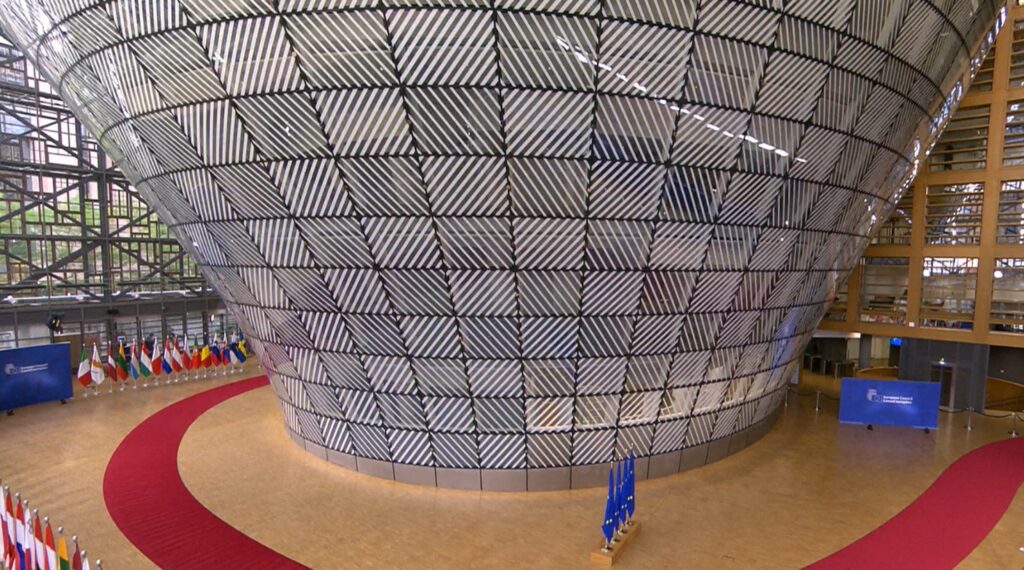
Leaders reached Brussels on 15 October with the budget on their minds. Other worries pushed it aside. Energy prices, the emissions trading system, China, Ukraine, shipping, and migration now share the two-day agenda.
Today’s European Council sesssion kicked off short before 11am. The cards were stacked in a way that put any notion of plain sailing to rest. European Council President António Costa wants the seven-year budget (Multiannual Financial Framework, MFF) settled before the 2027 elections. Governments have softened their pledge to finish by December, according to draft conclusions. Capitals fear a firm deadline would weaken their hand.
Ireland’s draft for 2028 to 2034 trims €159bn from the Commission’s opening offer. Few are satisfied. Seventeen countries, calling themselves the Friends of Cohesion, oppose further cuts to regional funding and farm subsidies in a joint statement agreed at a meeting convened by Italy and Romania.
German Chancellor Friedrich Merz wants deeper savings. He says the Irish text goes in the right direction but falls short. He expects no deal this weekend and hopes for one by year-end. “For the December summit, we should pack a few more shirts than usual,” he said.
Nobody wants to pay more
Swedish Prime Minister Ulf Kristersson says the plan would lift Sweden’s net contribution by 60 per cent. He rules out a deal this month or next. “I will simply say no to today’s proposals,” he said. “This is a no-go zone.”
Hungarian Prime Minister Péter Magyar finds the bills for cohesion countries still too high. He expects a big debate today and another in December.
European Parliament President Roberta Metsola says its members dislike the cuts. Bloc-wide taxes, known as own resources, have barely featured. “We were very surprised to see no movement on own resources,” she told reporters before the leaders’ meeting began.
(Cutting France’s aid to Ukraine) would be a very dumb decision because that would also mean more insecurity for the French.
— Rob Jetten, the Netherlands’ prime minister
Marine Le Pen, leader of France’s National Rally, opposes any agreement before the French election. A deal needs all 27 governments and Parliament’s consent. “The MFF will not be approved before the French elections because this would constitute such a democratic scandal within the EU,” she said.
Carbon, ceasefires, and the Black Sea
Leaders will press the Commission to act on energy costs tied to the wars in Ukraine and the Middle East. Diplomats expect mostly venting. They concede that Brussels has few tools.
The second phase of the carbon market, ETS2, will split the room. It would tax fuels and buildings from 2028. Italy, Poland, and Czechia want a delay. Estonian Prime Minister Kristen Michal wants it postponed or scrapped.
Finland, Sweden, and Denmark wrote to Mr Costa to defend the market. “Any weakening of the ETS would undermine the predictability on which investment decisions depend and risk slowing the pace of industrial decarbonisation,” the letter said.
Lithuanian President Gitanas Nausėda says any ceasefire must bind both sides. US President Donald Trump announced an energy truce on Sunday. Ukraine says it never agreed. “If Ukraine stops attacking Russian energy infrastructure, then Russia will be absolutely free to attack Ukrainian energy infrastructure,” Mr Nausėda said.
Dutch Prime Minister Rob Jetten rebuked a day old Ms Le Pen’s vow to halt aid to Ukraine. “That would be a very dumb decision,” he said, “because that would also mean more insecurity for the French.”
Belgium revives a grudge
Bulgarian Prime Minister Rumen Radev will join Romania in proposing a halt to drone attacks on civilian ships in the Black Sea. “I expect solidarity from all our European partners for the moratorium we are proposing to stop attacks on civilian ships,” he said.
If Ukraine stops attacking Russian energy infrastructure, then Russia will be absolutely free to attack Ukrainian energy infrastructure. — Lithuanian President Gitanas Nausėda
Belgian Prime Minister Bart De Wever will take up a quarrel with Berlin. A new law on capital-market oversight exempts Deutsche Börse from the EU watchdog’s supervision. It does not exempt Euroclear, which holds the Russian assets.
Belgian Finance Minister Jan Jambon told colleagues on Friday that his country opposes the exemption. “And I think that on the carve-outs, Germany won,” he said. One diplomat called the move a gesture with no practical consequences.
The summit’s real test is timing. Mr Costa—who wants a budget deal before the 2027 elections—will look for backing. At stake is an extraordinary summit in late November and the credibility of the December deadline.