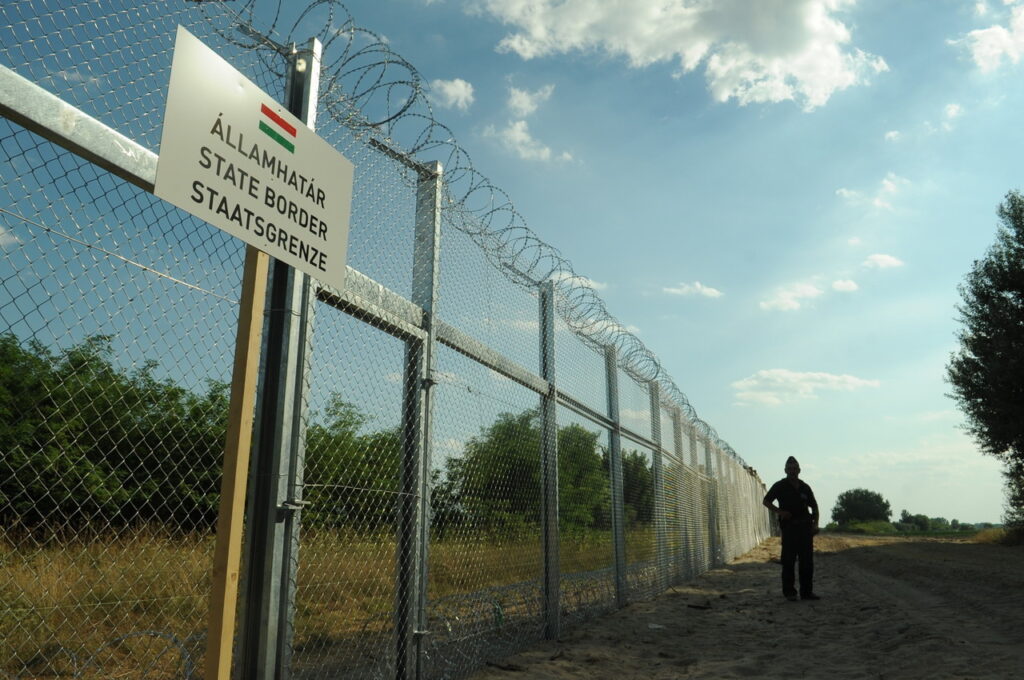
Convicted people smugglers walked out of Hungarian prisons with one instruction: leave the country within 72 hours. More than 2,500 were freed this way before Budapest scrapped the scheme. On Thursday, the EU’s top court ruled that Hungary broke EU law by running it.
For the judges in Luxembourg, a prison sentence that nobody serves is no punishment at all. The Hungarian scheme, they said, “in practice amounts to deportation from Hungarian territory and a prohibition on returning there”. EU law demands more. Anyone who helps migrants enter the bloc illegally must face effective, dissuasive, and proportionate penalties. The Court of Justice of the European Union therefore upheld an action brought by the European Commission.
The government of Viktor Orbán introduced the scheme by decree in April 2023. When a court jailed a smuggler and also ordered their expulsion, the sentence converted automatically. Convicts walked out and had 72 hours to leave Hungary. In May 2023 alone, the authorities released 777 smugglers, mainly Romanian, Ukrainian, and Serbian nationals. Hungary set up no system to check whether they actually went home.
A wrong signal from Budapest
According to the government, Hungary held around 2,600 foreign prisoners from 73 countries before the decree. Most of them were serving time for people smuggling. By the time Budapest repealed the decree in August 2025, 2,525 people had gone through the scheme.
The government defended the move as a matter of cost and space. Deputy Interior Minister Bence Rétvári blamed Brussels. In his words, the EU does not help pay for border protection but punishes Hungary for overcrowded prisons. Then Foreign Minister Péter Szijjártó called it a sovereign decision. Foreign criminals, he argued, were better off outside the country.
Austria saw it very differently. Vienna summoned the Hungarian ambassador. Austria’s then foreign minister, Alexander Schallenberg, was blunt. “We think this is an entirely wrong signal,” he told journalists. Austrian police stepped up checks on vehicles coming from Hungary, Romania, and Serbia. Vienna feared the freed smugglers would simply resume their business across the border.
The Commission opened proceedings in July 2023 and took Hungary to court in 2025. In its view, the decree created a systemic risk of total impunity for people smugglers. It also undermined the bloc’s common policy on immigration and border control.
Lives at stake
The judges sided with the Commission. Smugglers caught in Hungary could expect that, at worst, they would be deported, the court noted. So the penalty deterred no one. Release was also automatic. Courts made no individual assessment of the offence or the offender.
Hungary also breached EU rules that reserve the toughest sentences for the worst cases. Smuggling for profit, by organised gangs, or in a way that endangers migrants’ lives must carry a maximum prison term of at least eight years. Europe knows what such crimes cost. In August 2015, 59 men, eight women, and four children suffocated in an airtight lorry while it was still crossing Hungary. The smugglers dumped it on a motorway near Parndorf in Austria. A Hungarian appeals court later sentenced four of them to life in prison.
We think this is an entirely wrong signal. — Alexander Schallenberg, then Austrian foreign minister
The ruling lands on a new government in Budapest. Péter Magyar replaced Mr Orbán as prime minister in May. In court, Hungary still argued that the repealed decree applied to cases already under way. The country must now comply without delay. If it does not, the Commission can return to the court and seek fines. Hungary knows that path well. In 2024, the court ordered it to pay €200m and €1m a day for ignoring an earlier asylum ruling.